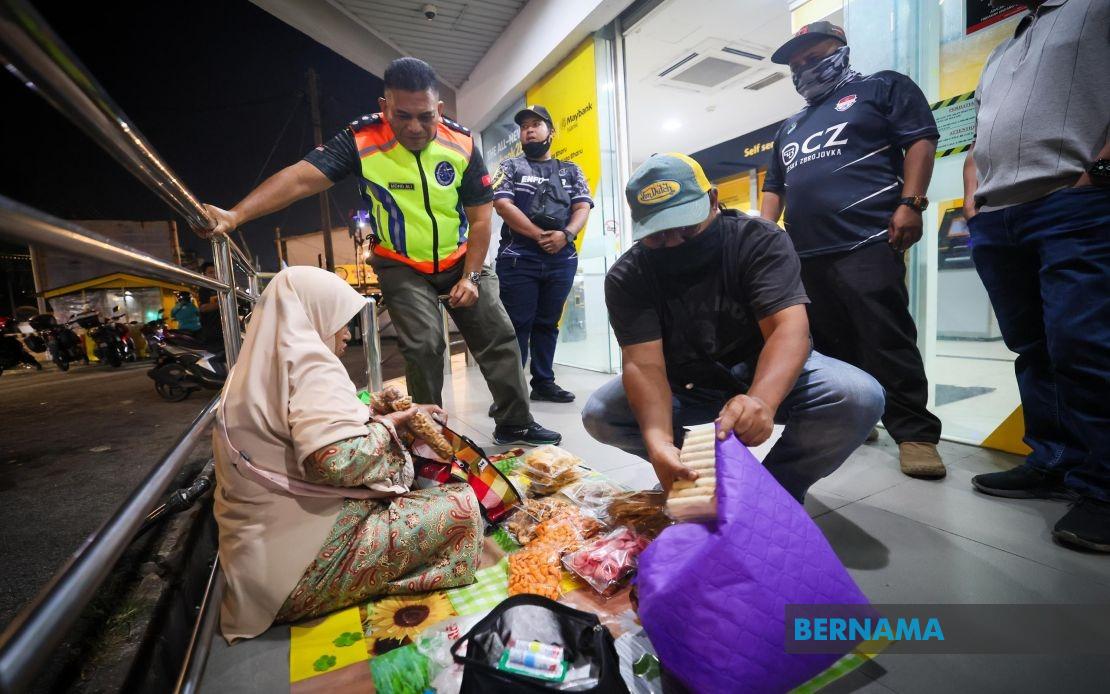
Authorities in Kota Bharu have apprehended three Thai nationals as part of a crackdown on fraudulent street solicitation schemes that exploit public sympathy. The women, detained during an integrated enforcement operation late yesterday, were operating near automated teller machines throughout the city and allegedly employing a calculated emotional appeal strategy to extract donations from unsuspecting bank users. The operation, conducted jointly by multiple agencies, has drawn attention to the growing prevalence of organized begging networks that masquerade as genuine hardship cases.
According to Kelantan Social Welfare Department director Che Samsuzuki Che Noh, preliminary investigations reveal the snack-selling activities were merely a facade designed to create an appearance of legitimate commerce while the real objective centred on soliciting money from sympathetic members of the public. The director emphasized that this represents a coordinated approach rather than spontaneous panhandling, suggesting organizational structure and predetermined tactics. What began as what appeared to be informal street vending has been exposed as a systematic effort to manipulate charitable instincts.
The financial incentive underlying these schemes is substantial. Officials disclosed that individuals participating in this operation generated income approaching RM300 daily, a figure that substantially exceeds what legitimate street trading would typically yield in the same locations. This income disparity serves as a key indicator that public generosity, rather than product sales, constitutes the genuine revenue stream. The lucrative returns underscore why such operations persist despite regulatory efforts, attracting both local participation and foreign nationals seeking quick income.
The enforcement initiative, spearheaded by the Kota Bharu-Islamic City Municipal Council's Enforcement Division and led by Chief Inspector Mohamad Ali, represented a coordinated multi-agency response involving the Immigration Department and police. The operation extended beyond central business districts, identifying targets in multiple hotspots including banking areas, public squares such as Dataran Muhammadi and Dataran Bandaraya, and commercial zones in Kubang Kerian and Pasir Tumboh. This comprehensive geographical coverage suggests authorities were addressing an organized network with multiple operational sites rather than isolated incidents.
The sweep resulted in eight individuals being brought into custody or protective care. The detainees comprised the three Thai women, three local men, one Malaysian woman, and notably a nine-year-old Malaysian child. The presence of a young child in the operation raises particularly concerning questions about exploitation and welfare vulnerabilities. The boy, discovered with his Thai mother at a bank compound along Jalan Kebun Sultan, was living in these circumstances despite having a Malaysian citizen father, highlighting potential family separation and cross-border custody issues that demand social intervention.
Authorities have invoked different legal frameworks depending on nationality status. The four Malaysian nationals have been processed under the Destitute Persons Act 1977, legislation designed to provide protective intervention and rehabilitation support for citizens lacking adequate means of subsistence. The Thai nationals, conversely, were transferred to the Immigration Department for action under the Immigration Act 1959/63, reflecting Malaysia's approach to managing undocumented or non-citizen involvement in illicit activities. This distinction underscores how immigration status shapes legal response and creates potential complications for resolving family situations involving mixed-nationality households.
Recognizing that enforcement alone cannot address the underlying demand that sustains these schemes, authorities have implemented an awareness initiative targeting public behaviour. The Kelantan Social Welfare Department and municipal council have deployed stickers bearing the Malay-language message "Bijak Membantu Elak Tertipu" (Help Wisely, Avoid Being Deceived) at prominent public locations throughout affected areas. This campaign seeks to educate community members about the manipulative nature of sympathy-based solicitation and redirect charitable impulses toward legitimate welfare channels that provide verifiable assistance rather than enriching organized schemes.
The broader context of this operation reflects a regional phenomenon affecting Southeast Asia, where cross-border migration combines with limited employment prospects to create conditions favourable for organized begging networks. Malaysia's relative prosperity compared to neighbouring countries generates pull factors, while sophisticated tactics exploiting cultural values around compassion and religious charity make communities vulnerable to manipulation. The involvement of foreign nationals in these schemes indicates they have become transnational operations rather than localized problems, requiring coordination across borders.
For Malaysian communities, the case illustrates the tension between genuine charitable impulses and the need for vigilance against exploitation schemes. The significant daily earnings identified in this investigation suggest substantial funds flow toward organized networks rather than toward individuals genuinely experiencing destitution. This diversion of charitable resources away from legitimate beneficiaries represents a broader social cost beyond the immediate fraud. The messaging campaign addresses this challenge by encouraging donors to verify legitimacy and channel contributions through established welfare organizations with transparent operations and accountability mechanisms.
The involvement of a mixed-nationality family highlights additional complexity around child welfare and social integration. The Malaysian child discovered in this operation requires assessment regarding parental custody arrangements, educational access, and long-term care provision. His presence in an organized solicitation network suggests systemic gaps in child protection oversight and possibly inadequate monitoring of vulnerable households containing undocumented or irregular residents. Addressing such cases requires coordination between immigration, welfare, and family services to ensure the child's welfare is prioritized.
The enforcement operation signals increasing attention from Kelantan authorities to street-level exploitation schemes that harm both public trust and genuine welfare beneficiaries. Future effectiveness will depend on sustained enforcement combined with addressing root causes including employment barriers for migrants and economic desperation among vulnerable local populations. The initiative also implies recognition that sympathy-based fraud, while perhaps less violent than other crimes, represents a sophisticated exploitation mechanism deserving serious intervention and public education.

