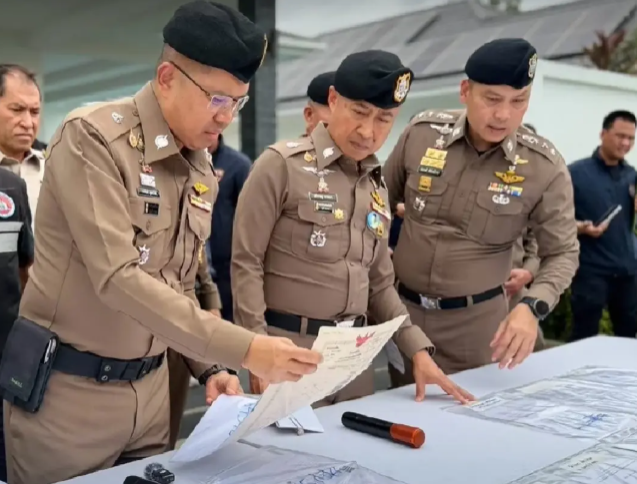
Thai police have arrested 13 foreign nationals during raids across 15 locations in the coastal resort town of Hua Hin, marking the latest phase of an intensifying nationwide campaign against the use of nominee shareholders to circumvent property ownership restrictions. The operation, which deployed more than 200 police officers and government officials to Prachuap Khiri Khan province on 10 August, represents the sixth major phase of an investigation that has expanded substantially since its inception.
The detainees comprise citizens from eight countries: three British nationals, four from China, and one each from Italy, France, the Netherlands, Austria, the Philippines and the United States. Thai authorities issued arrest warrants for an additional 45 foreign nationals in connection with the inquiry, while 39 Thai nationals were summoned for questioning. The suspects currently remain under investigation with no formal charges filed at this stage, though police indicated that further legal proceedings would follow as the probe intensifies.
The Hua Hin operation focused on a residential development in Thap Tai subdistrict comprising modern detached houses and pool villas valued individually at approximately 10–20 million baht. The broader investigation encompasses 33 companies suspected of holding property titles nominally in the names of Thai shareholders while being beneficially owned and controlled by foreign nationals. Police estimate the total property value implicated in this scheme to exceed 300 million baht. Investigators identified six companies at the targeted development allegedly employing Thai nominee shareholders, with four connected to the first phase of operations and two to the second.
According to police findings, foreign nationals questioned during the investigation claimed they sought legitimate property ownership in Thailand and had been directed toward the nominee structure by legal and accounting firms operating within the kingdom. These foreign property buyers believed the arrangement provided a lawful pathway to hold real estate, indicating that professional intermediaries had endorsed the scheme as compliant with Thai law. However, police investigations revealed that the companies in question engaged in no genuine commercial operations beyond holding property titles, suggesting the structures served purely as vehicles for foreign ownership concealment rather than legitimate business purposes.
The Thai nominees themselves told investigators a strikingly different narrative. Individuals listed as shareholders reported that they had accepted positions purely as nominal titleholders on behalf of foreigners without contributing any capital investment or participating in company management decisions. These Thai nationals stated they had never reviewed financial documentation, accounting records, or evidence of shareholding investments, and many appeared unaware of basic details regarding the companies bearing their names. This pattern of behaviour strongly suggests deliberate obfuscation of beneficial ownership through hollow corporate structures designed to exploit regulatory gaps in Thai property law.
Police seized extensive documentation and digital materials from the targeted locations, including company registration records, accounting files, computers, mobile devices and electronic data storage systems. Officers will now undertake forensic examination of these materials to trace financial transactions, identify additional participants in the networks, and establish connections extending both domestically within Thailand and internationally. The investigation represents a significant enforcement effort aimed at dismantling what authorities characterise as sophisticated schemes facilitating foreign property control in breach of Thai regulations.
The crackdown's scope extends beyond the immediate detainees and companies under scrutiny. Police announced that the investigation would specifically examine whether Thai government officials engaged in corruption or provided improper assistance to those operating the nominee schemes. This anti-corruption component signals official concern about potential institutional complicity in circumventing foreign ownership restrictions. The Royal Thai Police emphasised that the campaign targets illegal nominee structures and foreign-controlled businesses rather than legitimate foreign investors operating within established legal frameworks, a distinction potentially important for distinguishing between organised property evasion schemes and individual compliance.
The Hua Hin operation represents a continuation and escalation of enforcement efforts that commenced with investigations into nominee companies in Koh Phangan, Surat Thani in earlier phases. Subsequent operations expanded to Phuket, Phang Nga and Krabi in phase three, targeting 89 properties valued at over 1.05 billion baht. Phase four shifted focus to Chonburi province, while phase five concentrated on 31 companies and 29 land plots worth approximately 633 million baht across Chiang Mai. The cumulative impact of all six phases has involved examination of 233 land plots and buildings covering more than 160 rai, equivalent to 25.6 hectares, with an estimated combined value of 2.539 billion baht.
The enforcement effort has generated substantial legal consequences across previous operations. Courts approved 133 arrest warrants related to the first five phases, with police reporting that 20 cases resulted in formal convictions. These prosecution outcomes demonstrate that the crackdown extends beyond investigative stage to produce measurable legal accountability. The pattern of accumulating arrests, convictions and seized assets suggests Thai authorities view this as a systematic challenge requiring sustained enforcement attention rather than isolated wrongdoing.
The implications for foreign investors and property market participants throughout Thailand warrant careful consideration. The campaign reflects official determination to enforce foreign ownership restrictions that exist across Thai law, suggesting heightened legal risk for any foreigners considering nominee arrangements regardless of perceived legitimacy. For Malaysian investors and businesses with interests in Thai property markets, the investigation underscores the importance of engaging qualified local counsel to ensure complete compliance with Thai ownership restrictions and corporate regulations. Property acquisition by foreign entities in Thailand requires navigation through established legal channels, typically involving properly structured Thai companies or permitted exceptions, rather than nominee shareholder schemes.
Thai authorities indicated that the investigation would continue targeting suspected nominee networks and foreign-funded groups operating unlawfully throughout tourist destinations nationwide. Police provided public reporting mechanisms through local police stations and the Royal Thai Police hotline at 1599, available continuously for information about suspected illegal foreign commercial activity. The breadth of this enforcement agenda suggests the nominee property scheme investigation represents part of broader Thai policy efforts to reassert control over foreign economic activity in strategically important tourism and real estate sectors.

