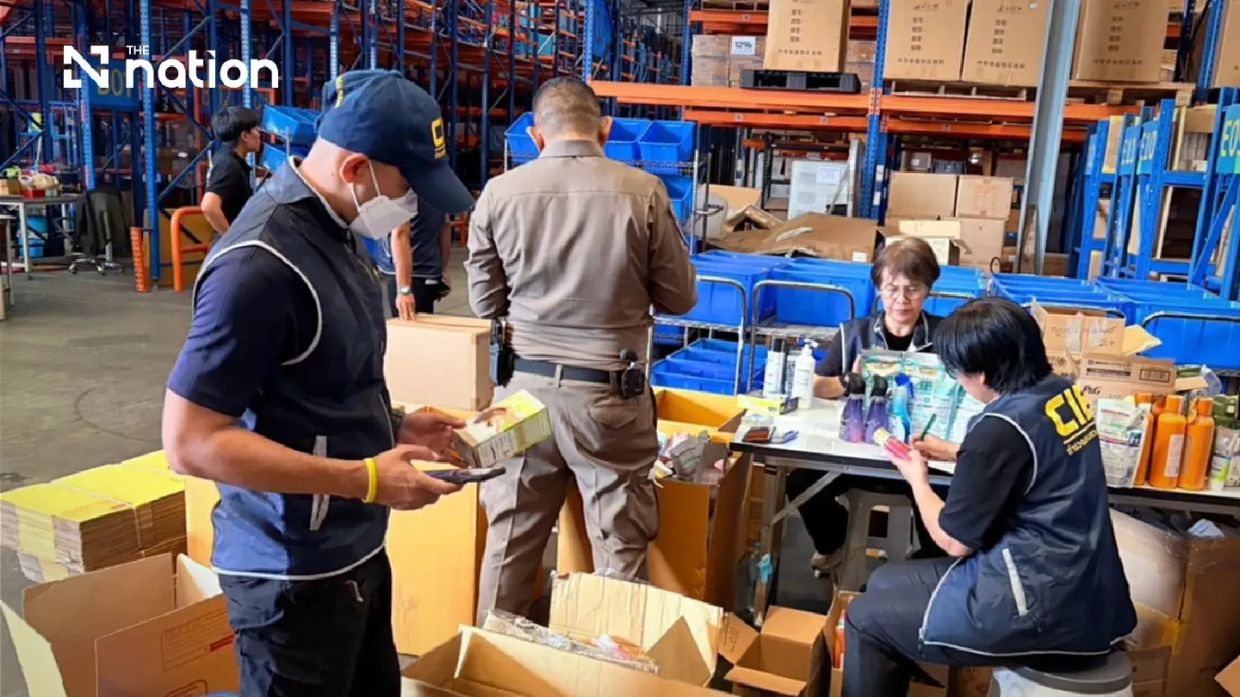
Thai police have dismantled a major distribution operation centred on the illegal importation and sale of Japanese cosmetics, dietary supplements, and medicines through online channels. The Consumer Protection Police Division (CPPD), operating under the direction of Pol Maj Gen Kongkrit Lertsittikul, conducted a raid on a warehouse in Bang Phli district, Samut Prakan, on August 13, resulting in the confiscation of 83,483 items across 116 different product types. The seized goods, valued in excess of 8.34 million baht, represent a significant enforcement action against the growing problem of unregulated health and beauty products reaching Thai consumers through e-commerce platforms.
The investigation began after complaints surfaced regarding online sellers offering cosmetics, dietary supplements, medicines, and household hazardous substances without proper Thai-language labelling and safety documentation. Investigators working the case identified Japan as the primary source of the contraband goods, establishing that the products had been imported into Thailand without undergoing mandatory regulatory checks or obtaining necessary certifications from the appropriate Thai authorities. This gap in compliance created substantial consumer safety risks, as these items had bypassed the safety assessments and quality controls required to ensure their suitability for use within Thailand's market.
The warehouse itself had operated as a sophisticated logistics hub supporting multiple online merchants. What began as a simple storage facility for imported goods had evolved into a comprehensive distribution centre offering packing and warehousing services to numerous online businesses. The operation achieved remarkable scale, processing between 200 and 300 items daily for shipment to customers across various e-commerce platforms. The facility charged online sellers a modest packing fee of 10 to 12 baht per box, a pricing structure that undercut legitimate logistics providers and helped make the illegal supply chain financially attractive to retailers seeking to maximise margins.
The longevity of this operation raises important questions about regulatory oversight and compliance mechanisms within Thailand's e-commerce ecosystem. Police investigations determined that the warehouse had been functioning in this capacity for more than four years, suggesting that detection and enforcement systems had failed to identify the illegal activity during an extended period. The scale of the operation—moving hundreds of items daily—indicates that the warehouse was generating substantial revenue and was likely known to a considerable network of online sellers who benefited from access to cheaper, uncertified products that they could resell with high markups to unsuspecting consumers.
For Malaysian readers and Southeast Asian observers, this case illustrates vulnerabilities in cross-border e-commerce that affect the entire region. Japanese cosmetics and dietary supplements enjoy significant popularity in Malaysia and throughout Southeast Asia, commanding premium prices due to perceptions of quality and safety. The existence of such extensive supply chains circumventing regulatory requirements in Thailand demonstrates how easily non-compliant products can enter regional markets through online channels, potentially reaching Malaysian consumers through cross-border purchases or domestic resellers acquiring stock from Thai sources. The lack of visible quality markers, authentic certifications, or proper labelling makes it difficult for end consumers to distinguish legitimate Japanese products from contraband items.
The legal framework mobilised in response to this operation reflects the seriousness with which Thai authorities view the breach. Those involved face prosecution under multiple statutes, including the Cosmetics Act, Food Act, Drug Act, and Hazardous Substances Act. This multi-statute approach acknowledges that the seized products span several regulatory categories and that violations extend across multiple compliance regimes. The decision to refer the case to investigators at Sub-Division 4 of the CPPD for formal legal proceedings signals that Thai enforcement authorities are treating this as a significant criminal matter rather than a simple administrative violation, suggesting they anticipate pursuing serious charges against the warehouse operators and potentially the online sellers who were knowingly sourcing goods through this channel.
The consumer protection implications extend beyond the immediate jurisdictional boundaries of Thailand. Online sellers operating across Southeast Asian markets often source products from multiple suppliers across the region, and the existence of uncertified import networks in one country can facilitate the supply of substandard goods to consumers in neighbouring jurisdictions. The cosmetics, supplements, and medicines recovered in this raid represent categories of products where quality and safety standards are particularly crucial, as these items come into direct contact with consumers' bodies or are ingested. Products lacking proper formulation oversight, contamination testing, or stability verification could pose health risks ranging from allergic reactions and skin damage to more serious systemic harm depending on the specific nature of the items involved.
From a regulatory perspective, this case highlights the challenge that governments across Southeast Asia face in maintaining control over e-commerce supply chains. The rapid growth of online shopping has outpaced the capacity of traditional enforcement mechanisms to monitor and regulate product flows effectively. Warehouse operators can establish distribution hubs relatively discretely, and the combination of low-cost logistics, high-margin products, and the difficulty of identifying individual online sellers creates a business model that generates sufficient profit to attract criminal operators despite the legal risks. The packing fees charged by the Bang Phli warehouse—though modest in absolute terms—multiplied across 200 to 300 daily shipments would generate significant daily revenue streams that justified the operation's investment and risk exposure.
The approximately 8.34 million baht value assigned to the seized inventory provides insight into the financial scale of the underground market these operators were servicing. This figure represents inventory that had already been stored and awaiting distribution rather than total annual throughput, suggesting that the actual market value of products flowing through this single warehouse over the course of a year substantially exceeded this amount. The willingness of numerous online sellers to utilise this supply chain indicates strong consumer demand for Japanese products at price points substantially below official retail channels, creating economic incentives that drive both supply and demand for illicit products.
As online commerce continues to expand throughout Southeast Asia, Thai and Malaysian regulatory authorities face mounting pressure to develop more sophisticated detection and enforcement capabilities. The traditional approach of conducting warehouse raids and confiscating inventory remains necessary but insufficient to address the underlying structural issues that permit such operations to flourish. Cooperation between regional enforcement agencies, enhanced requirements for e-commerce platform transparency regarding seller verification, and targeted investigations of logistics providers supporting multiple online retailers represent potential avenues for more systematic disruption of illegal supply chains. The case also underscores the importance of consumer education regarding how to verify product authenticity and the specific risks associated with purchasing cosmetics, supplements, and medicines from unverified online sources without proper regulatory documentation or certification marks.
The aftermath of this operation will likely result in significant disruption for online sellers who had established relationships with the Bang Phli warehouse as their primary supplier. However, the fundamental economic incentives that drove the creation and growth of this illegal distribution network remain intact. Unless accompanied by broader regulatory reforms, intensified platform accountability measures, and increased consumer awareness regarding product safety, the closure of this particular operation may represent merely a temporary setback in a much larger shadow economy of unregulated health and beauty products circulating throughout Southeast Asia's online retail ecosystem.

