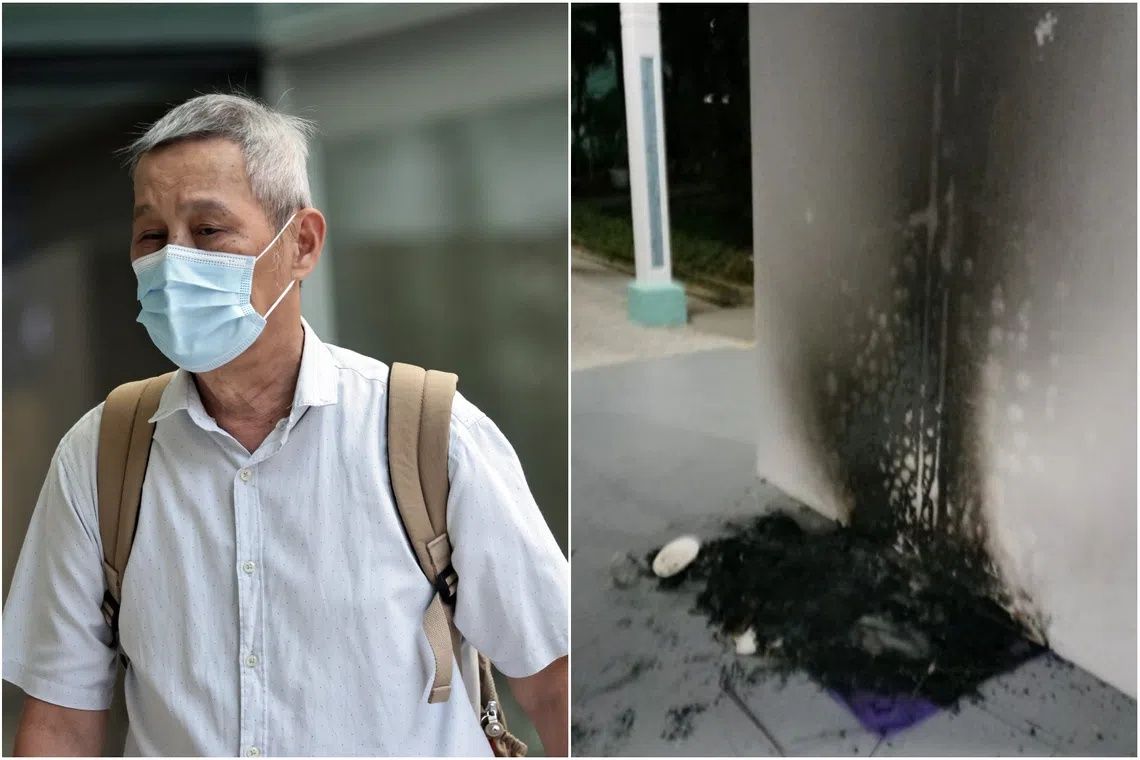
A 68-year-old retiree in Singapore's Bukit Batok district has been handed a three-month jail sentence after pleading guilty to committing mischief by fire, following his deliberate destruction of cardboard shelters erected to house community cats near his home. Koh Teng Boo, who resides at Bukit Batok East Avenue 4, burned multiple cat houses across two separate incidents in late 2025, triggering significant property damage to the surrounding void deck area where residents gather.
The dispute originated when cardboard structures began appearing around a pavilion and void deck adjacent to Koh's residence in September 2025. These shelters had been installed specifically to provide food, water, and sanctuary for stray cats in the neighbourhood. According to Deputy Public Prosecutor Stephen Yeo, Koh developed concerns about the arrangement, believing it would attract birds and other pests to the residential area, and he subsequently lodged a complaint with his elected Member of Parliament about the matter.
When he perceived that his concerns were being disregarded, Koh took matters into his own hands. In October 2025, he collected three of the cardboard cat houses and deposited them into an incense burner bin before deliberately igniting them. The prosecutor noted that Koh justified his actions by claiming that despite raising the issue directly with his MP, no visible steps had been taken to address his grievances. The situation escalated further when residents began throwing litter into the cat shelters, which reinforced Koh's view that the practice was creating an unsanitary environment within the residential complex.
Undeterred by the initial fires, community members continued setting up replacement cat houses around the block. This persistence prompted Koh to visit his MP once again on November 17, reiterating his objections and stressing that while he harboured no personal animosity towards cats themselves, he fundamentally opposed what he considered an unhygienic practice being permitted in a densely populated residential setting. His frustration mounted as the cat shelters reappeared despite his official complaints.
The situation culminated in two further arson incidents occurring within consecutive days. On the evening of November 19, after consuming alcohol, Koh encountered a cat house on his way home and used a lighter to set it ablaze before casually walking away from the burning structure, leaving the fire completely unattended. Official investigations could not definitively establish when or how this particular fire was ultimately extinguished. Undeterred and apparently angered by the continued presence of the shelters despite his repeated complaints, Koh repeated the action the following day by torching another cat house. This time, two passing residents discovered the fire and promptly extinguished it themselves before the situation could escalate further. Local authorities arrested Koh later that same day.
The financial consequences of Koh's actions proved substantial. The Jurong-Clementi-Bukit Batok Town Council incurred repair expenses totalling S$913 to restore damage to flooring and walls in the vicinity of the burned cat shelters. The defendant subsequently made complete restitution to the town council, satisfying the financial obligations arising from his destructive conduct. This case highlights an emerging tension in Singapore's urban residential environments between environmental concerns, animal welfare initiatives, and community quality-of-life considerations.
The legal implications underscore the seriousness with which Singapore's courts treat deliberate fire-related damage. Those convicted of committing mischief by fire with intent to cause property damage face potential imprisonment of up to seven years and substantial fines. While Koh's sentence of three months represents a moderate custodial term within this maximum framework, it reflects both the deliberate nature of his actions and the cumulative damage caused across multiple incidents. The fact that he did not set fires and walk away in a haphazard manner, but rather demonstrated clear intent across two separate occasions, likely influenced the sentencing decision.
This case resonates particularly with Malaysian and Southeast Asian readers given the growing phenomenon of informal animal welfare initiatives in public housing areas across the region. Community-led feeding and shelter programmes for stray animals have become increasingly common in housing developments throughout Malaysia, Singapore, and neighbouring countries, often emerging from compassion but occasionally creating friction between animal advocates and residents concerned about hygiene, pest attraction, and general cleanliness. The Bukit Batok situation demonstrates how disputes over such initiatives, if not managed through proper dialogue between residents, housing authorities, and animal welfare stakeholders, can escalate into criminal behaviour.
The case also underscores the importance of formal complaint mechanisms and stakeholder engagement. Koh's attempts to resolve the matter through his elected representative might be perceived as an appropriate first step, yet the apparent lack of responsive action—or at least the lack of visible progress from his perspective—seemingly drove him towards taking unilateral action. Property management authorities and elected officials in residential areas across Southeast Asia would benefit from establishing clear protocols for handling community disputes that involve competing interests, ensuring that formal channels provide timely responses and demonstrable follow-up to resident concerns before situations deteriorate into confrontation.
Furthermore, the case illustrates a broader debate about urban cohabitation and the management of shared spaces. The void deck, a quintessential feature of Singapore's public housing architecture, functions as a multipurpose community zone used by residents for various activities. When distinct groups—whether animal welfare advocates, cat enthusiasts, or other residents—stake claims to these spaces without comprehensive coordination, conflicts inevitably emerge. The responsibility for mediating such disputes falls upon housing management entities and local authorities, who must balance compassion for vulnerable animal populations against residents' legitimate concerns about environmental conditions and their right to enjoy communal spaces.
Koh's case also raises questions about what constitutes an appropriate escalation mechanism for civic grievances. Rather than pursuing additional formal avenues—such as engaging with town council officials directly, requesting community meetings, or exploring compromise solutions like designated feeding zones with improved hygiene management—Koh proceeded directly to destructive action. This pattern reflects a breakdown in community dialogue and suggests that formal channels for dispute resolution, though available in Singapore's relatively well-organised system, may not always be perceived as effective or responsive by all residents. The conclusion of this case with a custodial sentence serves as a cautionary reminder that taking unilateral action to resolve neighbourhood disputes, regardless of the frustration motivating such behaviour, carries serious legal consequences.

