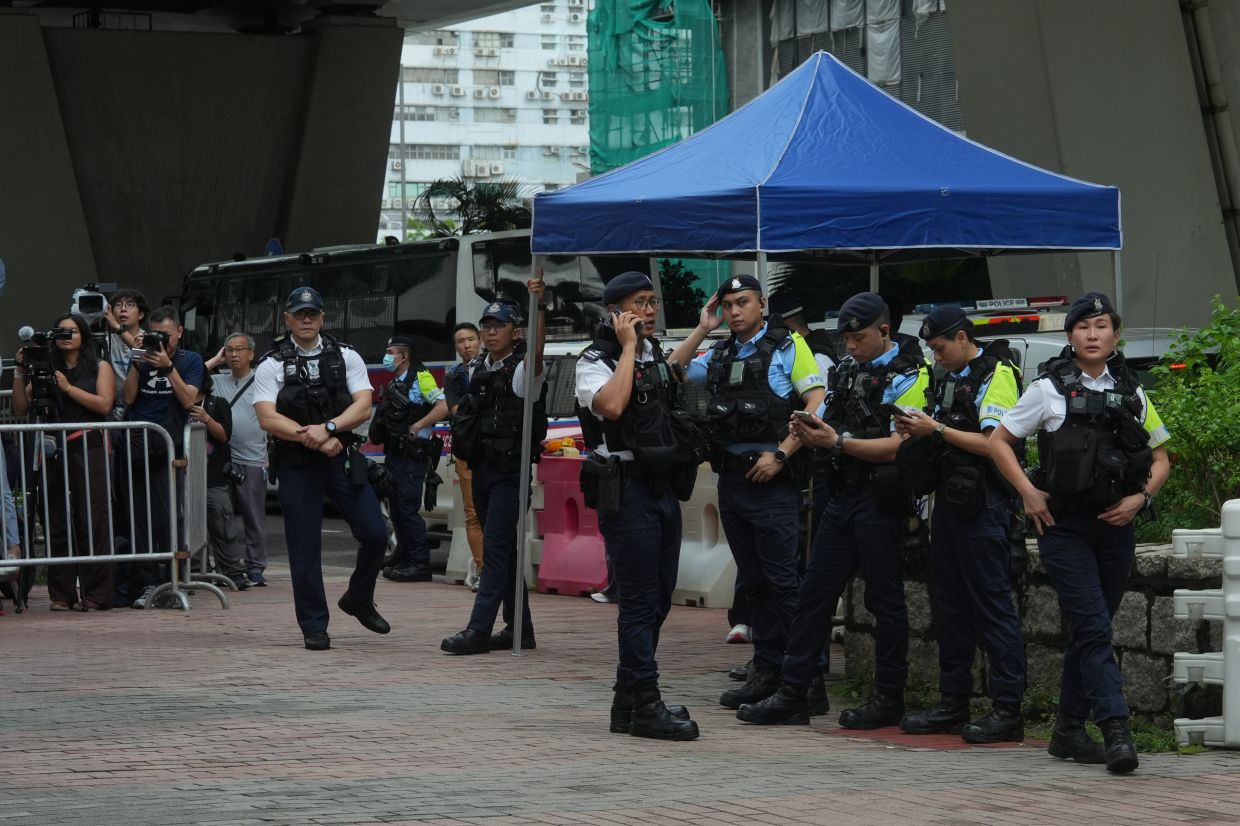
Hong Kong police have detained a woman accused of wearing clothing carrying a seditious message outside West Kowloon Court, marking another incident that underscores the territory's increasingly stringent enforcement of national security regulations. The arrest occurred last week on suspicion of public disorder, obstructing police, and seditious intention, according to a statement issued by the police force on Monday night. Authorities offered minimal detail about the operation itself, citing security concerns and declining to elaborate on the circumstances surrounding the detention.
The timing of the arrest proved particularly significant. It unfolded just hours before three High Court judges were scheduled to deliver verdicts against Lee Cheuk‑yan, former chairman of the Hong Kong Alliance in Support of Patriotic Democratic Movements of China, and Chow Hang‑tung, the alliance's former vice‑chairwoman. Both faced charges of inciting subversion under Hong Kong's national security law, specifically for calling for an end to "one‑party dictatorship" in mainland China. The convergence of events illustrated the intensifying legal pressure faced by democracy advocates in the semi-autonomous territory.
Early on Friday morning, more than fifty individuals had assembled outside the courthouse to await or observe the judgment. As dawn broke at approximately five o'clock, a plain‑clothes police officer approached a woman whose attire caught attention. According to witnesses and media observers present at the scene, the officer identified the woman as wearing a black T-shirt with Japanese characters and subsequently escorted her into a police vehicle. Video footage captured by journalists documented the interaction, though officers reportedly instructed media personnel to cease recording and vacate the area as the woman was removed from the courthouse plaza.
The arrest drew particular attention because it transpired against the backdrop of Hong Kong's expanding interpretation of seditious conduct under national security frameworks. In previous months and years, authorities in the territory have progressively widened the scope of what constitutes prohibited expression, including written symbols, artistic representations, and clothing messages. This approach reflects the territory's shift toward what critics describe as increasingly restrictive enforcement of political speech and dissent. For regional observers, the incident signals how national security legislation, initially presented as targeting espionage and foreign interference, has extended into everyday expressions and symbolic gestures.
Shortly after the woman's detention, the High Court delivered its long-anticipated ruling. The three judges found Lee, Chow, and the now-disbanded alliance guilty of inciting subversion. In their 216-page judgment, the judges established a sweeping legal framework for interpreting subversion under the national security law. Critically, they held that any attempt to overthrow or undermine the Communist Party of China's leadership constitutes subversion, since China's constitution does not permit Western-style democratic systems. This interpretation effectively criminalizes advocacy for electoral democracy or multi-party political competition, positioning such calls as inherently subversive rather than merely political disagreement.
The conviction carries profound implications for Hong Kong's political landscape and democratic space. Lee, a former legislator who spent decades advocating for democratic reforms, and Chow, a practising barrister, have already spent nearly five years in custody awaiting trial and conviction. A fourth defendant, Albert Ho Chun‑yan, the alliance's former vice‑chairman, has been detained for more than four years after pleading guilty in January and remains pending sentencing. These extended detention periods underscore how national security prosecutions have stretched Hong Kong's criminal justice timelines considerably.
The Hong Kong Alliance itself, which organised the annual Tiananmen Square vigil commemorating the 1989 crackdown in Beijing, voluntarily disbanded in September 2021 as national security pressures intensified. For decades, the vigil represented one of Asia's most visible and consistent expressions of commemoration for victims of the Tiananmen incident. Its disappearance marked a watershed moment in Hong Kong's transformation, as organisations deemed politically sensitive chose dissolution over legal confrontation. The alliance's dissolution and the subsequent conviction of its leaders suggest how the national security law has fundamentally reshaped the operating environment for political and civil society organisations.
For Malaysian observers, the Hong Kong case illuminates broader regional concerns about how national security legislation can expand beyond its stated counterterrorism objectives. Similar laws exist across Southeast Asia, often justified as necessary measures against terrorism, espionage, or foreign interference. However, Hong Kong's experience demonstrates how such frameworks, once codified, frequently experience mission creep. Authorities gradually interpret vague concepts like "subversion" and "sedition" to encompass political speech, historical commemoration, and symbolic expression. Malaysia, Indonesia, and other regional nations have faced comparable concerns from civil society groups warning that comparable provisions could follow similar trajectories.
The woman arrested for the T-shirt incident remains identified only through her clothing and physical description, with minimal information disclosed about her identity or specific charges. This lack of transparency itself reflects broader patterns in Hong Kong's security operations, where authorities increasingly limit disclosure of operational details and justify such restrictions as necessary for maintaining public safety. The opaque nature of such enforcement actions complicates independent verification and public understanding of how national security laws are applied in practice, creating space for inconsistent or discriminatory application.
The convergence of the woman's arrest and the verdict against pro-democracy leaders suggested coordination in messaging and enforcement, though authorities neither confirmed nor explicitly denied orchestrating the timing. Whether deliberate or coincidental, the simultaneous events reinforced the broader narrative of intensified pressure against dissent and democratic advocacy in Hong Kong. For Southeast Asian governments and civil society observers, the incidents raised urgent questions about how national security frameworks could similarly compress political space and constrain fundamental freedoms across the region.

