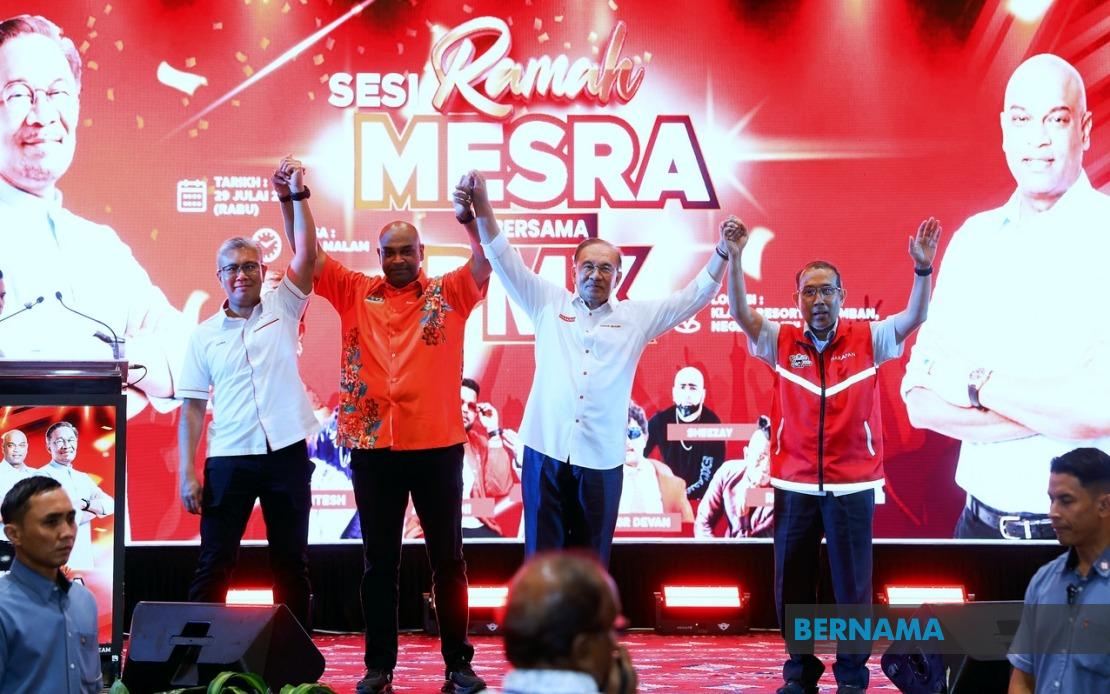
Prime Minister Datuk Seri Anwar Ibrahim has signalled a significant shift in how the federal government will address matters affecting Malaysia's Indian community by assuming direct personal oversight of the portfolio. Speaking at a community engagement event in Seremban on July 29, Anwar underscored his commitment to ensuring that policies and programmes affecting Indians receive sustained attention at the highest level of government, reflecting the administration's priority on inclusive governance across all demographic groups in the country.
The decision represents a consolidation of responsibility that aims to improve the efficiency and responsiveness of government mechanisms serving the community. Rather than relying solely on departmental structures, Anwar's direct involvement signals that matters of concern to Indians will now have immediate access to the Prime Minister's office, potentially accelerating decision-making processes and ensuring greater political will for their resolution. This approach has become increasingly common among Southeast Asian leaders seeking to demonstrate direct accountability to significant voter blocs and community segments.
Anwar was careful to clarify that his personal involvement does not undermine Human Resources Minister Datuk Seri R. Ramanan's portfolio responsibilities. Ramanan will continue to execute previously decided programmes and initiatives, but Anwar's oversight will add another layer of attention and coordination. This distinction is important for maintaining ministerial hierarchy and preventing the perception that the Human Resources Ministry has been sidelined—a concern that could have sparked internal political friction within the cabinet and coalition government.
The coordination mechanism Anwar outlined encompasses a comprehensive range of economic and welfare initiatives. These include financing through the National Entrepreneurial Group Economic Fund (TEKUN), which provides loans and support to small entrepreneurs, and Amanah Ikhtiar Malaysia (AIM), a microfinance institution that has served low-income communities. Additionally, financing guarantee schemes and broader economic development programmes will fall under Anwar's purview. The explicit inclusion of welfare programmes indicates the government recognises that the Indian community's concerns extend beyond business development to encompass social safety nets and livelihood security.
The Malaysian Indian Community Transformation Unit (MITRA) features prominently in Anwar's statement, though he clarified his oversight extends beyond this specific body to encompass all Indian community matters. MITRA, established to coordinate developmental initiatives, appears to be just one component of a larger framework Anwar intends to monitor. This suggests the Prime Minister views fragmentation across multiple agencies and programmes as a potential weakness that his personal engagement will help overcome.
Financial inclusion and entrepreneurship have long been identified as critical areas for the Indian community in Malaysia. TEKUN and AIM represent decades of policy evolution aimed at providing capital and support to individuals from lower-income backgrounds. By elevating these programmes under his direct watch, Anwar signals that the government takes seriously persistent gaps in economic participation and wealth creation within the Indian demographic. For a community that has historically faced representation challenges in corporate and professional sectors, ensuring robust access to financing can yield meaningful medium-term gains in business formation and asset accumulation.
The timing of this announcement carries political significance. Indian voters represent a meaningful constituency in Malaysian electoral politics, particularly in states like Selangor, Perak, and Negeri Sembilan where Seremban is located. By publicly committing to hands-on oversight, Anwar is reinforcing the coalition government's investment in community relations at a moment when political attention to demographic-specific needs remains elevated. The Majlis Ramah Mesra format—an informal gathering designed to build rapport—further emphasises the personal, accessible dimension of his leadership approach.
The practical implementation of Anwar's commitment will require establishing clear communication channels and reporting structures. Without these, his personal oversight risks remaining largely symbolic. Malaysian governance observers will likely scrutinise whether cabinet meetings now include regular briefings on community-specific initiatives, whether response times to community petitions improve, and whether funding allocations to Indian-focused programmes increase. These metrics will ultimately determine whether Anwar's pledge translates into tangible improvements in service delivery and community welfare.
For the broader Indian community across Malaysia and the region, this development reflects a growing recognition that demographic-specific governance requires dedicated attention rather than treating all citizens identically. Many Southeast Asian nations have experimented with similar approaches, acknowledging that minority or traditionally marginalised communities often have distinct economic and social needs that generic policies may not adequately address. Anwar's model could potentially inform how the government approaches concerns of other communities, establishing a precedent for direct prime ministerial engagement with specific demographic groups.
The announcement also underscores persistent challenges within Indian community representation in Malaysian governance structures. That a Prime Minister felt compelled to insert himself personally into these matters suggests existing mechanisms and ministerial portfolios have not been perceived as entirely adequate. This may reflect broader concerns about whether Indian community interests receive proportional attention relative to their population size and electoral significance. Whether Anwar's intervention resolves underlying structural issues or merely provides a temporary amelioration through high-level political attention remains to be seen.
Moving forward, the test of this commitment will lie in demonstrated outcomes: whether business loans through TEKUN increase among Indian applicants, whether AIM's penetration in Indian communities expands, whether welfare programmes reach beneficiaries more efficiently, and whether economic development initiatives produce measurable improvements in income levels and asset ownership. Community leaders will be watching closely for evidence that Anwar's personal involvement translates into substantive policy shifts rather than merely becoming another layer of bureaucratic oversight.

