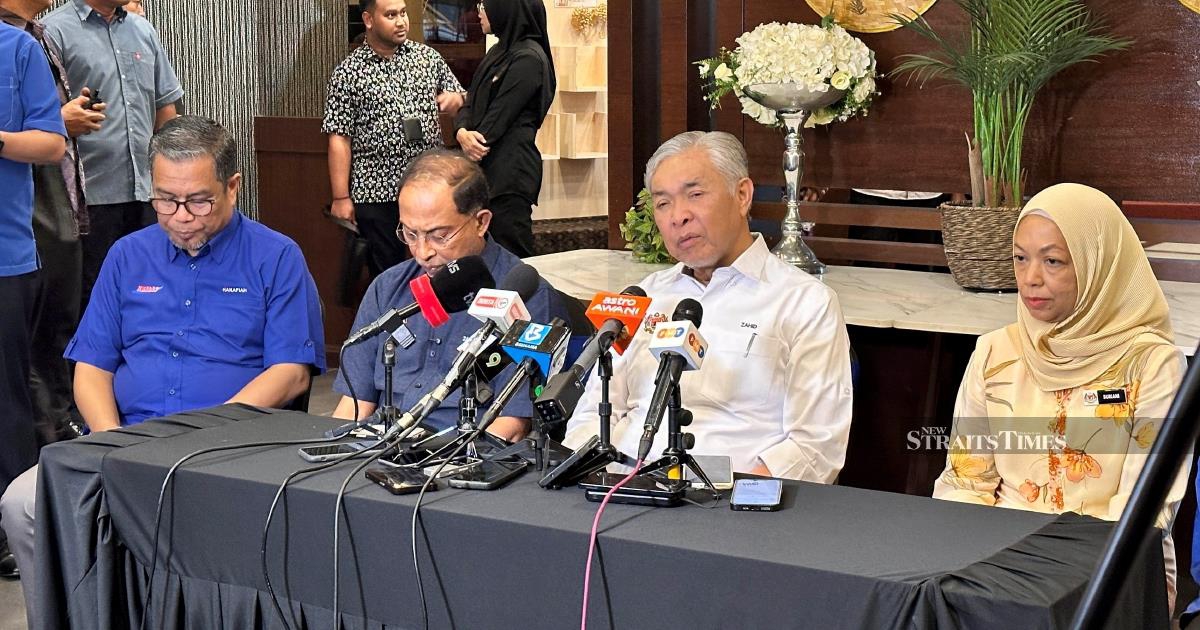
Barisan Nasional chairman Datuk Seri Dr Ahmad Zahid Hamidi has made clear his discomfort with the continued prominence of Datin Seri Rosmah Mansor in the unity government's Johor election strategy, effectively rebuking a coalition ally for centring the controversial figure in campaigning efforts. Speaking in Kluang, Zahid's intervention suggests mounting tensions within the unity coalition over how to navigate the fraught legacy of the Najib Razak era while pursuing electoral gains in the crucial southern state.
The rebuke carries significant weight given Zahid's position as BN chairman and his critical role in orchestrating the coalition's broader electoral strategy. His public displeasure signals that at least some senior BN figures view the deployment of Rosmah's image as counterproductive, potentially alienating swing voters and reinforcing perceptions that the coalition remains tethered to a tainted past rather than offering a fresh political direction. The move underscores the persistent challenge facing Malaysia's ruling coalition: reconciling its historical base with mounting public appetite for change and accountability.
Rosmah's presence in campaign materials remains deeply divisive within Malaysian politics. The wife of former Prime Minister Najib Razak has become a lightning rod for public criticism stemming from the 1Malaysia Development Berhad (1MDB) scandal, which implicated her in allegedly luxurious spending amid one of the country's most significant corruption cases. Though Najib himself has served his sentence and remains politically active, Rosmah continues to face legal proceedings and public scrutiny. Her invocation in campaign imagery resurrects these associations, potentially damaging electoral prospects rather than enhancing them.
Johor's electoral significance makes this internal dispute particularly consequential. As Malaysia's second-largest state and a traditional BN stronghold, Johor's political trajectory carries outsize implications for the coalition's broader viability. The state has emerged as a competitive battleground in recent years, with opposition forces mounting increasingly credible challenges to BN's dominance. Any internal discord regarding campaign messaging risks fragmenting the unity government's effort precisely when cohesion is most essential.
Zahid's intervention reflects a broader strategic calculation within BN circles. Forward-looking party strategists recognize that younger voters and urban constituencies—critical for maintaining electoral competitiveness—increasingly reject narratives tied to the Najib administration's corruption scandals. By distancing the campaign from Rosmah's image, Zahid signals an attempt to pivot toward governance performance and policy proposals rather than invoking figures whose association with institutional decay remains fresh in public memory.
The tension also illuminates deeper fissures within the unity government construct itself. The coalition comprises multiple components with sometimes divergent interests and constituencies. While some factions may believe invoking Najib and Rosmah energizes their core supporters, others perceive such approaches as electoral liabilities that surrender the moral high ground to opposition movements still building narratives around institutional reform and anti-corruption commitments.
For Malaysian observers, this dispute encapsulates the coalition's broader legitimacy challenge. The unity government, formed following the 2022 general election, was partly justified as a pragmatic arrangement ensuring stability. However, its cohesion depends on managing uncomfortable historical legacies while projecting credible governance credentials. Rosmah's campaign presence complicates this balancing act, seeming to validate opposition arguments that BN remains insufficiently committed to accountability and renewal.
Zahid's comments also carry implications for the broader Southeast Asian region. Malaysia's political trajectory—and whether major coalitions can successfully rehabilitate themselves following corruption scandals—influences regional perceptions about institutional resilience and democratic accountability. A BN campaign strategy that prominently features figures associated with major financial crimes risks conveying that sufficient time and political convenience can rehabilitate even serious allegations, a message with concerning ramifications across Southeast Asia's emerging democracies.
The Johor campaign ultimately reflects a turning point in Malaysian politics. The generation that benefited from or tolerated the Najib era is gradually yielding influence to constituencies prioritizing different values. Zahid's apparent discomfort with Rosmah's campaign presence suggests at least some establishment figures recognize this generational shift and are attempting to position themselves accordingly. Whether such repositioning proves sufficient to stabilize BN's electoral prospects remains an open question, but the friction between competing campaign strategies indicates the coalition recognizes the stakes involved in its messaging choices.
Going forward, how the unity government navigates such internal disagreements will substantially influence its electoral fortunes. Zahid's rebuke, while ostensibly focused on a single campaign decision, ultimately reflects fundamental questions about the coalition's identity, its relationship to its own history, and its capacity to appeal to an increasingly diverse electorate with varying expectations regarding institutional accountability and political renewal.

