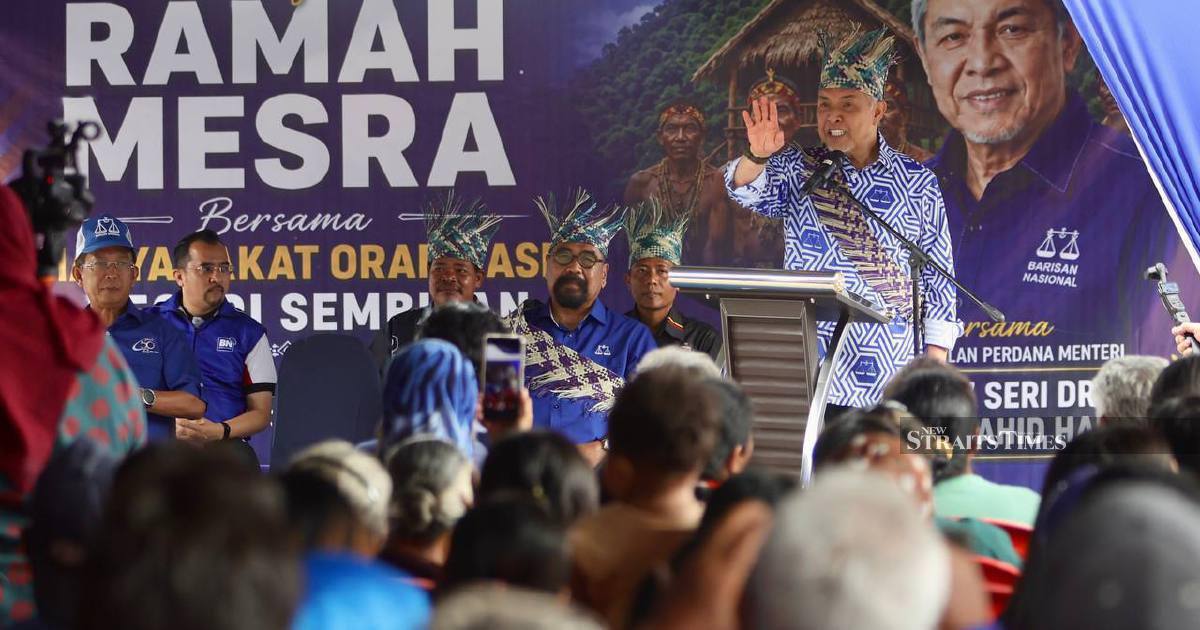
Deputy Prime Minister Datuk Seri Dr Ahmad Zahid Hamidi has floated the idea of stationing a dedicated officer representing the Orang Asli community within the Negri Sembilan Menteri Besar's office, presenting the move as administratively feasible without requiring prior campaign pledges. The proposal, outlined during remarks in Jelubu, positions government responsiveness to indigenous concerns as something that can be operationalised through internal restructuring rather than formal electoral commitments.
The initiative reflects an apparent shift in how federal authorities are approaching representation of Malaysia's indigenous populations. Rather than incorporating Orang Asli advocacy into broader electoral platforms, the government appears to be exploring embedding dedicated liaison capacity directly into state executive offices. This structural approach could provide Orang Asli communities with a consistent point of contact within the chief minister's administration, potentially streamlining grievance redressal and policy advocacy at the state level.
Negri Sembilan, which encompasses territories historically inhabited by Orang Asli populations, represents a logical pilot location for such an initiative. The state's geography and demographics position it as a test case for how indigenous representation might be institutionalised across Malaysia's federal structure. Success in Negri Sembilan could establish a template that other states might adopt.
Zahid's framing of the proposal—emphasising that it requires no campaign promise—is politically significant. It suggests the government views indigenous affairs as substantive enough to warrant dedicated administrative apparatus, yet simultaneously avoids the perception of making ethnic-specific electoral commitments. This rhetorical distinction matters in Malaysia's multi-ethnic political landscape, where explicit pledges to individual communities can trigger sensitivities among other groups.
The appointment of a specialist Orang Asli officer within the state chief minister's office would theoretically enhance the administration's capacity to address indigenous concerns ranging from land rights disputes to educational access and healthcare services. Such an officer could coordinate between the state government, federal agencies responsible for Orang Asli affairs, and community representatives, creating an institutional mechanism for elevating indigenous priorities in policy discussions.
Historically, Malaysia's Orang Asli communities have experienced marginalisation from mainstream political processes. Their land rights remain contested, their access to services often trails national averages, and their voices remain underrepresented in policy formulation. A dedicated liaison officer, if adequately resourced and genuinely empowered, could begin addressing these structural gaps by ensuring Orang Asli perspectives inform executive decision-making.
However, the effectiveness of such an appointment hinges on several factors. The officer's seniority within the bureaucracy, direct access to the chief minister, budgetary authority, and freedom to advocate independently all determine whether the role becomes substantive or merely symbolic. Malaysian administrative structures often create positions that lack meaningful power; ensuring this role avoids that trap will be crucial.
For Orang Asli communities themselves, the proposal carries mixed implications. On one hand, it acknowledges their distinct status and concerns warrant dedicated attention within state governance. On the other, placement within the chief minister's office ties indigenous advocacy to state-level politics, potentially limiting access to federal resources or creating dynamics where communities feel pressured to align with state government positions.
The initiative also raises questions about representation breadth. While a single officer can raise awareness of Orang Asli concerns, effective advocacy often requires multiple institutional touchpoints. Communities might benefit more from dedicated units spanning land administration, education departments, health services, and local government bodies—a more comprehensive institutionalisation of indigenous perspectives across state bureaucracies.
Zahid's proposal arrives amid broader Southeast Asian discussions about indigenous rights and representation. Countries across the region are grappling with how to incorporate historically marginalised communities into governance structures. Malaysia's approach of embedding liaison capacity within executive offices represents one model; others include dedicated parliamentary committees, autonomous councils, or resource allocation mechanisms favouring indigenous development.
For Malaysian policymakers, the Negri Sembilan proposal offers a relatively low-cost mechanism for signalling governmental commitment to indigenous affairs without requiring constitutional amendments or major legislative revisions. If successful, it could become a standard feature of state administrations across Malaysia, gradually professionalising how government engages with Orang Asli communities.
The coming months will reveal whether this proposal translates into concrete action. Actual implementation, the officer's qualifications and mandate, their resource allocation, and measurable outcomes will determine whether Zahid's initiative represents genuine institutional reform or administrative theatre. For Malaysia's Orang Asli populations, whose experiences with government promises warrant scepticism, demonstration of real change matters considerably.

