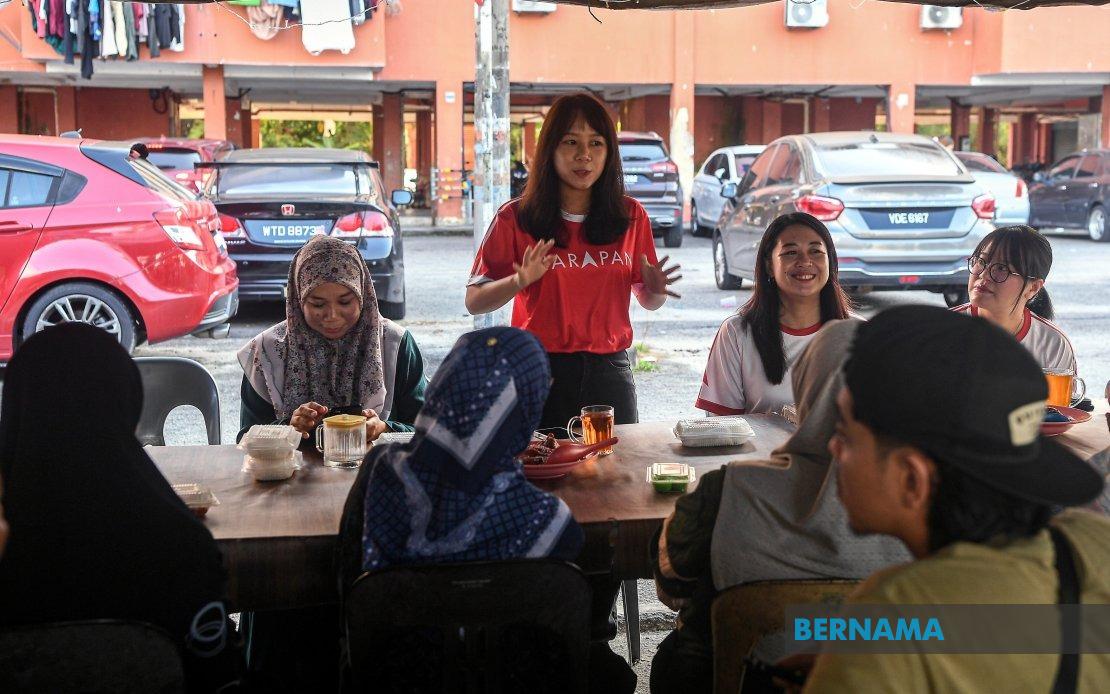
The contest for the Johor Jaya state seat has crystallized around two competing visions for the constituency's economic future, with candidates representing the two major coalitions articulating fundamentally different approaches to development and governance. Lee Wern Yiing of Pakatan Harapan and Chan San San representing Barisan Nasional have emerged as the dominant voices in what has become a four-way race, each bringing distinctive experience and policy priorities to their campaigns as voters prepare to cast ballots on July 11.
Lee, aged 30, represents a generational shift within Malaysia's political landscape. Her decision to forgo lucrative employment opportunities in Singapore and return to Malaysia in 2018 underscores a broader theme that animates her campaign: the retention and attraction of young talent to Johor. Having served as a special officer under former assemblyman Liow Cai Tung, she has established herself within the party machinery while maintaining credibility as a genuine advocate for younger constituents. As chief of the Johor DAP Socialist Youth, Lee has positioned herself at the intersection of youth representation and formal political structures, a positioning that carries both symbolic and practical significance for a demographic often perceived as disengaged from electoral politics.
Lee's narrative rests on a foundational premise that young Malaysians remain genuinely interested in political outcomes but demand substantive engagement rather than rhetoric disconnected from lived experience. She has invested considerable effort in deploying social media platforms and organizing community events such as the Johor Jaya Run, recognizing that traditional campaigning methods may fail to capture the attention of voters who obtain information through digital channels. This dual-track approach suggests recognition that mobilizing younger voters requires meeting them in spaces they naturally inhabit whilst simultaneously demonstrating tangible commitment to their material concerns.
The specific policy planks that Lee has articulated center on three interconnected challenges that disproportionately affect young adults: employment scarcity, housing affordability, and the rising costs of maintaining a household. These are not abstract policy domains but rather immediate realities shaping life choices for people in her age cohort. Her emphasis on leveraging the Johor-Singapore Special Economic Zone represents an attempt to connect large-scale infrastructure development with micro-level employment creation. The JS-SEZ, as a project of considerable regional significance, theoretically could generate employment opportunities across sectors, yet its potential depends substantially on how its development is managed and whether benefits diffuse to local populations or concentrate among investors and multinational enterprises.
Lee's framing of Johor as a destination where young people can intentionally choose to build families and careers rather than viewing it as a place to escape reflects implicit acknowledgment of a genuine challenge to the state's demographic and economic trajectory. Retaining talent has become increasingly important as migration to Kuala Lumpur and Singapore accelerates. Her policy proposal implicitly recognizes that infrastructure and rhetorical commitment alone prove insufficient; competitive employment with adequate remuneration forms the prerequisite for reversing outmigration patterns.
Chan San San approaches the contest from a substantially different foundation, rooting her candidacy in extensive community-level experience accumulated over more than a decade. As both a Johor Bahru City Council member and deputy secretary of the Johor MCA, Chan has accumulated exposure to governance mechanisms and local problem-solving. Her self-designation as "anak Plentong" emphasizes rootedness in the locality, implying that her understanding of constituency needs emerges from sustained presence rather than external analysis. Her work with the MCA Crisis Relief Squad indicates engagement with community support work, though such volunteer activity exists outside formal governance structures.
Chan's development priorities follow a somewhat different emphasis, with particular attention to economic strengthening and transportation infrastructure. Her proposal to position Johor Jaya as a transportation hub connecting the Rapid Transit System project reflects recognition that accessibility and commute times shape residential and business location decisions. By addressing traffic congestion alongside transit connectivity, she situates infrastructure investment within a framework of quality-of-life improvement. This formulation suggests that development encompasses not merely new economic opportunities but improved functionality of existing urban systems.
The distinction between Chan's focus on transportation infrastructure and Lee's emphasis on employment creation and housing reflects divergent diagnoses of the constituency's primary development challenge. Chan appears to emphasize that improved connectivity and reduced congestion create conditions within which economic activity flourishes, whereas Lee prioritizes direct intervention in employment and housing markets. These approaches are not necessarily incompatible, yet they suggest different assumptions about leverage points for policy intervention and different beliefs about which problems warrant immediate attention.
The four-way nature of the contest, with Parti Bersama Malaysia's Lau Yi Leong and independent candidate Lim Hun Peaw also competing, adds complexity to a race that might otherwise resolve simply into a binary choice between coalition visions. However, both Lee and Chan have effectively emerged as the principal contenders, reflecting the structural dominance of PH and BN within Malaysian electoral politics. Third-party candidates rarely possess sufficient organizational capacity and name recognition to mount genuinely competitive challenges in state elections, though their presence can shape outcomes in closely contested races where vote splitting influences the final result.
The Johor state election itself represents one of Malaysia's periodic opportunities for voters to assess government performance and indicate policy preferences through electoral choice. With 172 candidates competing for 56 seats across the state, the election carries significance beyond Johor Jaya's boundaries, as aggregate results will determine whether PH or BN controls state government. For the Johor Jaya constituency specifically, the contest crystallizes broader questions about which coalition better understands and can effectively address the development challenges facing a state capital's suburban constituency that encompasses both longtime residents and newer arrivals.
The policy priorities articulated by both candidates reflect contemporary Malaysian political discourse emphasizing economic growth and livelihood improvement, though with different emphases on timing, mechanisms, and immediate focus. Lee's campaign appears designed to mobilize first-time voters and younger eligible voters who may have disengaged from electoral politics, while Chan's appeals draw on accumulated goodwill from longstanding community engagement. Both candidates recognize that abstract policy visions matter less to voters than demonstrated capacity to deliver concrete improvements in daily life, whether through job creation, transportation access, or housing availability.
For Malaysian observers tracking state-level politics, the Johor Jaya contest exemplifies how even relatively local electoral races increasingly center on questions of economic management, demographic retention, and infrastructure development. The candidates' respective emphasis on the JS-SEZ and on transportation connectivity indicates recognition that Johor Bahru's future as a dynamic economic center hinges on decisions made regarding regional development frameworks and urban planning. Early voting commenced on July 7, with the decisive polling day scheduled for July 11.

