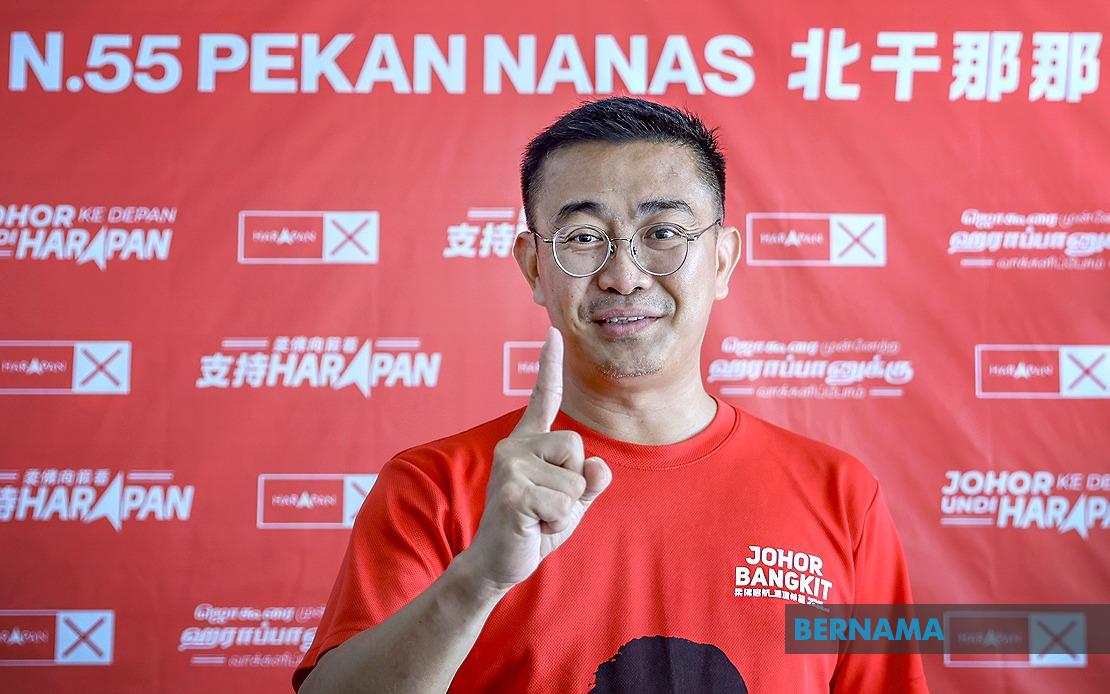
In his bid to retake the Pekan Nanas state seat, Pakatan Harapan's Yeo Tung Siong is positioning his previous nine years of service as the primary foundation for his campaign strategy in the ongoing Johor state election. The former assemblyman, who represented the constituency during the 2013-2022 period, believes that voters will reward his track record when they head to the polls, offering a stark contrast to what he portrays as his competitor's approach to representation.
Yeo's confidence appears grounded in what he describes as extensive ground engagement throughout the campaign trail. He reports having directly interacted with approximately 60 per cent of the constituency's electorate through a multifaceted outreach strategy. These encounters encompassed traditional walkabout programmes, community talks, organised group meetings, door-to-door house visits, and informal engagements at public markets, neighbourhood flea markets, and local dining establishments. This systematic approach to voter contact has, according to Yeo, generated consistently positive responses that he interprets as encouragement for his comeback attempt.
The candidate's professional background as an educator—specifically as a former vice-principal and discipline teacher—frames his communication about accessibility and constituent service. Rather than emphasising formal protocols or political positioning, Yeo emphasises his approachability and willingness to provide personal assistance. He contends that those seeking help from their representative should find him readily available for face-to-face meetings and direct intervention, positioning this as a distinguishing characteristic in an increasingly digital political environment.
During his previous tenure, Yeo highlights specific infrastructure accomplishments that he argues benefited residents. A RM500,000 allocation for rectifying the Pulai River's flow conditions addressed a chronic flooding issue that had plagued the area. Additionally, he collaborated with private sector partners to implement a drainage ditch project along the periphery of Kampung Melayu Raya, demonstrating what he characterises as pragmatic problem-solving through cross-sector cooperation. These projects exemplify the tangible outcomes that Yeo believes should convince voters of his effectiveness as a representative.
The candidate has identified two issues dominating voter concerns throughout his campaign period: traffic congestion and employment availability. These concerns carry particular resonance in the Pekan Nanas context, where proximity to urban Johor Bahru creates transportation pressures while industrial development opportunities remain unevenly distributed. The salience of these issues reflects broader challenges facing semi-urban constituencies in Johor that bridge rural and metropolitan zones.
Addressing traffic congestion, Yeo proposes two infrastructure projects designed to reduce travel time between Pontian and Johor Bahru. A proposed shortcut connecting Ulu Pulai to Pekan Nanas, and another linking Pulai to the Sri Bunian junction, would ostensibly provide alternatives to congested main routes. These infrastructure commitments suggest a platform centred on improving connectivity and reducing daily commute burdens for residents who work in or travel to Johor Bahru. For the Malaysian context, where urban-rural connectivity remains a persistent policy challenge, such proposals resonate with voter priorities in transitional areas.
On employment, Yeo proposes reviving the career carnival initiative that he previously organised during his tenure. These events, conducted in partnership with major corporations operating in and around the Pekan Nanas area, would create forums for jobseekers to connect directly with employers. This approach treats unemployment not primarily as an issue requiring government job creation, but rather as an information and matching problem where better connection between employers and workers can yield immediate benefits. The proposal suggests a view that local economic dynamism exists but requires better coordination mechanisms.
Social welfare provision represents the third pillar of Yeo's policy platform. He commits to facilitating access to government assistance through agencies including the Social Welfare Department and the Social Security Organisation (SOCSO). This emphasis on navigating bureaucratic systems reflects a recognition that formal safety nets often remain underutilised due to information gaps or administrative barriers. By positioning himself as an intermediary who personally ensures vulnerable constituents receive entitled assistance, Yeo frames the representative's role as one of administrative advocacy.
The straight two-candidate contest between Yeo and incumbent Tan Eng Meng of Barisan Nasional creates a clear choice for voters in Pekan Nanas. The race carries significance beyond the single seat, reflecting the broader competition between PH and BN for control of Johor's assembly. Pekan Nanas, positioned between the rural Pontian district and the urbanised Johor Bahru zone, represents the type of swing constituency that often determines election outcomes. For PH, recapturing previously held seats represents a necessary strategy for rebuilding influence in Johor following significant electoral reversals in recent years.
Yeo's campaign strategy reflects a time-tested playbook: former representatives leveraging accumulated social capital and demonstrated delivery to regain lost seats. The emphasis on personal accessibility and concrete project implementation appeals to voters who value practical governance over ideological positioning. His extensive ground engagement—claiming to have met 60 per cent of voters—suggests a campaign operating at the grassroots level, attempting to transform personal relationships into electoral support.
The Pekan Nanas contest ultimately hinges on whether voters perceive Yeo's previous tenure as sufficiently successful to warrant his return, or whether they view the BN incumbent as having provided adequate or superior representation. Yeo's strategy depends on voter memory of specific deliverables and appreciation for an accessible representative, betting that these factors outweigh any advantages accruing to the governing coalition through its control of state and federal resources.

