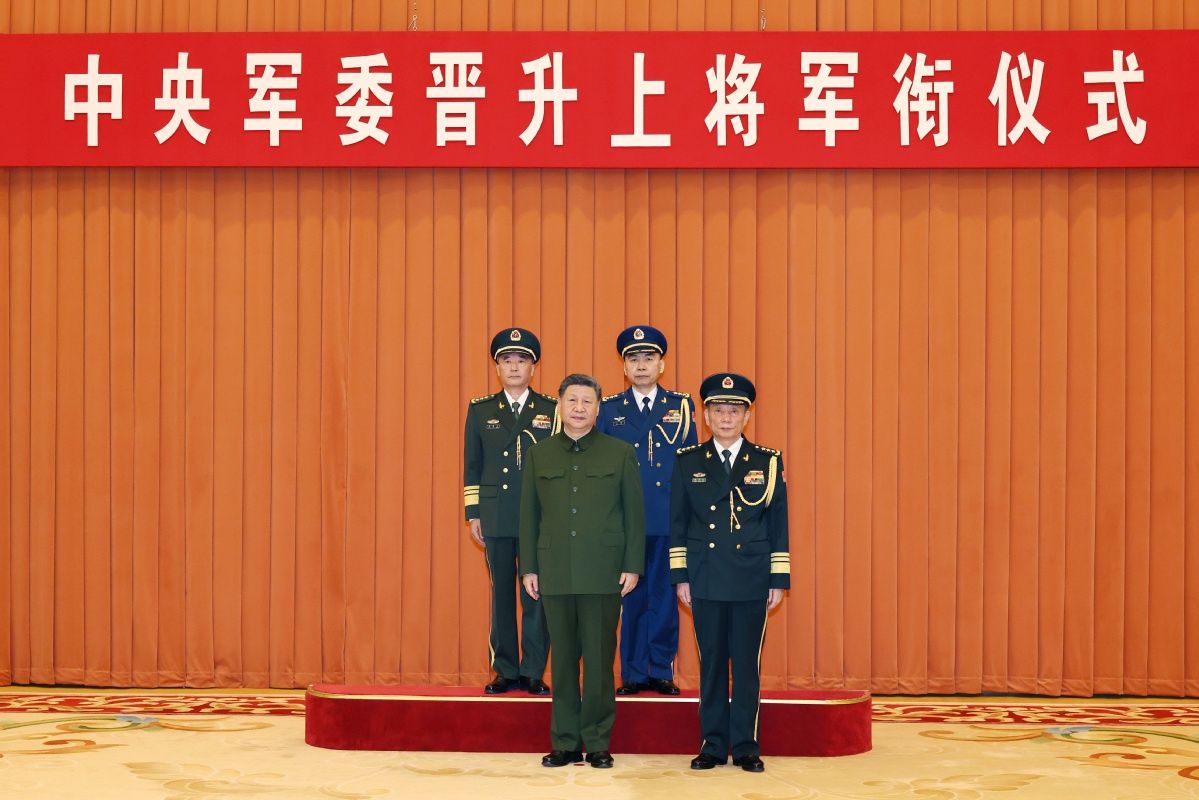
President Xi Jinping's grip on China's military apparatus has tightened further with a significant leadership reshuffle that underscores the ongoing scale of his anti-corruption campaign within the armed forces. Zhang Shuguang has assumed the position of secretary of the Central Military Commission's discipline inspection commission, a critical role overseeing military accountability, according to Xinhua News Agency reporting on ceremonies held in Beijing on Friday, July 3. The appointment of both Zhang Shuguang and Wang Gang, the new People's Liberation Army Air Force commander, to the rank of general—China's highest active-service officer rank—signals Xi's consolidation of control over key military positions.
The personnel changes reflect a broader institutional reshaping at the apex of China's military hierarchy. Zhang Shengmin, who previously held the position of the armed forces' top anti-corruption official, has been elevated to vice chairman of the Central Military Commission, a prestigious appointment that removes him from direct oversight of disciplinary matters. The departure of former Air Force Commander Chang Dingqiu from his visible post leaves his next assignment unclear, a situation that in recent months has often preceded further investigations or diminished roles for military figures caught in Xi's purge.
Since mid-2023, Xi has orchestrated what amounts to the most extensive military restructuring in roughly five decades, following his controversial securing of a third term in power—itself a break with recent Chinese political precedent. The scope of removals has been extraordinary by historical standards: two vice chairmen of the Central Military Commission, three additional CMC members, a former defence minister, and at least a dozen senior generals commanding major military institutions have been swept from their positions. This systematic dismantling of the military old guard has few parallels in recent Chinese military history and suggests deep institutional concerns about loyalty and control.
The most dramatic moment in this purge came earlier in 2024 when Xi moved against Zhang Youxia, his own one-time ally and the top general serving under him. The investigation into Zhang Youxia represented a stunning rupture with one of Xi's closest senior military associates, signalling that no rank or prior relationship offered protection from the anti-corruption campaign. This willingness to pursue even trusted inner-circle figures has reshaped perceptions of job security and loyalty within the military establishment.
The anti-corruption drive itself warrants closer examination for what it reveals about Xi's priorities and anxieties regarding military institutional dynamics. Corruption within the People's Liberation Army has long been a legitimate problem, with defence procurement, rank advancement, and command assignments historically subject to patronage networks and financial incentives. However, Xi's campaign has clearly transcended mere anti-graft enforcement; it functions simultaneously as a consolidation mechanism, removing potential rivals, breaking rival patronage networks, and installing commanders perceived as personally loyal to Xi's vision of military modernisation and civilian party control.
For Malaysia and the broader Southeast Asian region, these military restructurings carry substantial implications. A military leadership aligned with Xi's strategic vision and free from internal factional divisions could signal greater institutional coherence in China's defence policy, potentially affecting Beijing's approach to regional maritime disputes, military posturing in the South China Sea, and defence cooperation arrangements with neighbouring states. The purge also reflects Xi's determination to maintain absolute civilian—and more specifically, personal—control over military institutions, a pattern relevant to understanding China's strategic decision-making processes affecting the region.
The removal of six military lawmakers from the national parliament last week further demonstrates the extensiveness of the purge's reach into political representation structures. These dismissals go beyond operational military posts to affect a figure's political standing and representation role, suggesting the campaign encompasses not only active-duty commanders but also military representatives in broader civilian governance structures.
The appointment of new commanders and anti-corruption officials typically involves individuals with records of implementing Xi's preferences for military modernisation, professionalism, and centralised control. Zhang Shuguang's elevation to the discipline commission implies he is viewed as capable of pursuing Xi's anti-corruption agenda rigorously while maintaining command over the investigation process. Similarly, Wang Gang's appointment to lead the air force suggests he represents the type of commander Xi seeks—presumably one aligned with initiatives to modernise air operations and strengthen civilian oversight of military decisions.
Critical questions remain regarding the sustainability of such extensive military restructuring. While Xi's purge has certainly removed competing power bases and installed loyalists, sustained military effectiveness requires institutional stability, predictable advancement pathways, and senior officer confidence in the system. The ongoing uncertainty and investigations may create psychological pressures that affect morale, recruitment of top talent, and institutional memory within the officer corps. The balance between consolidating control and maintaining military capability represents a constant tension in Xi's military governance approach.
The broader context of this reshuffle involves China's strategic ambitions in an increasingly competitive Indo-Pacific environment. A military establishment cleansed of perceived disloyalty and reorganised around Xi's vision could prove more effective in executing long-term strategic initiatives. Conversely, the disruption inherent in such extensive purges—including the loss of experienced commanders and the elevation of potentially less-tested officers—introduces unpredictability into China's military decision-making. Regional observers monitor these changes closely for clues about Beijing's military confidence and strategic intentions during a period of significant geopolitical tension and competition for influence across Asia.

