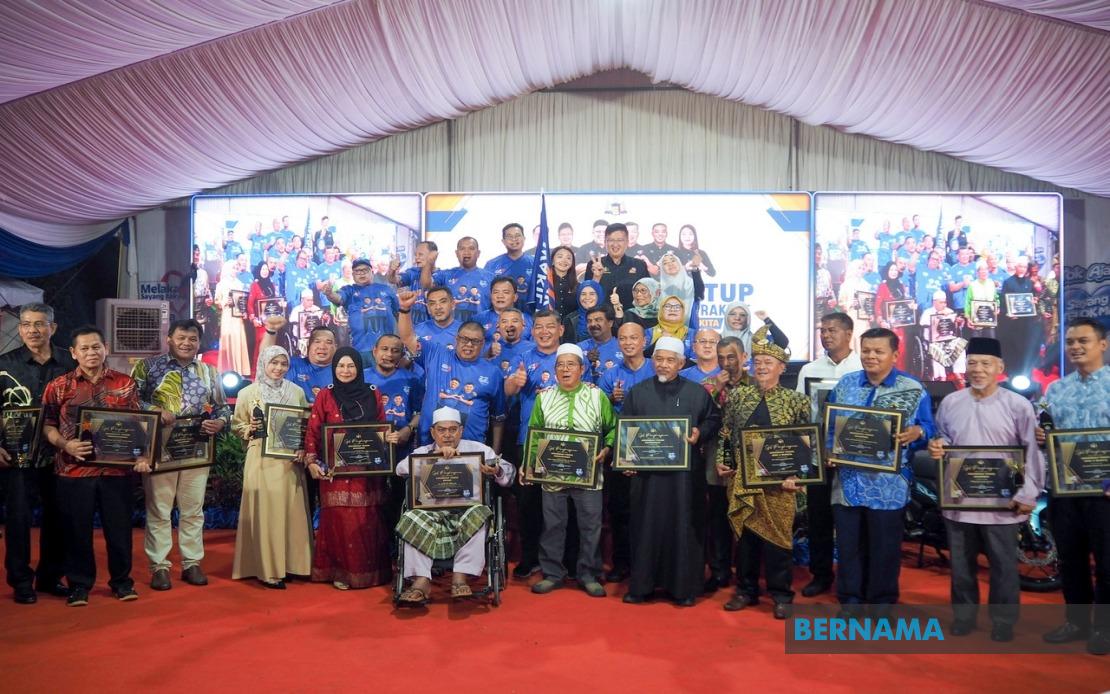
Melaka Chief Minister Datuk Seri Ab Rauf Yusoh has reframed how success should be evaluated for the state's flagship Wakil Rakyat Untuk Rakyat (WRUR) programme, arguing that meaningful governance depends on tangible outcomes for ordinary Malaysians rather than impressive programme counts. Speaking at the closing ceremony of the initiative's Kota Melaka rollout in Telok Mas, he underscored a philosophy increasingly relevant to Malaysian public administration: that responsive government must prioritise actual problem-solving over operational metrics.
The WRUR approach, which has now expanded to 19 state constituencies across Melaka, operates on the principle that every citizen's complaint deserves proper documentation and follow-up, irrespective of their political affiliation or geographic location. This bottom-up methodology reflects a broader shift in Malaysian governance towards community-centred administration, where local officials work directly with residents to diagnose and resolve systemic issues. By channelling grievances through structured mechanisms rather than ad-hoc consultations, the programme creates accountability pathways that persist beyond ceremonial announcements.
Data from the initiative's implementation demonstrates considerable scale. Since its rollout, the WRUR programme has collected 4,027 public complaints statewide, with 2,633 cases—representing more than 65 per cent—already resolved through coordinated action by relevant state agencies and local authorities. These figures carry particular weight because they reflect actual government responsiveness rather than merely planned interventions. The Kota Melaka parliamentary constituency, the third location to pilot the scheme after Alor Gajah and Hang Tuah Jaya, recorded 470 individual complaints during its four-week implementation window, with 31 resolved immediately and the remainder channelled into prioritised processing schedules.
What distinguishes the WRUR model from conventional citizen feedback mechanisms is its institutional continuity. Ab Rauf explicitly instructed all participating agencies to maintain their engagement with unresolved matters even after formal programme activities cease, ensuring that citizens' concerns do not evaporate when government attention shifts elsewhere. This commitment to sustained follow-through addresses a fundamental frustration that has dogged Malaysian public administration: the perception that officials listen, record feedback, then forget. By institutionalising ongoing accountability, the scheme attempts to rebuild trust in government responsiveness at the grassroots level.
The scale of the programme's initial deployment underscores its ambition. Over four weeks across the inaugural constituencies, WRUR delivered more than 500 distinct initiatives touching five state constituencies and benefiting over 200,000 residents directly. This rapid mobilisation suggests either exceptional coordination among state agencies or significant pre-existing capacity waiting for structural outlets—likely both. The breadth indicates that the programme functions not as a niche intervention but as a comprehensive engagement framework that integrates multiple government functions under unified leadership.
Telok Mas state assemblyman Datuk Abdul Razak Abdul Rahman provided additional context about underlying development priorities driving such programmes. His constituency has absorbed RM68 million in local project investments over the preceding five years, encompassing 328 discrete development initiatives spanning road rehabilitation, flood mitigation infrastructure, housing repairs, community facility upgrades, and educational establishment improvements across 12 residential areas. These data points reveal that WRUR operates within—and potentially accelerates—a substantial existing investment cycle, suggesting the programme serves partly as an accountability and visibility mechanism for work already underway.
Welfare and social assistance programmes administered through local structures have extended aid to 6,098 Telok Mas residents, distributing RM1.2 million in food support, welfare payments, and health assistance alongside 213 medical beds for household use. The Jualan Rahmah and Jualan Murah initiatives, which have operated 70 iterations since 2022, specifically target the cost-of-living pressures that dominate Malaysian household concerns. A petrol assistance scheme reaching approximately 15,000 local residents with RM177,000 in direct support demonstrates how governance can marry bread-and-butter economic relief with political engagement—addressing immediate financial strain while building citizen confidence in government intervention.
Educational support through these initiatives has reached substantial numbers of young Malaysians. SPM examination candidates in the constituency accessed tutoring programmes that benefited 1,694 students, while 255 high-achieving Form Five pupils and university students received RM244,200 in educational incentives. These investments signal recognition that social mobility in Malaysia increasingly hinges on educational attainment, and that government support for students facing economic constraints directly shapes family economic trajectories and broader social stability.
Tourism development represents an emerging priority within these frameworks, reflecting Melaka's positioning as a heritage destination and economic driver for southern Malaysia. Approved allocations totalling RM2.4 million from the Ministry of Tourism, Arts and Culture will upgrade facilities at Sungai Punggor and Alai, with completion targeted for 2027. Additional RM300,000 funding will establish Dataran Telok Mas as a single integrated centre promoting both tourism and local traditional crafts, potentially creating retail and employment opportunities for small-scale artisans. The Bukit Larang geosite's identification as a potential National Geopark represents a longer-term economic development lever, scheduled for assessment in October, that could establish Melaka as a geological tourism destination alongside its existing heritage appeal.
For Malaysian readers and Southeast Asian analysts, the WRUR initiative carries significance beyond Melaka's borders. As state and federal governments across the region grapple with public confidence deficits and demands for more responsive administration, the programme offers a replicable model for converting electoral mandates into sustained constituent engagement. The insistence by Melaka's leadership that programme success be measured through resident satisfaction and problem resolution—rather than activity counts—represents a subtle but consequential redefinition of governance accountability. At a time when Malaysian governance debates often focus on institutional reform and constitutional arrangements, this emphasis on implementation quality and citizen impact provides a counterpoint: that institutional change matters less than whether ordinary people experience tangible improvements in their circumstances. Whether WRUR ultimately proves to be transformational or merely incremental will depend on its ability to maintain momentum and resolve complaints once initial media attention fades—the true test of any citizen-responsive programme.

