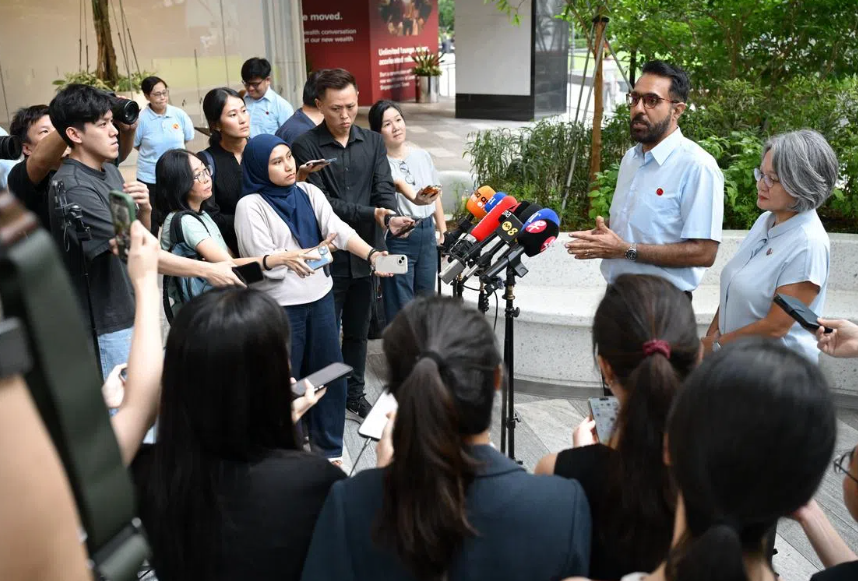
The Singapore Workers Party has decisively consolidated its leadership structure around secretary-general Pritam Singh following an intense internal challenge that tested party unity for the first time since his 2018 election to the top post. During two gruelling meetings on June 28, cadre members forced Singh to defend his position after he was convicted of lying to Parliament in connection with the Raeesah Khan scandal. The outcome demonstrates the party's capacity to absorb internal dissent, yet it simultaneously raises uncomfortable questions about whether the opposition movement can win over pragmatic middle-ground voters who may view the conviction as disqualifying.
Singh's supermajority endorsement, with 82 of 106 cadre members backing his continued leadership, represents a decisive statement of confidence that forestalls immediate succession speculation. The vote of no confidence, triggered by dissident cadres seeking accountability over his role in Khan's parliamentary deception, failed to gain the traction its initiators had anticipated. Rather than witnessing a confrontational interrogation of Singh's conduct, the meetings revealed mixed sentiment among attendees, with some stepping forward to defend Singh even as others raised concerns. The presumed challengers to Singh never materialised, suggesting that within the party apparatus, no credible alternative possessed sufficient support or ambition to contest the incumbent.
The parliamentary controversy at the heart of this internal turbulence stretches back to 2021, when the then-Sengkang GRC member Khan initially fabricated a police mistreatment claim involving a sexual assault victim. Parliament's Committee of Privileges concluded that Singh bore responsibility for enabling Khan to extend her falsehood rather than promptly compelling her to correct the record. This led to criminal charges against Singh, and despite his guilty verdict being upheld by the High Court in December 2025, the Workers Party hierarchy remained unwavering in their defence. Prime Minister Lawrence Wong removed Singh from his Leader of the Opposition position following parliamentary censure, yet the party declined to nominate a replacement despite the opportunity to demonstrate symbolic distance from the conviction.
The internal disciplinary response, while technically finding Singh in breach of party constitutional obligations, amounted to a formal letter of reprimand rather than substantive sanction. This measured punishment, characterised by some observers as lenient, reflects the party's strategic calculation that excessive distance from Singh would weaken the opposition's institutional coherence. Former party chief Low Thia Khiang, the architect of the Workers Party's modern iteration, publicly backed Singh before the June 28 meetings, lending his considerable moral authority to the incumbent. Such endorsements carry disproportionate weight within opposition movements where historical leadership commands deep reverence among cadres.
The consolidation of internal unity undoubtedly provides relief to the Workers Party by foreclosing possibilities of damaging public feuding that has occasionally plagued other opposition movements across Asia and beyond. By containing the Raeesah Khan matter within private deliberations and emerging with demonstrated cohesion, the party has prevented the prolonged institutional damage that might otherwise have accumulated through months of contested leadership transition. This tactical success allows the Workers Party to redirect organisational energies toward parliamentary work and strategic positioning ahead of the next general election cycle, while simultaneously freeing party chair Sylvia Lim to discuss succession planning without operating under crisis conditions.
Yet the cadre vote and surrounding narrative reveal a more troubling subtext regarding the Workers Party's relationship with Singapore's broader electorate. Singh's conviction is not a matter of partisan interpretation susceptible to reframing—it represents judicial determination that he provided false information to Parliament. The party's ability to absorb and move past this reality through internal endorsement does not necessarily translate to voter acceptance, particularly among the moderate, education-conscious demographic that forms the crucial swing constituency in Singapore's electoral geography. Middle-ground voters, typically less ideologically committed than core supporters and more responsive to governance competence and personal integrity concerns, may regard the conviction as incompatible with leadership of an opposition movement.
The Workers Party's growth trajectory, highlighted by consolidation of existing constituencies and two additional Non-Constituency MP seats in the May 2025 general election, was achieved despite Singh's lower court conviction being known to voters. Party officials and supporters interpret this electoral resilience as evidence that public opinion has already rendered judgment favourably, suggesting that Singapore voters compartmentalise legal troubles from political performance assessment. This narrative offers a comforting interpretation for the party apparatus but may underestimate the complex interaction between conviction salience, voter recall, and shifting political contexts. Subsequent elections will test whether the conviction remains politically inert or whether it accumulates resonance as political opponents repeatedly invoke it.
The Workers Party's challenge now extends beyond internal management to a fundamental question about democratic representation. Opposition movements thrive when they can plausibly claim moral authority as watchdogs over governmental conduct, drawing legitimacy from perceived ethical superiority and independence from compromises that afflict long-governing establishments. A conviction for parliamentary dishonesty erodes this claim, particularly when the lying involved coverup rather than principled position-taking. The party's decision to retain Singh despite this conviction signals that institutional preservation outweighs ethical differentiation—a calculation that may alienate voters seeking principled alternatives to the People's Action Party.
Looking forward, the Workers Party faces the task of demonstrating that Singh's parliamentary work, constituency service, and strategic opposition positioning outweigh the conviction's reputational damage. The party has indicated that leadership renewal processes are underway, with Lim suggesting that future media interfaces may feature different faces representing the organisation. This succession planning, if executed thoughtfully, could gradually restore credibility by institutionalising principles of accountability and renewal. However, whether such measures suffice to rebuild trust among middle-ground voters remains contingent on Singh's own conduct, the party's advocacy effectiveness, and the relative performance of the governmental majority.
For Malaysian observers monitoring Singapore's political evolution, the Workers Party saga offers instructive lessons about opposition sustainability under adverse circumstances. The cadre vote demonstrates that party unity can be maintained through determined leadership commitment and historical authority deployment, but it simultaneously reveals constraints on opposition movements' ability to transcend integrity concerns through internal affirmation alone. As Singapore's political landscape potentially shifts toward greater pluralism, the Workers Party's capacity to attract swing voters may ultimately depend less on cadre endorsements and more on whether the conviction becomes normalised within public consciousness or hardens into a disqualifying liability that constrains electoral expansion.

