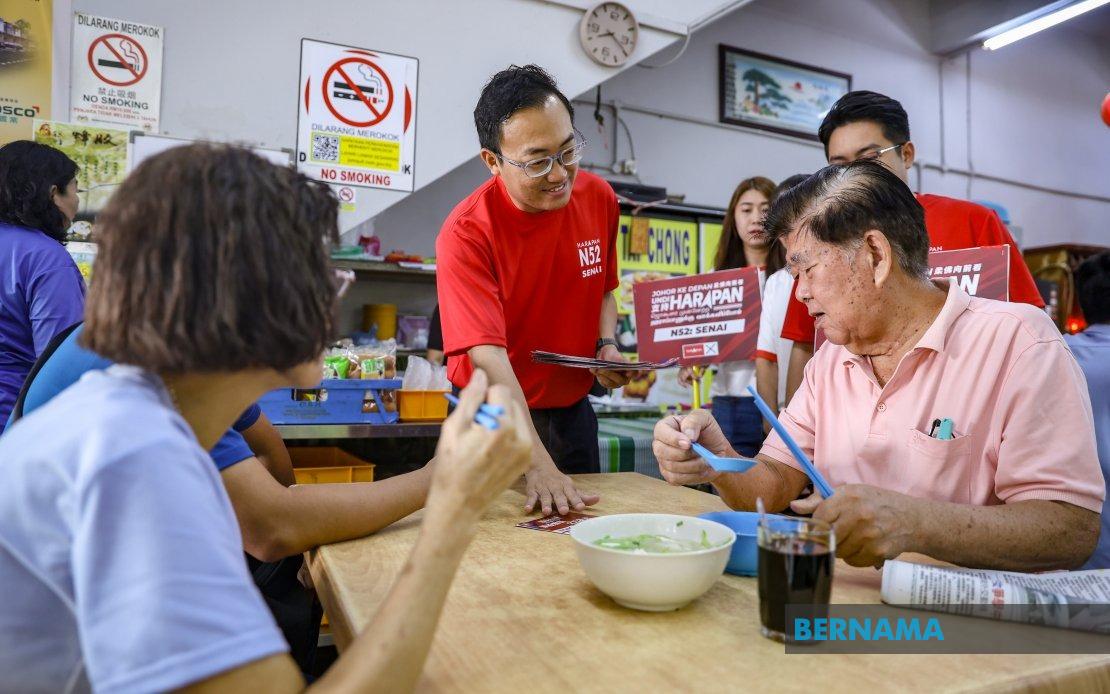
Wong Bor Yang, the incumbent Senai state assemblyman, is confident that Pakatan Harapan will hold onto the Johor seat in the upcoming 16th state election, pointing to what he characterises as a substantive tenure marked by tangible improvements to resident welfare and local infrastructure. Speaking during campaigning in Kulai, Wong emphasised that his previous term was not merely a learning period but rather a continuation of administrative work spanning over a decade, lending him the experience necessary to address pressing community needs with practical solutions rather than political rhetoric.
The former journalist's political journey has been unconventional, progressing through multiple phases of Malaysia's recent political transitions. Beginning his public service in 2014 as a special officer at the Kulai Member of Parliament's office, Wong later transitioned into local government as a councillor in 2018 before securing election as a state assemblyman. This varied exposure across opposition and government roles has, according to Wong, shaped his problem-solving approach and given him insight into governance from multiple vantage points.
During his previous term, Wong pursued what he describes as persistent advocacy for addressing the chronic flash flooding that has plagued several neighbourhoods within his constituency. Although serving in opposition at the time, he employed state assembly debates and formal petitions to pressure relevant government agencies into approving infrastructure upgrades. His efforts ultimately yielded approval for RM1 million in funding to improve drainage systems in Taman Aman, channelling water more effectively into Sungai Skudai and reducing inundation risks in that area.
Beyond his individual efforts, Wong highlights his collaborative approach with Kulai MP Teo Nie Ching in securing an additional RM3 million for drainage system enhancements across Peladang Kulai Besar and Saleng. These two projects proved significant enough to remove both localities from the district's list of persistent flash flood hotspots, demonstrating that sustained political pressure can yield measurable infrastructure improvements. For a constituency like Senai, where seasonal flooding has historically disrupted livelihoods and posed safety risks, such achievements represent concrete evidence of advocacy effectiveness.
Beyond infrastructure, Wong has invested effort into preserving and developing Senai's historical character and community amenities. He oversaw the conversion of a defunct cinema into a community operations centre, capitalising on the area's heritage value while simultaneously creating a functional public space. Additionally, a two-decade-old badminton court was upgraded into a family recreational facility branded as Tiny Lake under the Sejati MADANI initiative, illustrating how targeted investment in aging public assets can enhance quality of life without necessarily requiring major capital outlays.
Healthcare provision looms large in Wong's campaign messaging for his potential second term. A graduate of Shih Hsin University in Taiwan, Wong has mounted sustained calls for upgrading Kulai Hospital, a facility currently operating with 93 beds despite the district's projected population reaching 500,000 by 2030. This demographic trajectory creates an obvious mismatch between current capacity and anticipated demand, a gap that Wong argues demands urgent government attention during the next electoral term.
One specific healthcare project that Wong intends to prioritise involves resolving the land-acquisition bureaucracy that has stalled the construction of a new Health Clinic in Taman Mewah. According to Wong, state-level administrative delays have prevented the Health Ministry from commencing work on this facility, leaving gaps in primary healthcare access within that residential area. His pledge to intervene and unblock these administrative roadblocks reflects an understanding that political capital can be deployed to accelerate public health infrastructure development.
The Senai contest encompasses a field of three candidates competing for the state seat, which possesses an electorate of 66,635 registered voters. Beyond Wong representing Pakatan Harapan, Barisan Nasional has fielded Tai Chee Chee as its candidate, while the independent Bersama party put forward Tew Chien How. This three-way competition reflects the evolving political landscape in Johor, where traditional two-party contests have given way to more fragmented contests.
Wong's campaign strategy rests on the assumption that Johor voters, whom he characterises as politically mature and discerning, will evaluate candidates primarily on demonstrated performance rather than campaign promises. This framing implicitly challenges opposing candidates who may lack comparable administrative experience, positioning Wong's track record as a decisive advantage in an electorate fatigued by unfulfilled pledges. His emphasis on practical governance—resolving specific flooding problems, upgrading healthcare facilities, preserving heritage—appeals to voters seeking tangible results rather than ideological appeals.
For Pakatan Harapan, Wong's contest in Senai represents part of its broader effort to consolidate control in Johor following its electoral gains in 2022. The coalition's performance in state-level contests throughout the peninsula has been mixed, making retention of existing seats strategically important. Wong's emphasis on his cross-partisan administrative experience and collaborative relationships with MPs from different coalitions suggests a governing philosophy oriented toward pragmatic delivery rather than partisan posturing.
The broader implications for Johor's political trajectory extend beyond Wong's individual candidacy. The presence of newer competitors like Bersama indicates that voter preferences are fragmenting, potentially making incumbency and demonstrated track record more determinative factors. In constituencies where governance delivery has been tangible—flood management, healthcare improvements, heritage preservation—sitting assemblyman possess meaningful campaign ammunition. Conversely, constituencies where residents perceive administrative stagnation become vulnerable to challenges.
As polling approaches on July 11, with early voting scheduled for July 7, Wong's campaign exemplifies how successful elected officials in Malaysia increasingly position themselves. Rather than relying solely on party machinery or ideological appeals, Wong foregrounds specific projects and measurable outcomes, inviting voters to assess his tenure on concrete evidence. Whether this approach proves effective against better-resourced Barisan Nasional machinery and the novelty factor of Bersama's candidate will provide insight into contemporary Malaysian electoral preferences regarding incumbency and performance.

