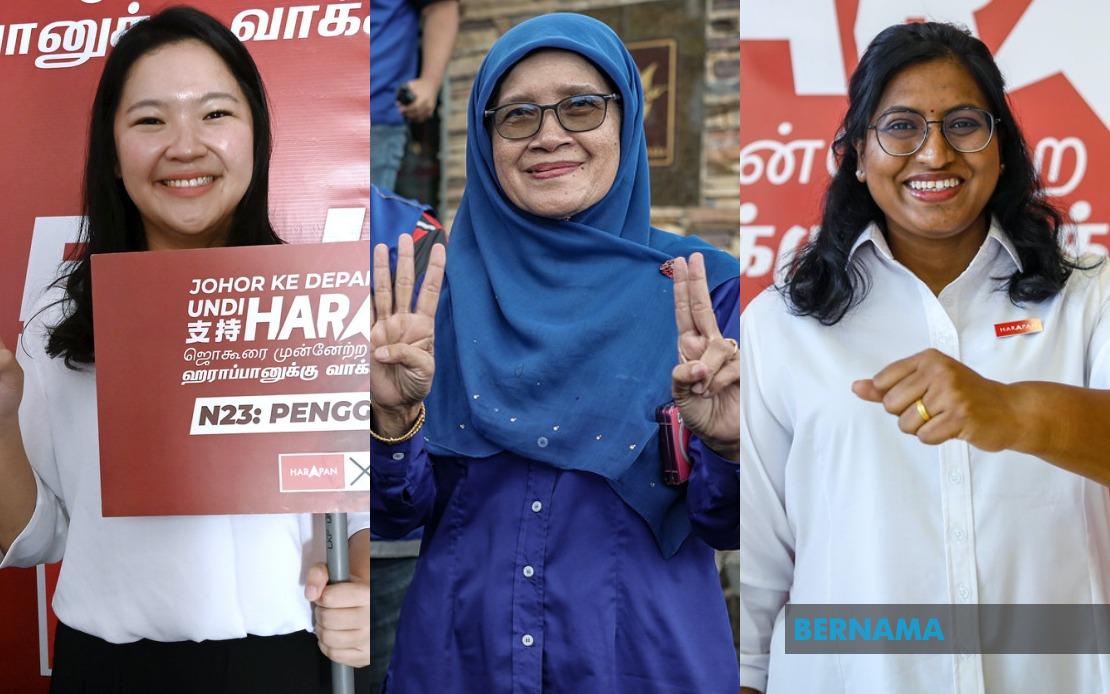
The 16th Johor State Election has delivered a notable result for female representation, with ten women successfully capturing seats in the State Legislative Assembly. The outcome demonstrates that voters in Malaysia's southernmost mainland state continue to back women candidates across the political spectrum, even as competition intensifies and the overall political landscape remains dominated by male representatives. This achievement carries significance not only for Johor but also as an indicator of broader trends in women's political participation across Southeast Asia.
The successful female candidates split along partisan lines, with seven winning under the Barisan Nasional banner and three advancing Pakatan Harapan's interests. For BN, Nadhirah Afiqah Abdull Rahim claimed the Serom seat in her electoral debut, leveraging her position as Ledang Puteri UMNO chief to overcome competition from Perikatan Nasional and PH challengers with a decisive majority of 9,406 votes. Nor Rashidah Ramli's triumph in Parit Raja proved particularly striking, as her 13,576-vote majority represented a substantial improvement over her 2022 performance when she secured the same seat with just 4,219 votes advantage—a testament to strengthened BN support in the constituency.
Alwiyah Talib's victory in Endau marked her third consecutive win for the seat, reinforcing the political durability of experienced female legislators who have successfully built grassroots networks over multiple election cycles. In Johor Lama, incumbent Norlizah Noh recorded a commanding win with a 16,344-vote majority against opposition from both PN and PH contenders, including the election's youngest candidate Danish Hossman Abd Rahman. Her resounding endorsement reflects the electoral security that comes with effective representation and established constituent relationships built over preceding terms.
Fauziah Misri's landslide victory in Penawar, achieved with a 15,776-vote majority, further illustrated the potential for female candidates to mobilise substantial voter support when standing on strong party platforms. Chan San San's capture of the Johor Jaya seat represented a particularly significant upset, as the constituency had long been regarded as a stronghold for the DAP within Pakatan Harapan's coalition structure. Chan's victory, backed by 35,971 votes, signalled either a notable shift in local sentiment or successful BN ground organisation that fractured the opposition's traditional support base. Incumbent Hasrunizah Hassan successfully defended her Pulai Sebatang seat with a 13,590-vote majority, a gain of 6,325 votes compared to her 2022 result, suggesting deepening voter confidence in her legislative performance.
Packatan Harapan's female victors demonstrated their own capacity to retain constituencies against competitive challenges. Felicia Poh Rui Ling, just 28 years old, captured the Penggaram seat in her maiden electoral contest, defeating the BN incumbent Boo Chin Liong by 4,137 votes in a direct contest. Her youth and success suggest that opposition coalition can draw on a fresh generation of female political talent capable of resonating with younger voters. Chu Poh Yee retained the Mengkibol seat with a 4,213-vote margin over her BN rival Yap Zhi Peng, maintaining PH's hold in a constituency where the party had previously established electoral credibility.
Kartiyaini Jeyapalan, a lawyer from Skudai, successfully held the traditional PH stronghold of Skudai against a four-cornered contest involving candidates from BN, the breakaway Parti Sosialis Malaysia, and Parti Bersama Malaysia. Her 15,280-vote majority underscored PH's continued strength in urban constituencies where professional and educated voters have tended to support the coalition's political message. The diversity of her opposition—spanning establishment BN, left-wing PSM, and the newly-registered Bersama—illustrated how the Malaysian political landscape has become increasingly fragmented beyond the traditional two-coalition framework.
The 34 female candidates who contested across the state represented just under 20 percent of the total field of 172 candidates, a proportion that has become increasingly standard in recent Malaysian elections. This near-parity in numbers between male and female candidacies reflects both formal commitments within parties to improve gender representation and the growing acceptance among party leadership that female candidates command voter confidence comparable to their male counterparts. Yet the conversion rate—with ten of 34 women winning seats—requires contextualisation within the broader results. While BN's seven female victors contributed meaningfully to its commanding 48-of-56 seat majority, PH's three female successes formed part of a more modest eight-seat performance that failed to challenge the ruling coalition's dominance.
The electoral performance of female candidates in Johor carries implications for Malaysian politics beyond the state level. As women continue to penetrate upper echelons of party structures and contest increasingly winnable seats, their successful track records build institutional momentum for further gender advancement. The diversity of female representation across both BN and PH indicates that support for female political leadership has transcended partisan boundaries, suggesting a genuine shift in voter attitudes rather than tokenistic appointment by individual parties. Female candidates have demonstrated they can mobilise majorities comparable to, and occasionally exceeding, those achieved by male counterparts in identical constituencies.
Looking forward, the Johor results will likely influence internal party calculations across Malaysian politics regarding female candidate selection and portfolio allocation. Successful women legislators like Alwiyah Talib, who has now won three consecutive terms, and Norlizah Noh, with her commanding recent majority, establish templates for career progression within political hierarchies that historically have preferred male advancement. The performance of younger female candidates like Felicia Poh suggests pathways exist for women to enter electoral politics and immediately establish themselves as credible representatives, potentially shortening the timeline between initial candidacy and higher party office that previous generations of female politicians required.
The broader Southeast Asian context further elevates the significance of Johor's outcomes. Across the region, women's political representation remains concentrated in consultative rather than executive positions, with elected female legislators disproportionately assigned ministerial portfolios in culture, social welfare, or women's affairs rather than portfolios controlling state resources or security policy. Malaysia's relatively stronger historical record of female political participation—evident in cabinet positions, state assembly representation, and successful municipal governance—continues this election cycle, though the ceiling for advancement into the highest executive positions remains substantially below male contemporaries. The Johor result reinforces that Malaysia's female voters will support competent female candidates with strong constituency records, a prerequisite for any further breakthrough in women's political advancement.

