What happens when you hand the power of urban design to the people who use playgrounds most—children themselves? In New York City, thousands of young students have spent their time as junior landscape architects, fundamentally reshaping how their schools look and function. Their approach has yielded something far more valuable than conventional playgrounds: spaces that genuinely reflect the needs, dreams, and creativity of the communities they serve. The scale of this transformation is remarkable. Over two decades, the Community Schoolyards programme, managed by the Trust for Public Land working alongside city education and environmental authorities, has overseen the construction of 225 kid-designed playgrounds. With nearly US$200 million (RM815.6 million) invested through government budgets and private donations, these spaces have become vibrant hubs that remain open year-round and welcome the broader neighbourhood beyond just students.
The design process itself represents a crucial lesson in democratic participation. Rather than allowing architects to dictate what children should want, the programme inverts this relationship entirely. Students begin by generating ambitious wish lists—swimming pools, chocolate fountains, merry-go-rounds, and koi ponds dominate their initial visions. They then engage in the practical work of reality-testing, measuring actual spaces, mapping layouts, and most importantly, incorporating feedback from teachers, parents, and neighbours who collectively vote on final designs. This collaborative approach ensures that the finished playgrounds serve not just student interests but also address broader community needs and safety concerns.
What emerges from this process are playgrounds that balance whimsy with functionality in ways that only active users can truly appreciate. While themes featuring unicorns, dragons, and aliens provide the colourful backdrop, the real genius lies in how children solve actual social problems through design. At one Queens middle school, students recognized that introverts needed sanctuary within shared spaces, resulting in a dedicated "introvert's corner" complete with gazebo and plantings—a quiet zone that acknowledges different temperaments and social preferences among the student body. This kind of nuanced thinking about inclusive space design reflects emotional intelligence often missing from adult-led urban planning.
Sex and gender dynamics play a significant role in how children reimagine their physical environments. At a Bronx playground, girls observed that boys monopolized the basketball courts, effectively excluding them from this activity. Rather than accepting this informal segregation, they designed their own designated space: a half-court painted distinctly in pink while the remaining courts stayed blue. The psychological impact proved substantial. Girls reported feeling more confident and less anxious about judgment when playing on their designated court, with boys respecting this boundary and asking permission before entering. For one eleven-year-old participant, Charlotte Lawrence, the design choice translated directly into personal empowerment: "It makes me honest, believe in myself because I'm not alone on this court."
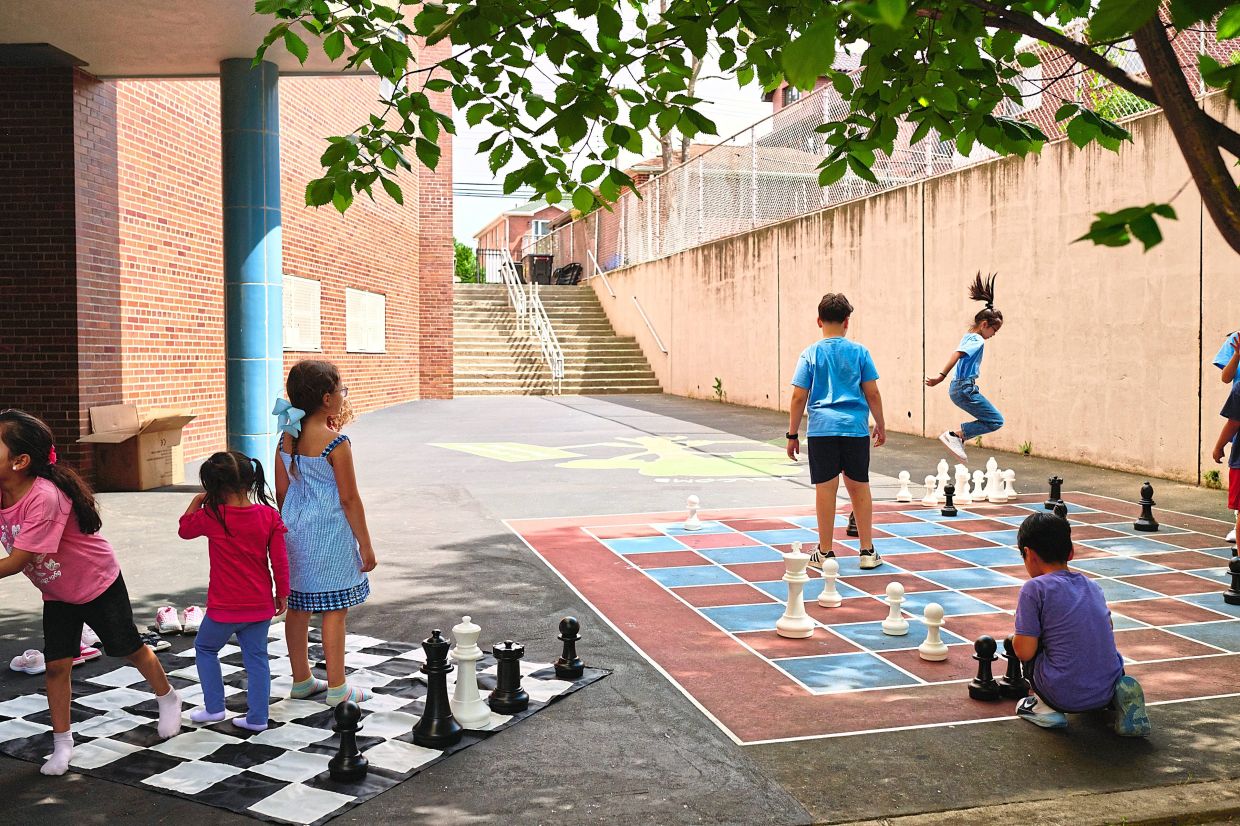
Literary and cultural references inform playground design in unexpected ways. Students at North Hills School in Queens, inspired by the Harry Potter series and the image of wizards playing life-size chess, installed two giant painted chessboards as focal points. The scale difference transforms the game itself—players report that larger pieces make strategy more visible and the game experience richer. The practical limitation—pieces going missing or breaking—represents the kind of real-world trade-off that adult designers encounter but that young architects now understand directly through use.
Playground design also responds to specific cultural practices within communities. At a Harlem playground, students observed girls sitting on the ground to have their hair braided and recognized this as both a practical activity and social ritual deserving proper infrastructure. They designed tiered seating with three pairs of steel-slat benches positioned at slightly different heights, acknowledging the ergonomic needs of both the person braiding and the person being braided. Yet the genius of good design is its flexibility. These same benches became multipurpose: students use them for parkour jumping, as a dance stage, and imaginatively as car seats in pretend play.
Gameification emerges naturally from child-designed spaces. A Brooklyn playground features a "floor is lava" obstacle course built around a volcanic theme, with painted lava flowing around equipment, chess tables, and benches. What began as a simple visual theme became a social connector. Students described how the game functioned as an icebreaker, drawing together children who might not otherwise interact. One participant, Amia Peoples, recognized the inclusive power of the design: "I like that it's something a lot of people can play. I connected with a lot of people on this playground." This speaks to how thoughtful design can inadvertently strengthen social bonds and community cohesion.
Educational value extends beyond recreation in these spaces. At Emanuel Kaplan School in Queens, students designed mushroom-shaped stools with bright red tops and white spots that reflect their neighbourhood's woodland history. These serve dual purposes—rest and play—with younger children discovering that the stools create sequences for hopping games. Similarly, at Pacific School in Brooklyn, students initially proposed an ambitious petting zoo but, through pragmatic design conversations, settled on a pollinator garden. A dedicated student club called Team Tomato now stewards the space, with broader school participation through winter seedling growing and parent involvement. The garden has become a sensory education tool—one nine-year-old described stopping to smell mint and lavender as a moment of genuine connection: "It makes my nostrils say, 'This is nature.' I'm breathing in nature."
The implications for Southeast Asian cities merit consideration. As Malaysian and regional urban planners grapple with increasingly dense cities, the New York model suggests that participatory design involving young people can address real infrastructure gaps while building civic engagement. In Malaysia's rapidly urbanizing landscape, where schoolyards often remain underutilized concrete expanses, adopting similar community-centred design processes could transform educational environments while simultaneously creating neighbourhood gathering spaces. The relatively modest cost per playground (averaging under US$900,000 each) represents achievable investment for municipal authorities, particularly when leveraging corporate partnerships and community fundraising.
Perhaps most significantly, these playgrounds demonstrate that good urban design isn't something imposed from above but emerges through genuine dialogue between users and creators. Children, when given the tools and processes to express their needs, generate solutions that adults might overlook—problems they experience daily but have never had platforms to articulate. The success of the Community Schoolyards programme ultimately rests on a simple but profound recognition: those who live in spaces understand them most deeply, and their insights should drive decisions about how those spaces evolve.

