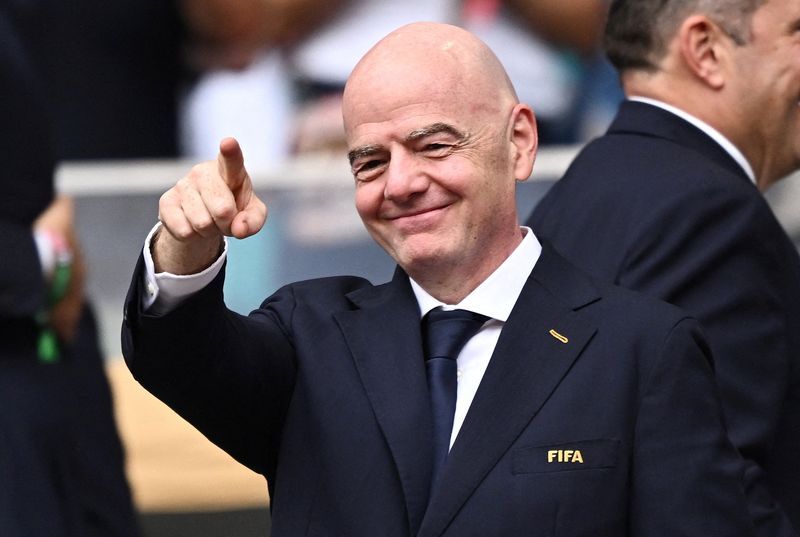
FIFA President Gianni Infantino faces mounting political pressure after Wales formally withdrew its backing for his candidacy in the 2027-2031 election, marking the first concrete defection from a major football federation. The withdrawal comes in the aftermath of a collapsed privatisation scheme that aimed to generate up to $4.2 billion by ceding roughly 20% stakes in a commercial entity overseeing international tournaments, including the World Cup. The decision signals that Infantino's previously unchallenged position atop world football's governing body is now vulnerable to serious challenge.
The ambitious monetisation plan, which would have brought private capital into FIFA's competition framework, fell apart on Friday after sustained opposition from multiple stakeholders within the international football community. The initiative had been positioned as a way to modernise FIFA's financial architecture and unlock new revenue streams for the organisation, but it triggered an unexpectedly fierce backlash that demonstrated the depth of resistance among member federations and regional confederations who feared losing control over the sport's most valuable assets.
The Football Association of Wales articulated its position in unequivocal terms, declaring that Infantino had lost the confidence necessary to lead global football governance. The statement specifically referenced failures in governance standards, procedural integrity, leadership qualities, and stakeholder management—criticisms that extend beyond the failed commercial proposal to encompass broader concerns about how FIFA's highest office has been conducted. This framing suggests that the privatisation scheme merely exposed deeper organisational tensions rather than creating them.
Infantino's troubles intensified when two major continental bodies joined Wales in expressing lost confidence. UEFA, the European governing body, led the initial resistance to the commercial plan and welcomed its abandonment, though it has remained circumspect about whether legal action will follow. Meanwhile, CONCACAF, representing North and Central American nations, also indicated on Saturday that it had lost confidence in the FIFA President's leadership. The nearly simultaneous withdrawal of support from multiple influential federations indicates a coordinated shift in the balance of political power within FIFA.
The convergence of these challenges arrives as Infantino prepares for the March Congress in Morocco, where FIFA members will gather for their regular assembly. What appeared months ago to be a routine re-election campaign has now transformed into a contested presidential race with genuine uncertainty about the outcome. Infantino had announced in April his intention to seek a fourth term as FIFA chief, and until recently, his path to victory seemed assured given his control of the organisation and unopposed re-elections in 2016 and his subsequent term.
UEFA's decision to issue a document preservation order—a procedural move that prevents the destruction of emails, correspondence, and digital records—suggests the possibility of formal investigations or legal disputes over the handling of the commercial rights proposal. This administrative action typically precedes formal disputes and signals serious intent to challenge decisions or conduct, placing additional legal and political pressure on FIFA's leadership during a critical period for the organisation's governance.
Since assuming FIFA's presidency in 2016 following Sepp Blatter's departure under a cloud of corruption allegations, Infantino has generally consolidated power and appeared to command broad support from football federations seeking stability and financial growth. His earlier tenure was marked by expansion of the World Cup format and efforts to professionalise FIFA's operations. However, the commercial rights proposal appears to have crystallised underlying anxieties among member federations about the pace and scope of institutional change, particularly regarding the privatisation of assets they collectively own.
The timeline leading toward Morocco's Congress creates complexity for all parties involved. Federations must now recalibrate their positions and consider whether they will support Infantino, nominate alternative candidates, or demand deeper reforms to FIFA's governance structures. The fact that Wales became the first federation to formally withdraw support suggests that others may follow, particularly if UEFA and CONCACAF translate their expressions of lost confidence into formal action or alternative candidacies.
For Malaysian and Southeast Asian observers, the FIFA leadership contest carries implications for the region's football development. The AFC, ASEAN's continental confederation, will need to position itself strategically within the evolving political landscape at FIFA headquarters. The outcome of the 2027 election will influence how global football resources are distributed, which continental confederations receive investment, and what governance standards apply to development programmes across Asia.
Experts consulted by Reuters indicated that while Infantino's re-election had previously appeared inevitable, the commercial plan's failure exposed substantial dissatisfaction among federations that was previously masked by his apparent control. This reservoir of discontent now threatens to complicate his path ahead, even if he ultimately secures re-election. The episode demonstrates that even within FIFA's hierarchical structure, membership federations retain capacity to collectively resist initiatives perceived as threatening their interests or values.
The broader governance question at stake transcends personalities and touches fundamental questions about whether FIFA should remain primarily controlled by member federations or whether private capital should gain meaningful stakes in the organisation's commercial operations. This philosophical divide, now plainly visible following the failed privatisation effort, will likely shape debate not only around Infantino's candidacy but around FIFA's trajectory for the next decade. The withdrawal of support from Wales and expressions of lost confidence from UEFA and CONCACAF suggest that a substantial portion of global football's leadership believes decisive change is necessary.

