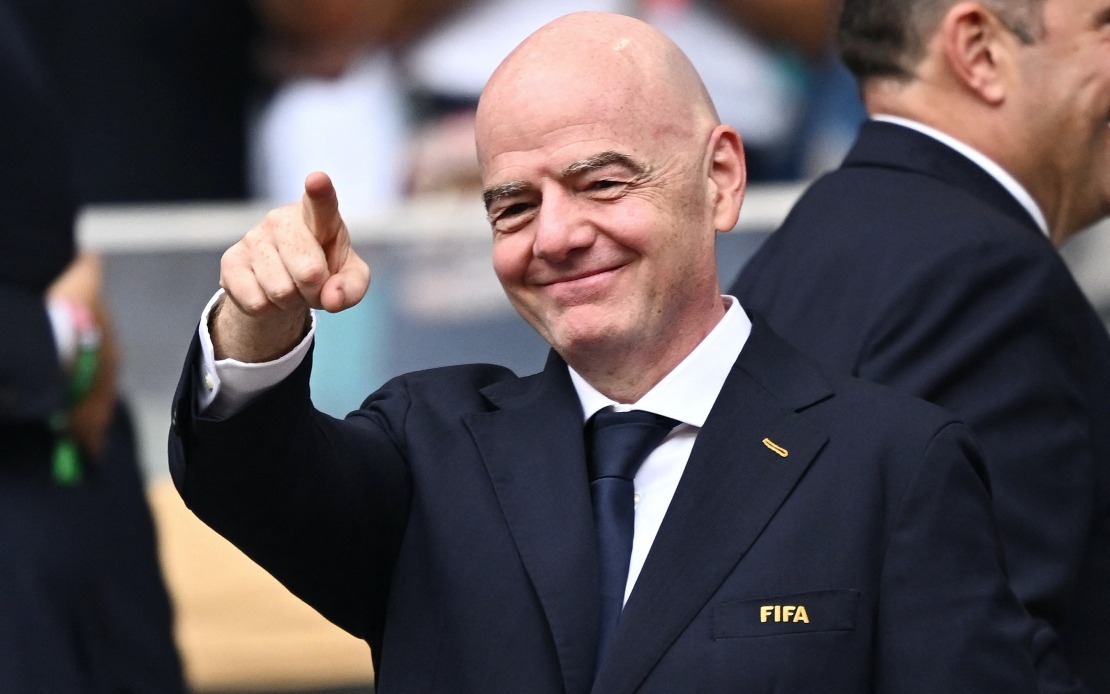
The Football Association of Wales (FAW) has formally withdrawn its support for Gianni Infantino's campaign to retain the FIFA presidency, marking a significant blow to the incumbent leader's re-election prospects. The decision comes in response to Infantino's now-abandoned proposal to sell stakes in the World Cup to private investors, a scheme that generated widespread condemnation across football's governing structures and forced the FIFA president to shelve the initiative last week. The reversal highlights deepening concerns about governance standards within world football's administrative hierarchy.
Infantino's troubled tenure as FIFA president, spanning a decade, is facing intensifying scrutiny as major confederations reassess their confidence in his leadership. The specific catalyst for the FAW's withdrawal centres on what the Welsh governing body characterises as systemic failures spanning governance, decision-making processes, stakeholder engagement, and fundamental judgment. In a statement released on Monday, the FAW emphasised that Infantino had squandered their goodwill and institutional trust, noting that his approach fundamentally contradicted the principle of prioritising football's core interests. Prior to the emergence of the FIFA Forward Enterprise (FFE) proposal, the FAW had indicated its intention to support Infantino's re-election bid scheduled for the following year.
The momentum against Infantino extends considerably beyond Wales. The English Football Association has similarly communicated to FIFA its withdrawal of support, with the organisation issuing a statement on Saturday declaring its full alignment with UEFA's position that confidence in the FIFA president has been irreparably damaged by the FFE proposal. UEFA itself has adopted a notably aggressive posture, stating that "no option should be off the table"—a carefully chosen phrase that leaves open the possibility of triggering a vote of no confidence in Infantino. Such a procedural mechanism could ultimately convene an Extraordinary FIFA Congress where his continued leadership could be directly challenged. The confederation's cautious language reflects the delicate political calculations required to coordinate opposition across football's diverse membership.
The mechanics of removing Infantino, while theoretically straightforward, present significant practical complications. Only 43 national associations—representing less than one-fifth of FIFA's 211-member organisation—need to petition for a no-confidence vote and extraordinary congress. However, political observers within football governance suggest that such a step would only materialise if proponents possessed confidence, preferably approaching certainty, that a majority coalition existed among FIFA members to actually unseat the president at the subsequent congress. This calculation has prevented immediate action despite the growing chorus of institutional criticism.
North American football governance has joined the European critique. CONCACAF, the confederation representing associations across North America, Central America, and the Caribbean, issued its own demand over the weekend for a comprehensive leadership review. When combined, UEFA and CONCACAF encompass approximately 96 national associations, representing substantial voting weight within FIFA's structure. Notably, sources have indicated to media observers that Victor Montagliani, the CONCACAF president and current FIFA vice-president, would be willing to contest the leadership position should an electoral opportunity emerge. His potential candidacy underscores the political dimension underlying the governance debate, as institutional criticism intersects with leadership ambitions.
Despite the mounting Western institutional opposition, Infantino retains meaningful support from several continental blocs. Multiple African and Asian national associations have issued statements expressing confidence in the FIFA president, including governing bodies from Morocco, Egypt, and Qatar. This geographic division in support reflects broader structural fault lines within FIFA's membership, where economic interests, developmental relationships, and historical alignments continue to shape institutional politics. The survival of Infantino's presidency may ultimately depend on whether the fragmented opposition can construct a sufficiently cohesive alternative, a task complicated by the absence of an obvious consensus candidate beyond the speculative interest from CONCACAF's leadership.
For Malaysian football administrators and regional Southeast Asian observers, this institutional tumult carries significance beyond procedural intrigue. FIFA's governance trajectory influences resource allocation to confederations, the structuring of international competitions, and the technical standards imposed on member associations. The FFE proposal itself represented an attempt to fundamentally restructure FIFA's financial model by introducing private capital into World Cup operations—a development with potential implications for how international football's crown jewel is organised and administered. The rejection of this approach by European and North American confederations reflects broader philosophical disagreements about commercialisation and institutional autonomy.
The withdrawal of support from major confederations simultaneously signals deeper institutional dysfunction beneath FIFA's administrative surface. Prime Minister Andy Burnham's characterisation of Infantino as the "wrong man" to lead global football, combined with the English FA's call for a "full and robust review" of his leadership, indicates that loss of confidence extends beyond the executive boardroom into political circles with stakes in football governance. These articulations of criticism from nation-state level officials underscore how FIFA's leadership decisions intersect with broader governmental interests in sports administration and international soft power.
The timing of these coordinated withdrawals of support creates pressure on Infantino without immediately forcing a constitutional crisis. The re-election bid scheduled for the following year provides a chronological anchor for decision-making, yet the accumulating institutional criticism may accelerate the timeline for either voluntary withdrawal or more confrontational removal mechanisms. The apparent cohesion among Western confederations, despite their occasional historical rivalries, demonstrates how governance failures and perceived threats to institutional autonomy can temporarily override competitive interests. Whether this coalition can maintain unity long enough to coalesce behind an alternative candidate remains uncertain, but the momentum has clearly shifted against the incumbent FIFA president.

