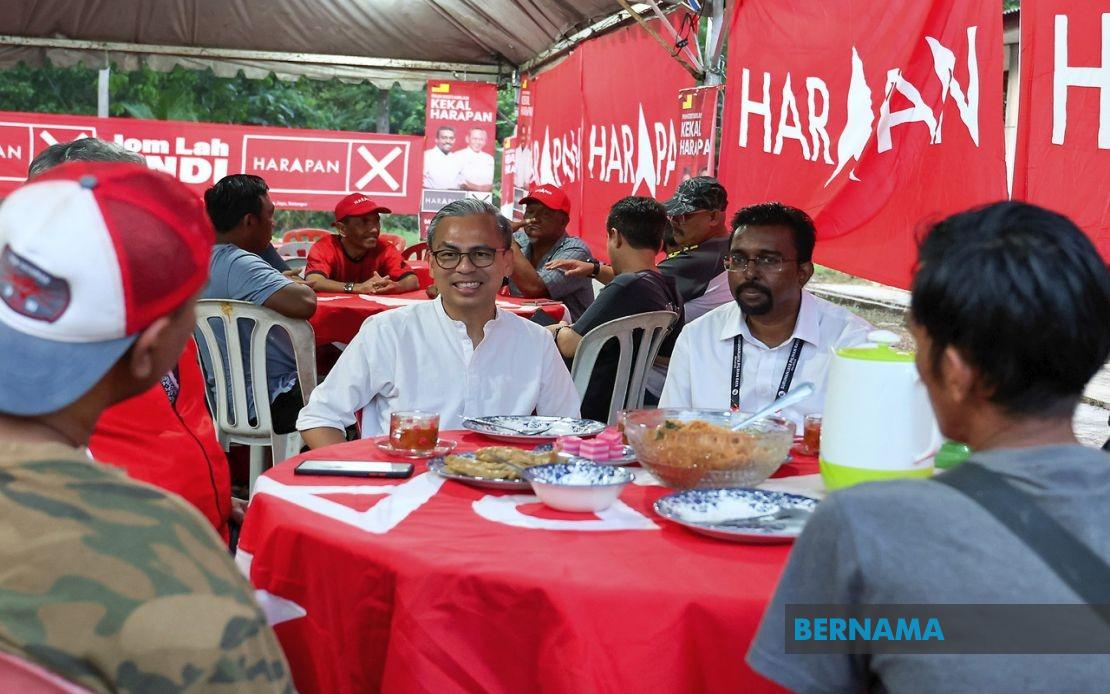
The outcome of any election ultimately hinges on the choices made by voters in the ballot booth, not on the assessments of political analysts or survey data, according to Pakatan Harapan Communications director Datuk Seri Fahmi Fadzil. Speaking during a community gathering in Jempol as voting approaches for the 16th Negeri Sembilan state election, Fahmi reframed electoral predictions as motivation for candidates rather than reliable forecasts, presenting a perspective that underscores the unpredictability of electoral contests even in the age of sophisticated polling methodologies.
Fahmi's remarks came as a direct response to commentary by Dr Ong Kian Ming, the former Bangi MP, who had offered predictions about potential competitive races across several Negeri Sembilan seats. Rather than dismissing such forecasts outright, Fahmi characterised them as useful challenges that should compel PH's campaign machinery to intensify grassroots engagement. This framing reflects a broader strategic approach where political organisations acknowledge but do not concede to analytical projections, treating them instead as benchmarks against which to measure campaign effectiveness and voter mobilisation efforts.
The Communications Minister drew upon his own electoral history to illustrate the gap between prediction and reality. During the 2018 general election, comprehensive survey data consistently suggested he would lose his Lembah Pantai parliamentary seat, yet he ultimately retained the position. This personal experience shapes his current perspective on the Negeri Sembilan contest, lending credibility to his assertion that voter preferences, particularly among undecided voters who typically determine close races, remain fluid and responsive to campaign messaging right up to polling day.
Fahmi emphasised that PH's campaign strategy must prioritise sustained dialogue with fence-sitters—voters who have not yet committed to any political faction. These persuadable voters frequently prove decisive in determining which party forms government, especially in state-level contests where political allegiances may differ from federal preferences. The imperative for continuous voter engagement reflects recognition that electoral outcomes are shaped by dynamic interactions between campaigns and publics rather than static predetermined patterns.
According to Fahmi, feedback from Negeri Sembilan voters has been encouraging for PH, suggesting a receptive audience for the governing coalition's message. Voters appear to appreciate concrete assistance programmes administered by the state government, including entrepreneurship incentives aimed at supporting small business operators, newlywed couples' assistance schemes, and laptop distribution initiatives targeting students. These tangible benefits form a substantive foundation for campaign messaging, moving beyond abstract political rhetoric to highlight material improvements in residents' lives.
However, Fahmi issued a stern warning about the information environment in the election's final three days, when historical patterns show that misinformation campaigns typically intensify. Unscrupulous actors, he suggested, would exploit the compressed timeline of the campaign's closing phase to circulate false, misleading, or deceptively edited content across digital platforms, particularly WhatsApp where verification mechanisms are weakest and content spreads rapidly through informal networks.
The misinformation hazards Fahmi identified encompass several tactics increasingly common in Malaysian political discourse. Partial statements extracted from their original context can be weaponised to misrepresent a politician's actual position. Video clips, particularly those recorded years earlier, may be recirculated with false dating or misleading captions to suggest recent controversial statements. Fahmi specifically highlighted an instance where an older video of Prime Minister Datuk Seri Anwar Ibrahim, filmed during his years as opposition leader, had been circulated with claims that it contained recent critical remarks about Malaysia's armed forces—a distortion designed to manufacture political controversy.
To combat such tactics, Fahmi advised voters to apply critical scrutiny to information encountered on social media. He recommended using the presence or absence of coverage by established mainstream media outlets as a verification heuristic. If significant political claims fail to appear in reporting by outlets including Berita Harian, TV3, RTM, Bernama, and Awani, or through official government channels, voters should harbour scepticism rather than accepting such claims uncritically. This guidance essentially encourages voters to privilege institutional gatekeepers over viral social media content, a position that assumes traditional media outlets maintain higher editorial standards than peer-to-peer networks.
The distinction Fahmi draws between reliable information sources and unreliable social media circulation reflects broader concerns about information integrity in contemporary Malaysian elections. Digital campaign environments enable rapid dissemination of unverified content, creating conditions where misinformation can influence voter perceptions before fact-checking mechanisms operate. The compressed timeline of the campaign's final days exacerbates these dynamics, as voters make final decisions amid information overload and deliberate disinformation.
Fahmi's framing of these challenges carries implications extending beyond the Negeri Sembilan contest. His emphasis on voter agency and scepticism toward both electoral predictions and social media misinformation offers a template for how political organisations might inoculate supporters against both overconfidence in favourable polls and vulnerability to deliberately misleading content. By positioning voters as active decision-makers rather than passive subjects of survey methodology or social media manipulation, he acknowledges the central role of voter discernment in determining electoral outcomes.
The strategic context for these remarks reflects PH's positioning as the incumbent state government in Negeri Sembilan, defending its record while seeking to expand its legislative majority. Fahmi's messaging therefore emphasises concrete achievements—the assistance programmes he cited—while simultaneously cautioning against complacency that might result from favourable internal polling. This dual approach of promoting voter engagement while warning against overconfidence attempts to mobilise the party's base without triggering the organisational complacency that sometimes accompanies predictions of comfortable victories.
As voting neared in the Negeri Sembilan election, Fahmi's statements served to emphasise that electoral outcomes remain fundamentally open questions, determined by the accumulated voting decisions of Negeri Sembilan residents rather than by analysts, predictions, or digital misinformation campaigns. His message implicitly called voters to exercise their democratic responsibility with care and critical awareness, whilst simultaneously mobilising PH's campaign organisation to sustain maximum effort through the final voting day.

