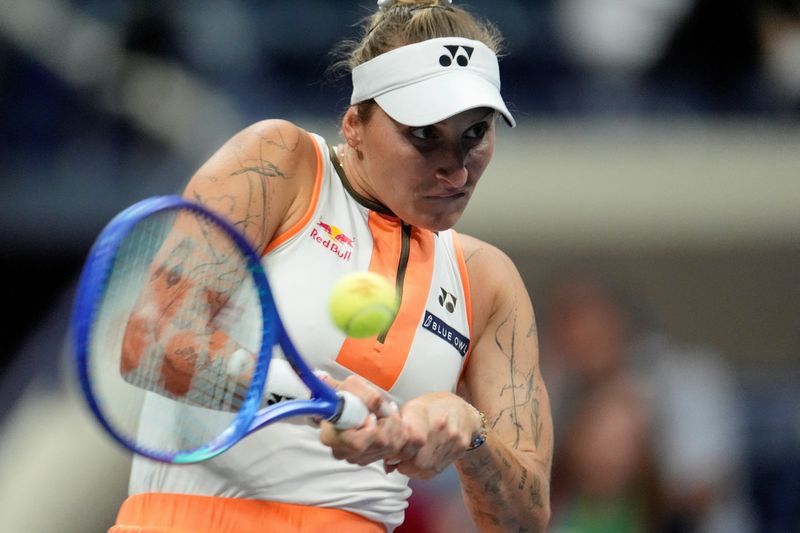
The tennis world is grappling with difficult questions about the balance between anti-doping enforcement and player rights following the International Tennis Integrity Agency's decision to suspend Czech player Marketa Vondrousova for four years after she declined to submit a sample during an unannounced test at her home in December. The ban, issued on Monday, has exposed deep tensions within professional tennis around how testing protocols are implemented and who has a voice in shaping them—a dispute that carries real significance for athletes across the sport and potentially raises implications for how anti-doping systems operate more broadly.
Vondrousova's case is particularly striking because the former Wimbledon champion has never tested positive for banned substances. According to the ITIA, a doping control officer arrived at her residence at 8:15 p.m. to conduct an out-of-competition test, but Vondrousova refused to cooperate. The 26-year-old subsequently revealed that she had been struggling with profound physical and mental strain and that the late-evening arrival of an unidentified official at her private home felt like an unacceptable violation of her personal security. She referenced the traumatic 2016 knife attack on fellow Czech tennis player Petra Kvitova at her residence, explaining that fear for her safety prevented her from opening the door.
The Professional Tennis Players Association has seized on the case as a moment to challenge the existing power structure within the sport's anti-doping apparatus. In a strongly worded statement, the PTPA questioned how a four-year ban could be justified for a player with a clean testing history who expressed legitimate safety concerns, arguing that the sport should reconsider whether current testing rules adequately protect player welfare. The association's intervention reflects broader frustration with what many athletes perceive as an anti-doping system designed without meaningful consultation from those subjected to its procedures. For Malaysian and Southeast Asian athletes competing at the professional level, this dispute highlights the challenge of navigating international anti-doping frameworks that may not adequately account for individual circumstances or regional differences in how safety protocols are understood.
Tensions have been building within tennis for some time, particularly after high-profile players like Jannik Sinner and Iga Swiatek avoided lengthy suspensions despite positive drug tests. Those outcomes, handled more leniently than Vondrousova's case, have fuelled accusations of inconsistency and raised questions about whether the system treats all players equally regardless of ranking, nationality, or market value. The PTPA has not shied away from making this connection explicit, arguing that players deserve genuine representation in the creation of rules that profoundly affect their careers and livelihoods. Last year, the association filed a lawsuit against tennis's governing bodies alleging privacy violations through random testing protocols, indicating that this conflict has deeper institutional roots.
From the anti-doping authorities' perspective, the situation is more straightforward. The ITIA and broader tennis establishment operate under World Anti-Doping Agency codes applied consistently across all sports globally. According to ITIA CEO Karen Moorhouse, cases are determined purely on facts and evidence without regard to player reputation or ranking. The agency maintains that unpredictable testing at any time and location is essential to the integrity of competition and that refusing a test carries inherent consequences. This standardised, zero-tolerance approach reflects the long-standing philosophy that clean sport can only be guaranteed through rigorous, surprise testing that athletes cannot game or anticipate.
Yet the safety concerns Vondrousova articulated strike at a genuine vulnerability in the current system, particularly for women players. The protocol of sending testing officials to residential addresses during evening hours creates legitimate concerns about personal security, especially given the documented history of violence against professional athletes. Moorhouse attempted to address these worries by emphasising that testers are well-trained professionals who carry identification and that the gender of testing witnesses matches that of players. However, these assurances do not fully resolve the fundamental tension: a player cannot verify an official's credentials before opening her door, and the requirement to submit immediately upon notification leaves little room for verification or safety precautions.
The Vondrousova case also illuminates how international anti-doping frameworks, while designed to ensure consistency, can sometimes override legitimate individual concerns and contextual factors. Vondrousova is currently recovering from a shoulder injury and has not competed since January, meaning she was unlikely to have performance-enhancing drugs in her system at the time of testing. The ban effectively ends a portion of her career during years when she might have been at peak competitive and commercial value. For athletes in Malaysia and the region, this precedent suggests that the anti-doping system prioritises absolute compliance over nuance, potentially discouraging athletes from raising safety concerns.
The PTPA's call for players to have meaningful input into anti-doping rules represents a significant challenge to the current governance model. Rather than simply opposing testing, the association explicitly stated that it supports anti-doping efforts but believes athletes should have formal representation in policy-making processes. This distinction is important: the dispute is not fundamentally about whether testing should occur, but rather about power dynamics and whether those affected by rules have any role in shaping them. Analogous debates have emerged in other sports and international systems, reflecting a broader movement toward athlete agency in governance structures that affect them.
Vondrousova retains the right to appeal her ban to the Court of Arbitration for Sport, meaning this case is unlikely to conclude quickly. The outcome could significantly influence how tennis handles future testing disputes and whether the ITIA and other governing bodies are forced to reconsider elements of their protocols. If the court finds in her favour, it could open pathways for other players to contest testing procedures on safety or fairness grounds. Conversely, if the ban stands, it sends a clear message that compliance is absolute regardless of circumstances, potentially hardening player resentment toward the system.
The broader implications for Southeast Asian tennis and sport are substantial. As the region produces increasingly competitive players on the global stage, they will inevitably encounter international anti-doping systems not designed with their specific contexts in mind. The debate sparked by Vondrousova's case suggests that these athletes may face a choice between accepting testing protocols that feel invasive or unsafe, or risking the same severe consequences that Vondrousova now faces. Malaysian players and other regional athletes would benefit from clearer guidance on their rights and protections under anti-doping frameworks, as well as stronger athlete representation in organisations that determine these policies.
Ultimately, the Vondrousova situation exposes a fundamental question: can anti-doping systems simultaneously be rigorous enough to protect competitive fairness and flexible enough to respect player welfare and safety? The tennis authorities' current answer appears to be no—safety and welfare concerns are acknowledged but subordinated to the imperatives of unpredictable testing. However, the PTPA's intervention suggests that this answer may no longer be acceptable to the sport's athletes, who are increasingly willing to challenge systems that exclude them from decision-making. As this case proceeds, it will likely shape not only tennis's anti-doping future but also broader conversations about how international sport balances enforcement with athlete rights and dignity.

