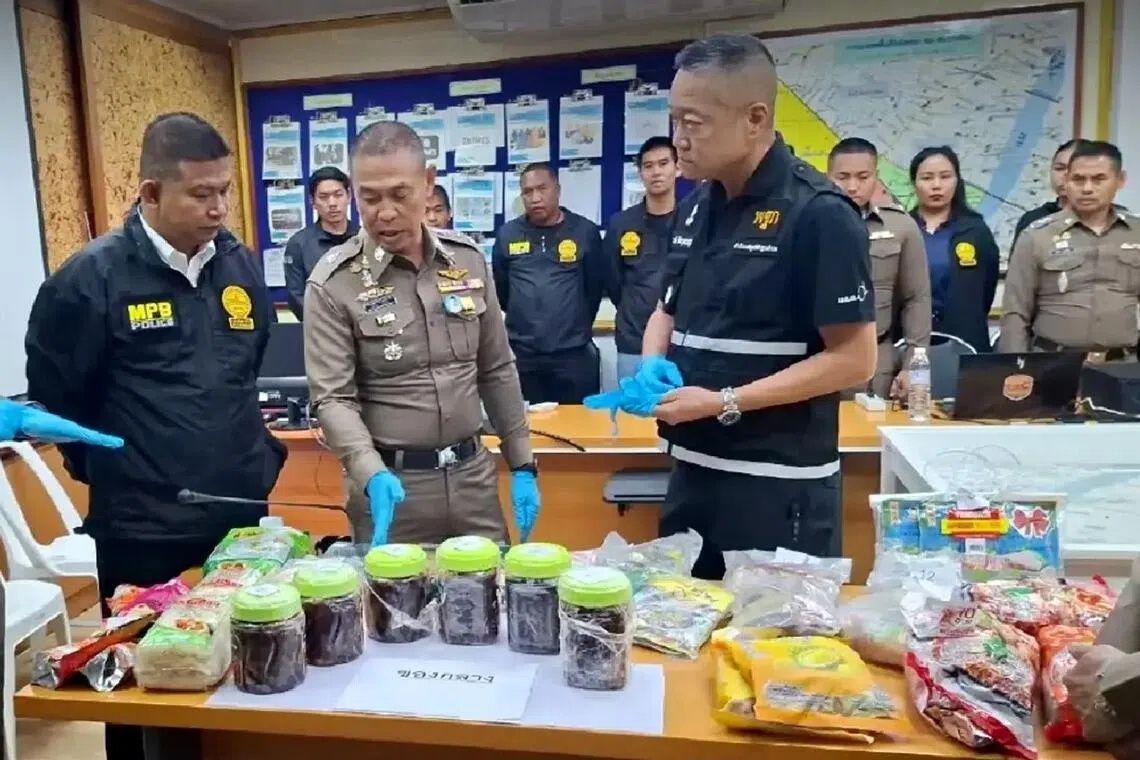
Bangkok police have uncovered an international drug trafficking network operated by Vietnamese nationals that ingeniously concealed crystal methamphetamine inside tamarind paste containers bound for Japan, with Thailand serving as the crucial transshipment point. Metropolitan Police Bureau commissioner Siam Boonsom, working alongside Metropolitan Police Division 7 commander Chaiya Phetpanya and investigators from Bang Yi Khan Police Station, detailed the operation on July 17 after months of investigation into the smuggling enterprise. The case represents yet another iteration of Thailand's ongoing struggle with transnational criminal networks that view the kingdom as an ideal logistical platform for moving contraband through Southeast Asia and beyond.
The breakthrough came unexpectedly when a courier became suspicious of the shipment he had been hired to transport overseas. On July 13, the man contacted police after noticing that several jars of tamarind paste destined for Tokyo felt disproportionately heavy for their apparent contents. His instinct proved correct when officers examined the containers and discovered six foil-wrapped packages secreted within them. Laboratory analysis confirmed the packages held more than 2kg of crystal methamphetamine, commonly referred to as ice on the street market. The discovery marked the culmination of an investigation that had begun with the arrest of Sompong, a Thai national whose involvement would eventually expose the entire conspiracy's architecture.
What distinguished this operation was its sophisticated use of intermediaries and deliberate distance between operational layers. The Vietnamese organisers, who allegedly orchestrated the entire scheme from their base in Hanoi, never directly contacted the couriers or handlers who moved the drugs. Instead, they employed anonymous Facebook accounts to recruit delivery riders operating throughout Thailand. These riders collected packages from residential addresses where Vietnamese nationals temporarily resided, establishing the first buffer against direct identification. The packages would then pass to Thai couriers hired specifically to transport goods internationally, creating multiple separations between the network's leadership and the actual contraband movement.
This compartmentalised approach reflected a methodical understanding of law enforcement investigative techniques. By inserting Thai nationals at several junctures in the supply chain, the organisers reduced the likelihood that investigators could establish a direct line back to Vietnam-based controllers. Each person in the chain possessed only limited knowledge of their role within the larger operation, a classic organised crime strategy designed to frustrate prosecutions and protect senior figures from direct culpability. The use of legitimate food products as concealment added another layer of obfuscation, as tamarind paste is genuinely exported from Thailand to Japanese markets, rendering the shipments less conspicuous to customs authorities.
The financial mechanisms underpinning the operation further demonstrated its organisational sophistication. Police discovered that all monetary transactions flowed through a bank account registered to Sompong, the Thai suspect. Vietnamese members of the network then made regular withdrawals from this account, typically collecting between 20,000 and 50,000 baht in cash before shortly thereafter departing Thailand for Vietnam. This circular financial pattern served dual purposes: it obscured the money trail by fragmenting large sums into numerous smaller transactions, and the frequent departures of Vietnamese nationals to their home country reduced their exposure to arrest and prosecution in Thailand. The strategy reflected understanding that maintaining presence in Thailand while conducting such operations substantially increased detection risk.
Investigators believe the revealed network represents only a portion of a larger smuggling infrastructure. The systematic nature of the operation, the apparent planning that went into concealment and layering, and the scale of the methamphetamine seizure all suggest this was no ad hoc criminal enterprise but rather a functioning component of transnational trafficking. The police assessment that more than four people participated in the operation, with arrest warrants issued for Sompong and three Vietnamese nationals, indicates that significant organisational capacity remains either unidentified or beyond immediate apprehension. The involvement of unidentified individuals in Hanoi who directed the overall operation means that the leadership architecture likely extends well beyond the individuals currently sought.
The case also highlights Thailand's vulnerability to exploitation by foreign criminal syndicates. The country's geographic position, extensive transportation networks, significant Vietnamese migrant population, and relatively porous borders create conditions favourable for transnational drug operations. Criminal networks recognise that Thai territory offers multiple advantages: the ability to source products locally or regionally, to rent residential spaces through informal channels, to hire local couriers, and to access international shipping routes with less intense scrutiny than might occur in more heavily monitored jurisdictions. Thailand's role as a drug transit hub remains entrenched despite ongoing enforcement efforts.
The operation's target destination is also significant within the broader regional narcotics landscape. Japan represents a lucrative market for methamphetamine, where substantial demand supports high wholesale prices. The supply routes established from production regions in Myanmar and Laos through Thailand to Japan are well-established, though individual trafficking networks constantly evolve their methods to evade detection. By disguising the contraband as a legitimate food product, the Vietnamese network tapped into existing commercial channels, using real export pathways to move illegal cargo alongside legitimate trade.
Police investigation continues into the girlfriend of Sompong, though she has not been named in any arrest warrants. Officers believe she may have possessed knowledge of the operation and potentially facilitated certain logistical arrangements. Her case underscores the reality that drug trafficking networks often rely on family members and intimate partners for various support functions, from housing to financial management to transportation logistics. Determining the precise extent of her knowledge and involvement will inform whether additional charges can be substantiated.
The Metropolitan Police Bureau's announcement of the investigation reflects Thailand's ongoing commitment to disrupting transnational drug flows, a priority driven by the country's internal methamphetamine epidemic and international obligations under drug control treaties. However, the sophistication of this particular network and the difficulty law enforcement faces in reaching the Vietnamese command structure illustrate the persistent challenges of combating organised drug trafficking. Unless enforcement efforts extend into Vietnam through international cooperation mechanisms, the senior figures directing such operations may evade accountability. For Malaysian authorities, the case provides important intelligence about Vietnamese trafficking networks operating across Southeast Asia, potentially highlighting vulnerabilities in Malaysia's own borders and transit infrastructure that comparable organisations might similarly exploit.

