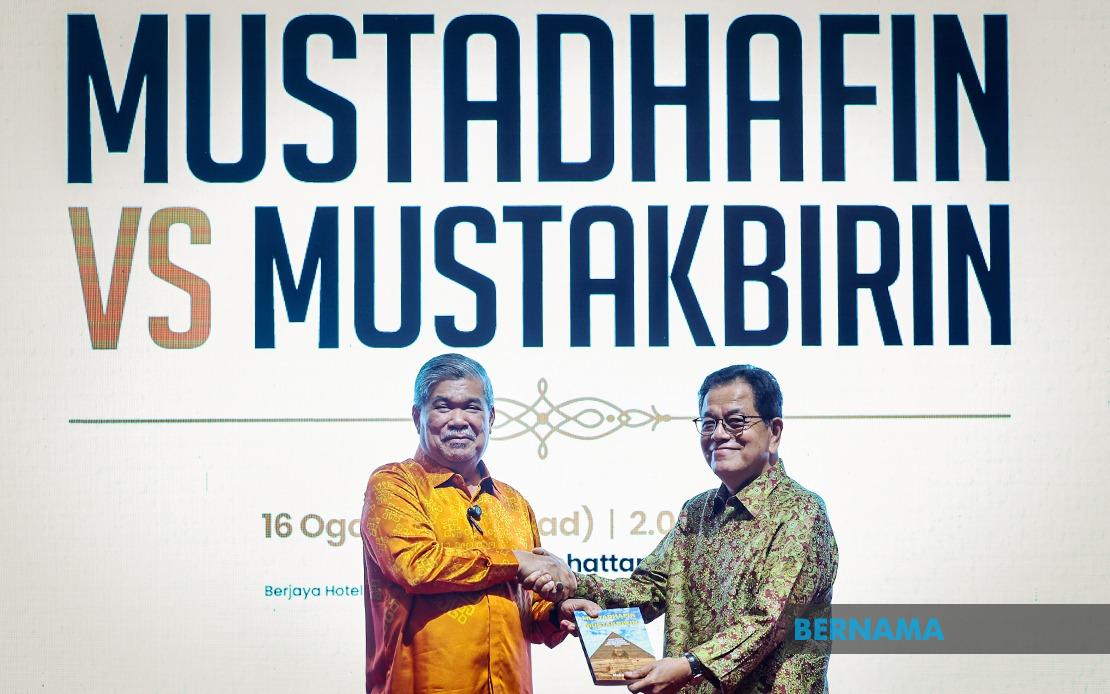
Datuk Seri Mohamad Sabu, president of Amanah, has issued a timely reminder to Malaysians to scrutinise political claims rigorously rather than embracing them uncritically, a concern that takes on added significance in an era when misinformation spreads with unprecedented speed through digital channels. Speaking in Kuala Lumpur on August 16, the Agriculture and Food Security Minister cautioned that unchecked acceptance of allegations without proper verification feeds what he described as 'asabiyyah'—a troubling tribal mentality wherein individuals reflexively defend their own group regardless of merit while dismissing the positive contributions of rival factions.
The concept of 'asabiyyah' that Mohamad invoked carries particular resonance in Malaysian political discourse, rooted as it is in historical Islamic scholarship examining group loyalty and sectarian bias. In the contemporary context, such partisanship manifests when citizens automatically reject information presented by opposing political camps or accept damaging claims about rivals without demanding corroborating evidence. This pattern weakens democratic deliberation and undermines the informed citizenry that plural societies require to function effectively. Mohamad's intervention suggests growing frustration within Amanah over the quality of public discourse and the ease with which unfounded narratives gain traction.
The minister's remarks came during the launch of his recently published book, an event graced by National Journalism Laureate Tan Sri Johan Jaaffar, who also serves as a director of Star Media Group Berhad. The venue and timing suggest that Mohamad intended his message to reach both political audiences and the broader Malaysian public through media channels. His emphasis on personal verification over passive consumption of information reflects a philosophy shaped by decades in politics and activism, during which he has consistently sought first-hand understanding of complex situations rather than relying on hearsay or partisan narratives.
A case in point that Mohamad specifically referenced involved recurring allegations that the Democratic Action Party is a communist organisation and that any coalition partner working alongside it automatically endorses communist ideology. These claims, which resurface periodically in Malaysian political debate, lack substantive foundation yet persist because they tap into deep historical anxieties surrounding the Communist insurgency that plagued the nation during the Cold War era. By questioning the logical validity of such allegations—essentially asking whether DAP is genuinely communist—Mohamad invited the public to demand evidence rather than accept assertions uncritically. This approach mirrors the responsibility journalists and opinion leaders bear in demanding higher standards of proof before amplifying divisive claims.
Crucially, Mohamad highlighted an asymmetry in how human cognition processes information. Accusations and suspicions travel rapidly and take root easily, particularly when amplified across social media platforms where algorithmic incentives favour sensational content over measured analysis. By contrast, factual information and genuine knowledge demand sustained engagement, contextual understanding, and intellectual effort to properly digest and evaluate. This disparity explains why misinformation often outpaces fact-checking in the public sphere. Malaysian society, like democracies worldwide, struggles with this imbalance, where unsubstantiated rumours can dominate headlines whilst detailed rebuttals struggle for visibility.
The minister's published work documents his personal journey of seeking direct understanding rather than accepting received wisdom, a methodology he developed from youth and maintained throughout his career. According to Mohamad, he habitually resisted the temptation to uncritically absorb information circulating through his immediate environment, instead preferring to investigate situations independently and form conclusions based on observable reality rather than propaganda. This epistemological stance offers a constructive model for citizens navigating Malaysia's complex political landscape, where competing narratives jostle for dominance and partisan interests shape how information is framed.
Beyond domestic political concerns, Mohamad's book reportedly addresses broader geopolitical questions drawing on his international observations and experience. The work apparently explores contemporary global dynamics through the lens of historical processes including colonialism and imperialism, examines the evolution of Islamic political movements, reflects on the Palestinian question, and analyzes shifting distributions of global power. These thematic concerns suggest Mohamad intends to connect Malaysian political challenges to wider international contexts, potentially arguing that the tendency toward uncritical acceptance of allegations reflects not merely local shortcomings but patterns observable globally.
For Malaysian readers, particularly those engaged in political discourse or concerned with the quality of public debate, Mohamad's message carries practical implications. In a nation where electoral competition remains intense and social divisions occasionally surface along communal and ideological lines, the capacity to distinguish evidence-based claims from unfounded allegations becomes essential. The rise of social media has democratised information distribution whilst simultaneously reducing gatekeeping functions that once forced claims through editorial scrutiny. Citizens now encounter a vastly expanded range of political narratives, many emanating from sources without institutional accountability or reputational stakes in accuracy.
The warning against 'asabiyyah' also resonates within coalition politics, where Amanah itself operates as a junior partner alongside DAP and other parties in the Pakatan Harapan alliance. Mohamad's defence of pragmatic cooperation despite disagreements on various issues implicitly critiques opponents who weaponise coalition membership as evidence of ideological contamination. By insisting on verification and contextual understanding, he positions Amanah as a rational actor making calculated political choices rather than a naive partner blindly allying itself with ideological enemies.
Moving forward, Mohamad's intervention contributes to an ongoing conversation about information literacy and democratic citizenship in Malaysia. As election cycles approach and political competition intensifies, the public will encounter increasingly sophisticated propaganda and coordinated disinformation campaigns. The minister's fundamental point—that verification precedes judgment, and that tribal loyalty must yield to evidence-based reasoning—provides essential intellectual infrastructure for resisting manipulation. Whether sufficient numbers of Malaysians embrace this disciplined approach to evaluating political claims will substantially influence the tenor and substance of democratic competition in the years ahead.

