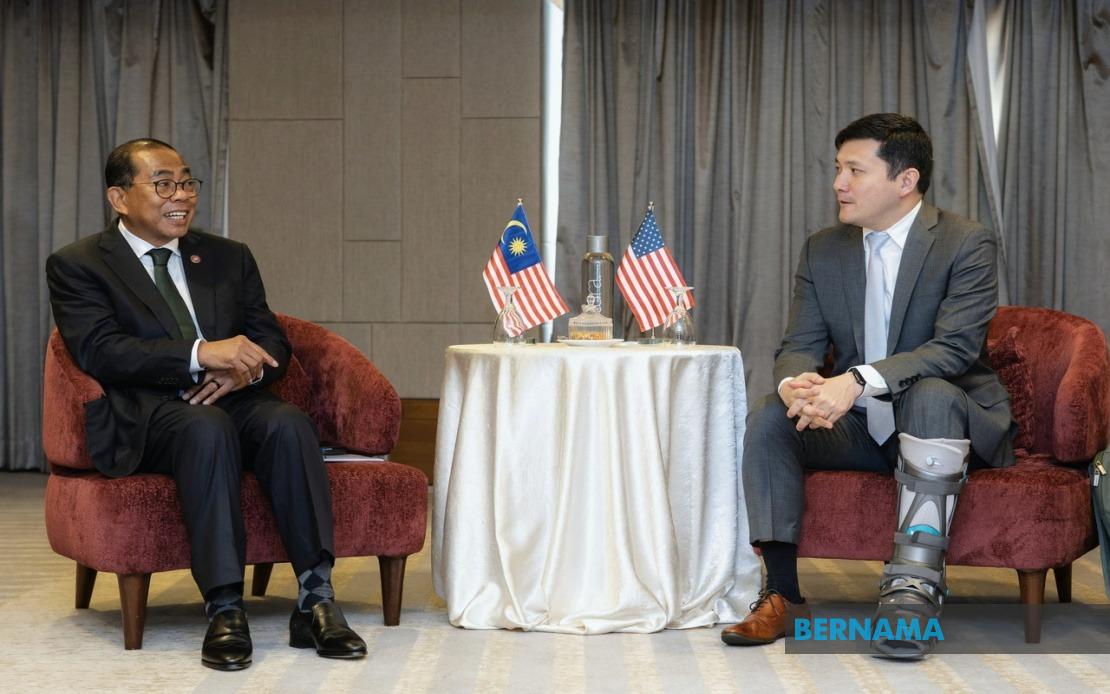
Defence Minister Datuk Seri Mohamed Khaled Nordin has underscored the United States' unwavering commitment to deepening security partnerships with Malaysia, signalling continued American engagement in Southeast Asia's defence landscape during a period of regional strategic competition. The assurance came during a courtesy call from US Ambassador to ASEAN Kevin Kim at the 37th Annual Military Law and Operations Conference in Kuala Lumpur on August 3, reflecting ongoing efforts by Washington to maintain its influence across the strategically vital region.
The meeting between the defence minister and Ambassador Kim concentrated on consolidating existing bilateral defence mechanisms rather than addressing contentious policy questions. Mohamed Khaled noted that the US emphasis on strengthening ties extended across multiple domains, demonstrating that American interest in Malaysia transcends narrowly defined security concerns and encompasses broader strategic alignment. This measured approach by the United States suggests a pragmatic diplomatic strategy designed to avoid complications while building institutional frameworks for deeper cooperation.
Beyond his engagement with the American envoy, Mohamed Khaled received separate delegations from ASEAN and Singapore, reflecting Kuala Lumpur's central role in regional security discussions. These back-to-back meetings underscore Malaysia's significance within both bilateral relationships and multilateral security architecture, particularly as tensions in the Indo-Pacific intensify. The convergence of high-level visitors at the MILOPS conference demonstrates how Malaysia continues to punch above its weight in regional diplomatic circles.
His discussion with ASEAN Secretary-General Dr Kao Kim Hourn centred on the bloc's collective challenges and the pivotal contribution that defence ministries can make toward sustaining ASEAN Centrality—a concept increasingly tested by geopolitical pressures from major powers. Both officials acknowledged that the defence sector occupies a crucial position in upholding regional principles of peace and stability while facilitating prosperity. This recognition reflects growing awareness within ASEAN that military-to-military cooperation can serve as a stabilising force amid intensifying strategic competition.
Malaysia's defence relationship with Singapore took on added significance following Joseph Leong's appointment as Permanent Secretary for Singapore's Ministry of Defence. Leong's courtesy call conveyed Singapore's determination to deepen bilateral defence cooperation, which encompasses not only direct security arrangements between the two neighbours but also broader multilateral frameworks. This multi-layered approach demonstrates how Southeast Asian nations are skilfully leveraging both bilateral and regional mechanisms to advance their security interests.
The scope of Malaysian-Singaporean cooperation extends beyond traditional defence matters to include participation in the Five Power Defence Arrangements, a legacy mechanism involving Australia, New Zealand, and the United Kingdom. This framework, while originating from Cold War-era strategic calculations, remains relevant in contemporary discussions about maritime security and regional stability. Malaysia's participation in FPDA underscores how historical defence ties continue influencing modern security partnerships, even as regional actors seek greater strategic autonomy.
The 37th MILOPS conference, running through August 6, assembled government officials and military representatives from over 30 nations to deliberate on emerging security challenges and harmonise legal standards governing military operations. The breadth of international participation reflects Malaysia's credibility as a convener of multilateral security discussions and its capacity to facilitate dialogue among diverse stakeholders. These conferences provide crucial venues for establishing common understandings about operational principles and conflict prevention mechanisms.
For Malaysian policymakers, the convergence of these defence engagements illustrates the delicate balancing act required in contemporary Southeast Asian diplomacy. Malaysia must simultaneously accommodate strategic interests of major powers—including the United States—while maintaining ASEAN solidarity and protecting its bilateral relationships with neighbours. The emphasis on strengthening ties without addressing divisive policy matters suggests Malaysia is pursuing a gradualist approach to deepening defence partnerships, avoiding commitments that might complicate regional relationships.
The timing of these assurances assumes particular importance amid ongoing uncertainties about Indo-Pacific stability. American commitment to Southeast Asian defence partnerships provides reassurance to regional states concerned about power vacuums or overwhelming influence from any single actor. Malaysia's willingness to host and participate in multilateral defence forums reflects its recognition that regional stability depends on maintaining balanced relationships rather than aligning exclusively with any particular strategic camp.
As major power competition intensifies across the region, Malaysia's defence sector faces mounting pressure to modernise capabilities while maintaining operational interoperability with multiple partners. The convergence of American, ASEAN, and Singaporean defence delegations at the MILOPS conference illustrates how Malaysia has positioned itself as a node within broader security networks spanning the Indo-Pacific. These relationships offer Malaysia opportunities to access advanced defence technologies and expertise while preserving strategic flexibility in an increasingly multipolar environment.
Moving forward, the success of these renewed defence commitments will depend on translating diplomatic assurances into concrete operational cooperation. Malaysia will need to carefully manage the expansion of defence relationships without creating domestic political complications or perceived strategic dependence on external actors. The multi-track approach evident in recent high-level meetings suggests Malaysian defence planners understand that sustainable regional security requires nurturing diverse partnerships simultaneously.

