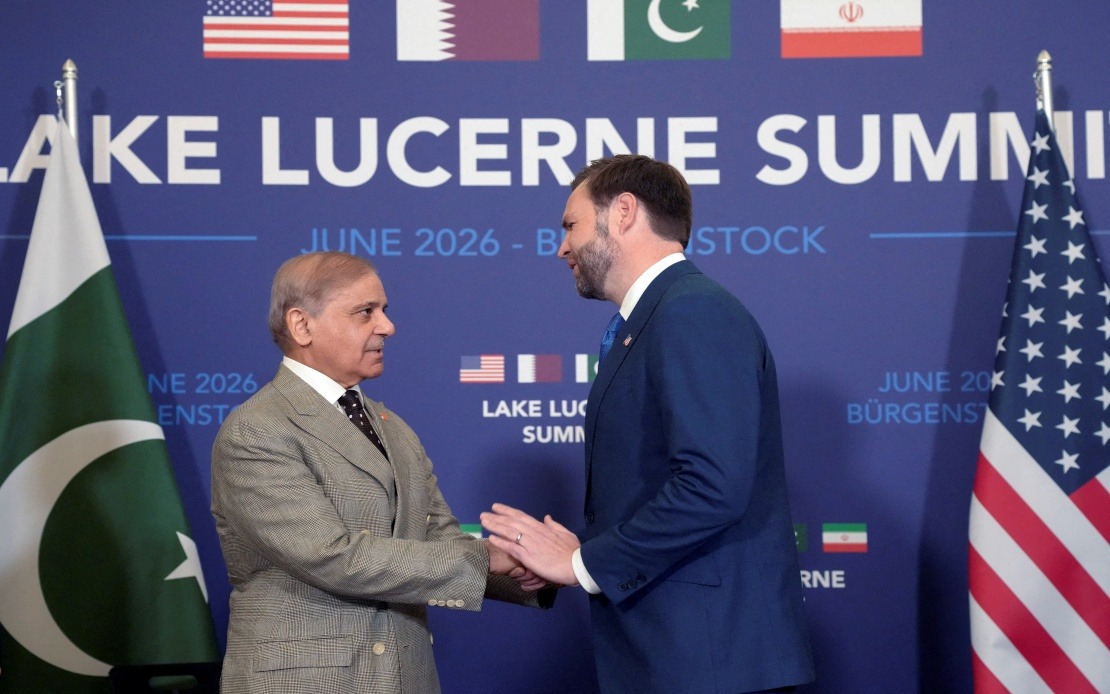
A high-level delegation from the United States met with Pakistani officials in Burgenstock, Switzerland on Sunday, marking an important moment in regional diplomacy during a critical juncture in American-Iranian relations. Vice President JD Vance hosted Pakistan's Prime Minister Shehbaz Sharif and Pakistan Army Chief Field Marshal Asim Munir at the Alpine resort, where special envoys Steve Witkoff and Jared Kushner also participated in the discussions. The encounter took place as part of broader diplomatic efforts unfolding in Switzerland, signalling the strategic importance both Washington and Islamabad place on coordinating their positions during ongoing negotiations with Tehran.
The meeting between American and Pakistani delegations occurred on the margins of technical-level talks involving Iran, the United States, Pakistan, and Qatar—all key players in efforts to stabilise the Middle Eastern security landscape. These technical discussions were scheduled to commence on the same day in closed sessions, indicating the sensitive nature of the negotiations and the need for confidential deliberations among parties working to reach a comprehensive agreement. The gathering of such high-ranking officials from both nations underscores Pakistan's pivotal role as a mediator and stakeholder in resolving one of the region's most consequential disputes.
The diplomatic activity in Burgenstock was anchored in a significant breakthrough achieved just days earlier. On the night of June 18, Iran and the United States remotely signed a memorandum that formally provides for an end to the military conflict that erupted on February 28. This agreement represents a dramatic shift from escalating tensions that threatened broader regional destabilisation and international shipping disruptions. The document's execution, despite being conducted remotely, demonstrates both parties' commitment to de-escalation and their willingness to move beyond the recent confrontation that had heightened anxieties about global energy security and geopolitical stability.
Critical to the memorandum are provisions addressing two major issues that have long complicated US-Iran relations. The agreement establishes specific timelines for the United States to lift its naval blockade, which has significantly impacted Iran's economy and international trade. Simultaneously, it commits Iran to restore shipping activities through the Strait of Hormuz, one of the world's most vital maritime corridors through which roughly one-third of global seaborne oil passes. The restoration of this crucial shipping lane carries profound implications for international commerce, global energy markets, and the broader stability of regional trade networks that Malaysia and other Southeast Asian economies depend upon for their own prosperity.
The nuclear dimension of the dispute, however, remains unresolved and constitutes the centrepiece of ongoing negotiations. Iran has committed under the memorandum to refrain from acquiring nuclear weapons, but the resolution of Iran's broader nuclear programme—a subject of contention for nearly two decades—will be determined through a separate, dedicated agreement. Rather than attempting to resolve this extraordinarily complex technical and political issue immediately, the parties have agreed to pursue negotiations on nuclear matters within a sixty-day timeframe, allowing space for detailed discussions and expert-level consultations.
For Iran, the primary incentive to participate in this diplomatic process centres on sanctions relief. The Iranian government has consistently framed its participation in negotiations as conditional upon the lifting of comprehensive economic sanctions that have severely constrained its access to international financial systems, technology transfers, and markets. The memorandum implicitly acknowledges this Iranian objective, though the specific mechanics and timing of sanctions removal remain to be negotiated in subsequent phases of talks. This aspect of the agreement represents a fundamental trade-off between security assurances from Iran and economic relief for Tehran.
Pakistan's involvement in these negotiations reflects its complex geopolitical position as a neighbour to Iran with significant economic and strategic interests at stake. As a mediating party alongside Qatar, Islamabad has invested considerable diplomatic capital in facilitating dialogue between Washington and Tehran. The presence of Prime Minister Shehbaz Sharif and Pakistan Army Chief Field Marshal Asim Munir in Burgenstock indicates that Pakistan views these negotiations as central to its own regional security calculations and economic prospects. Pakistan's geographic location and historical ties to both the United States and Iran position it as a natural facilitator of dialogue.
The role of special envoys Witkoff and Kushner in leading the American delegation suggests the White House is treating these negotiations with the highest priority and political sensitivity. The involvement of figures with direct access to senior decision-making authority indicates that discussions extend beyond technical details into matters of strategic importance. This level of engagement signals American seriousness about reaching a durable agreement that addresses not merely the immediate military confrontation but the underlying grievances and security concerns that generated the conflict.
For Southeast Asian observers and policymakers, the implications of successful US-Iran rapprochement extend well beyond the Middle East. A stabilised Iran could reduce oil price volatility and restore normalcy to energy markets that significantly affect regional economies. Furthermore, a reduction in regional tensions could decrease the likelihood of broader military escalation that might draw in other powers and create instability affecting global trade routes crucial to Southeast Asian commerce. Malaysia, in particular, has substantial interests in maintaining maritime security and stable energy supplies for its growing economy.
The negotiating framework established through the Burgenstock process also reflects a broader shift toward multilateral approaches to conflict resolution. The inclusion of both Pakistan and Qatar as mediators rather than having the United States and Iran negotiate bilaterally demonstrates recognition that regional partners possess essential legitimacy and influence. This approach contrasts with more unilateral strategies and may offer lessons for other regional disputes where third-party mediation by respected neighbours could facilitate breakthroughs.
The sixty-day nuclear negotiation timeline introduces both opportunity and risk. While extended deliberations allow for thorough examination of technical safeguards and verification mechanisms, extended timelines also provide opportunities for political pressure or domestic opposition to derail progress. Both Washington and Tehran will face domestic constituencies questioning aspects of any agreement, making the next two months a critical test of political will on both sides. The outcomes will shape not only bilateral US-Iran relations but broader Middle Eastern geopolitics for years to come.

