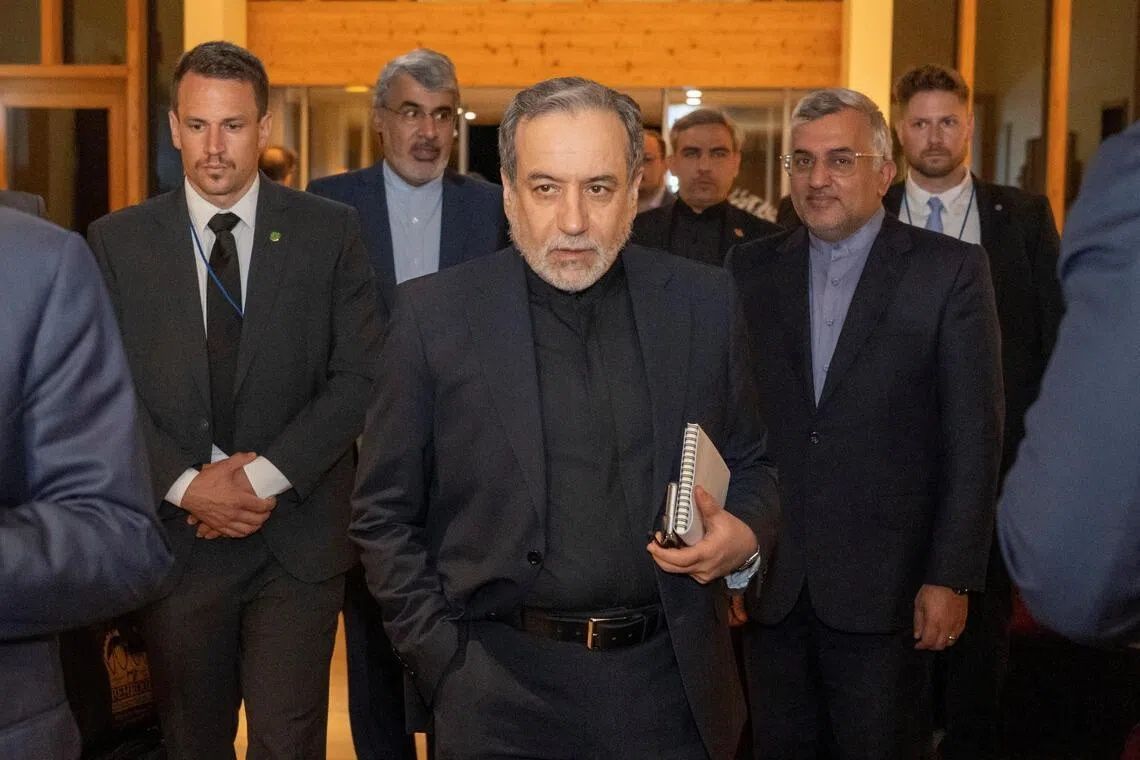
Peace negotiations between the United States and Iran formally commenced on Sunday morning at the Buergenstock resort in Switzerland, marking a significant diplomatic escalation as both powers attempt to establish a lasting end to their four-month conflict. US Vice President JD Vance and Iran's chief negotiator Mohammad Baqer Qalibaf are leading delegations aimed at transforming an interim agreement signed earlier this week by Presidents Donald Trump and Masoud Pezeshkian into a comprehensive settlement. The talks arrive at a critical juncture, with multiple flashpoints threatening to derail negotiations even as diplomats gather in the Swiss Alpine setting.
The negotiating framework rests on a 60-day ceasefire arrangement, during which both nations committed to intensive talks on nuclear matters, regional security, and economic arrangements. However, the agreement's fragility became evident immediately when Iran's Islamic Revolutionary Guard Corps declared the Strait of Hormuz closed on Saturday in retaliation for Israeli military operations in Lebanon. This unilateral assertion contradicted American military observations that commercial shipping continued transiting the waterway, setting the tone for contentious discussions ahead. The dispute over the strait's status carries enormous implications for global energy markets, as the passageway traditionally carries approximately one-fifth of the world's oil supplies.
The composition of delegations reflects the seriousness both sides attach to these proceedings. The American team extends beyond Vance to include envoys Steve Witkoff and Jared Kushner, the latter serving as Trump's son-in-law and a trusted advisor. Iran's delegation encompasses Foreign Minister Abbas Araqchi alongside senior officials from security, banking, and petroleum sectors, underscoring Tehran's intention to address not merely political issues but the economic dimensions of any settlement. Pakistan's Prime Minister Shehbaz Sharif and military chief Field Marshal Syed Asim Munir have arrived to participate as mediators, their presence reflecting Pakistan's crucial role in brokering the initial agreement and its ongoing stake in regional stability.
The Strait of Hormuz disagreement represents far more than rhetorical posturing. Iran's claim that it has sealed this chokepoint appears designed to pressure negotiators whilst establishing leverage for future discussions, particularly regarding sanctions relief and economic cooperation. US Central Command reported that 55 merchant vessels successfully transited the strait on Saturday alone, carrying over 17 million barrels of crude destined for global markets, directly contradicting Iranian assertions of closure. President Trump has taken the opportunity to introduce a novel proposal: guaranteeing free passage through the strait during the 60-day negotiation period, but suggesting that the United States might levy a toll afterwards if peace efforts fail—framing American military presence as a service for which compensation could reasonably be demanded.
Lebanon's precarious ceasefire threatens to unravel even as negotiations commence. Despite a truce taking effect, Israeli and Hezbollah forces engaged in mutual attacks on Saturday, with Israeli strikes reportedly killing twenty civilians according to Lebanese civil defence sources. This escalation directly undermines one of the primary conditions that both the US and Iran established for beginning broader nuclear and strategic talks. Israel maintains an ambiguous position, claiming commitment to the ceasefire whilst refusing to withdraw from occupied Lebanese territory and reserving the right to respond to any perceived threats. Hezbollah, backed by Iranian military support, has declared it will not tolerate Israeli freedom of movement in the country, creating a powder keg of competing declarations and military postures.
The Lebanese casualty toll since March represents the human cost of the region's ongoing militarization. Lebanon's health ministry documents 4,057 deaths from Israeli operations since early March, encompassing medical personnel, women, and children, though the breakdown between civilian and combatant casualties remains unclear. Israeli forces report losing 32 soldiers and four civilians in exchanges with Hezbollah, figures substantially lower than the Lebanese toll but nonetheless significant given the conflict's relatively short duration. These disparities highlight the asymmetrical nature of modern Middle Eastern conflicts and raise questions about proportionality and civilian protection that will inevitably surface during broader peace discussions.
Public opinion in Israel presents another complication for negotiators. A Hebrew University poll reveals that approximately 92 percent of Israelis believe Iran has emerged as the conflict's primary beneficiary relative to Israel, with fewer than 8 percent viewing their nation as victorious. Nearly 90 percent of respondents indicated that stated war objectives remain unmet, and less than 30 percent accept Prime Minister Benjamin Netanyahu's claims of major accomplishments. This substantial disconnect between government messaging and public perception constrains Netanyahu's negotiating flexibility, particularly if talks demand Israeli territorial concessions or acceptance of Iranian regional influence restoration.
Iranian negotiators have signalled their own conditions for progress. Mohammad Mokhber, an advisor to Supreme Leader Ayatollah Mojtaba Khamenei, has accused the United States of failing to implement the first of fourteen points in the peace agreement, specifically the comprehensive ceasefire that should encompass all fronts including Lebanon. Mokhber suggests that without authentic implementation on the ground, Iran will maintain restrictions on energy exports and the reopening of crucial waterways, effectively holding Middle Eastern oil supplies hostage to negotiation outcomes. This stance demonstrates Iran's determination to extract maximum concessions by weaponizing energy supplies, a traditional tool of leverage for OPEC members facing Western pressure.
Conversely, Iran's Oil Minister Mohsen Paknejad has suggested a more cooperative posture, indicating that if Western parties honour the agreement's spirit, hundreds of investment opportunities and contract frameworks await activation. This apparent contradiction between hardline and pragmatic rhetoric reflects internal Iranian debates about the peace process itself, with competing factions within Tehran's leadership struggling to define negotiating positions. The presence of multiple institutional actors—security forces, banking authorities, petroleum officials—in the Swiss delegation ensures that Iran's negotiating team carries considerable internal pressure to protect various sectoral interests whilst pursuing national reconciliation objectives.
The geopolitical implications extend far beyond the immediate parties. Malaysia and other Southeast Asian economies remain heavily dependent on stable Middle Eastern energy supplies, making the Strait of Hormuz closure threat directly consequential for regional energy security and inflation trajectories. Any sustained disruption to oil flows through this strategic waterway would inevitably trigger price spikes affecting Malaysia's cost of living, manufacturing competitiveness, and government revenues. Similarly, regional stability in the Middle East influences broader international security architectures, including trade routes, investment patterns, and the operational environment for multinational corporations with significant Southeast Asian operations.
The negotiating agenda encompasses nuclear matters alongside ceasefire implementation and regional security architecture. American insistence on addressing Iran's nuclear programme reflects longstanding Western concerns about Tehran's uranium enrichment activities and potential weapons development pathways. Iran counters that its nuclear programme remains entirely peaceful and subject to International Atomic Energy Agency inspections, positioning any restrictions as infringements on sovereign technological development rights. These disagreements touch on fundamental issues of state sovereignty versus international non-proliferation norms, disputes that have resisted resolution through previous diplomatic channels and Geneva agreements.
Vance has publicly expressed confidence in the ceasefire's durability and claimed to have observed no evidence of actual Strait of Hormuz closure, statements that appear designed to project confidence whilst subtly challenging Iran's narrative control. This rhetorical positioning suggests American strategy emphasizes momentum and perception management, attempting to move negotiations forward despite contradictory claims about operational realities on the ground. The next several days will prove crucial in determining whether initial diplomatic progress can overcome the mounting evidence of continued military operations in Lebanon and competing interpretations of what the preliminary agreement actually obligates each party to accomplish.
The Buergenstock setting itself—a scenic Swiss mountaintop accessible by narrow roads and secured by armed checkpoints—creates both symbolic and practical conditions for intensive negotiations. The isolation from external political pressures and media scrutiny may facilitate candid discussions, whilst the resort's neutral Swiss hosting provides diplomatic cover for both American and Iranian delegations to engage without appearing to surrender principle or legitimacy. Whether this carefully constructed environment can overcome the fundamental conflicts embedded in decades of US-Iran hostility, Israeli-Palestinian tensions, and regional proxy warfare through Hezbollah and other militias remains the central question as substantial talks commence.

