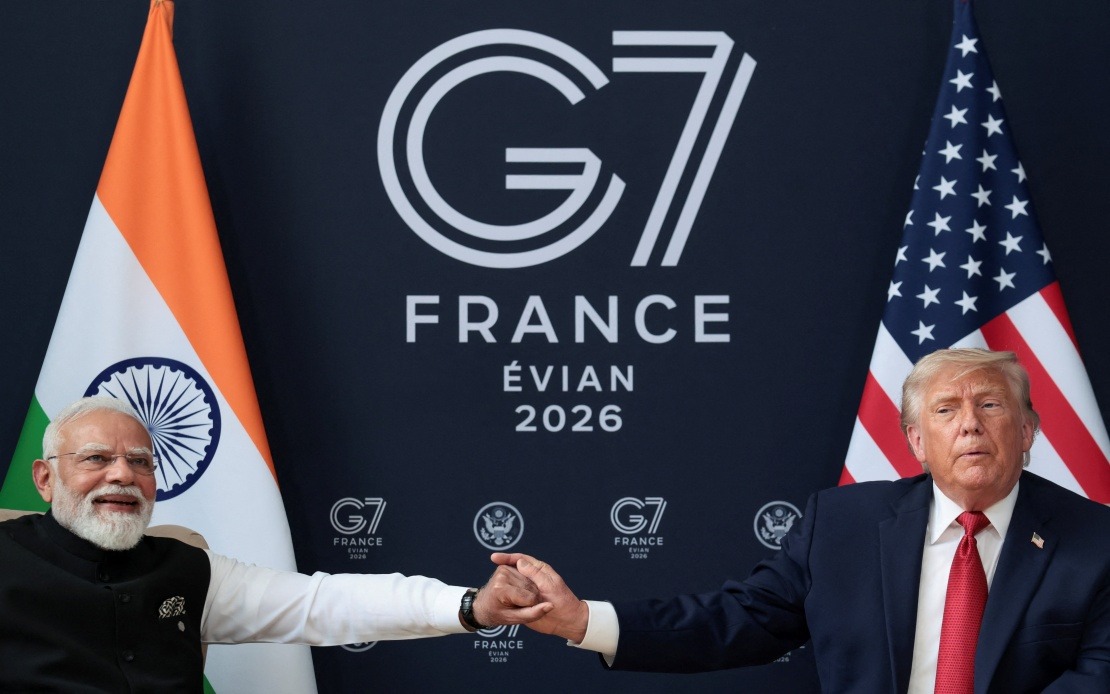
India's government has announced substantial advancement in trade negotiations with the United States, signalling renewed momentum in a dialogue that has stretched across multiple administrations and geopolitical shifts. The breakthrough emerged from discussions between Prime Minister Narendra Modi and US President Donald Trump during their bilateral meeting on the sidelines of the Group of Seven summit held in Evian, France on Wednesday, touching on economic ties that have become increasingly central to Indo-American strategic partnership.
Both nations have publicly committed to crafting an interim trade agreement that balances commercial interests with mutual benefit, according to a statement released by India's External Affairs Ministry. The language chosen—emphasising satisfaction with progress and instructing officials to accelerate work—reflects recognition that trade tensions between the world's largest and fifth-largest economies require sustained, high-level attention. This diplomatic framing suggests both sides view a deal as strategically important beyond mere tariff schedules, reflecting broader geopolitical considerations in the Indo-Pacific region.
The immediate next step involves a visit to India by US Trade Representative Jamieson Greer in the coming week, indicating that negotiators will press ahead without delay. Greer's visit carries symbolic weight as well as practical significance, demonstrating Washington's commitment to resolving outstanding issues despite broader trade friction that has characterised the Trump administration's approach to global commerce. For Indian negotiators, the presence of a senior US trade official signals an opportunity to lock in concessions while political will remains high at the presidential level.
Trump's characterisation of Modi as "one of the toughest" negotiators offers insight into how the American president views the Indian leader's approach to these discussions. The remarks, made in a seemingly complimentary tone, underscore the competitive nature of trade negotiations while suggesting respect for India's refusal to capitulate to American demands. Trump's observation that Modi "looks like an angel" but is "as tough as a killer" reflects the reality that beneath diplomatic courtesy lies hard-nosed bargaining over market access, tariffs, and industrial policy priorities that diverge significantly between the nations.
The historical context of these negotiations reveals their complexity. Earlier this year, both countries reached an interim trade agreement under which the United States reduced tariffs to 18 per cent on certain Indian products, representing a partial rollback of earlier restrictions. However, the broader trade environment deteriorated when Trump implemented 25 per cent tariffs across Indian exports and added a further 25 per cent penalty specifically targeting Indian purchases of Russian oil. These moves created leverage for negotiations but also highlighted the tension between India's energy security interests and American foreign policy objectives regarding Russia.
For Malaysian and Southeast Asian observers, the India-US trade dynamics carry regional implications. A successful comprehensive trade agreement could signal that the Trump administration is willing to differentiate between trading partners based on strategic alignment, potentially opening space for other nations to negotiate similar arrangements. Conversely, if negotiations stall, it might indicate that American trade policy remains fundamentally protectionist, with limited flexibility even for valued partners in regions of strategic importance.
India's negotiating position reflects its dual imperatives: maintaining energy ties with Russia while deepening economic integration with the West. The additional penalty tariff on Russian oil purchases represents American pressure on this exact point, making any final trade deal a test of how New Delhi can balance non-aligned principles with deepening US partnership. This constraint distinguishes India's trade negotiations from those of other major economies and suggests that any agreement will involve implicit or explicit understandings about India's foreign policy orientation.
The interim nature of the proposed agreement is itself noteworthy. Rather than pursue a comprehensive agreement immediately, both nations appear to have opted for a phased approach, allowing officials to resolve easier issues first while building momentum. This pragmatic sequencing recognises that comprehensive deals covering all sectors and sensitive industries require extended negotiation, whereas an interim framework can unlock benefits relatively quickly while demonstrating goodwill to domestic constituencies awaiting results.
For Indian exporters and manufacturers, the stakes are substantial. Tariff reductions on textiles, pharmaceuticals, agricultural products, and engineering goods could expand market access to the American economy. Indian services providers, particularly in information technology and business process outsourcing, may also benefit from improved visa provisions or commitments on digital trade. American firms, meanwhile, are seeking greater access to India's vast consumer market and clearer intellectual property protections for technology and agricultural biotechnology exports.
The timeline for concluding negotiations remains crucial. Officials have been instructed to work towards completion at the earliest possible time, but no specific deadline has been announced. The absence of a public deadline reflects the complexity of harmonising regulations and resolving disputes over agricultural subsidies, environmental standards, and labour practices—issues that have derailed previous trade agreements in other contexts. Whether officials can move swiftly enough to deliver results before political attention shifts elsewhere will determine whether this period of progress translates into a concrete agreement.
Regionally, how the US-India trade relationship evolves will influence broader Asian trade architecture. Other nations are watching to assess whether bilateral agreements represent a viable path forward or whether multilateral frameworks remain necessary. The India-US negotiation thus carries significance extending far beyond bilateral commerce, touching on fundamental questions about the future organisation of Asian trade and the role of major powers in shaping regional economic rules.