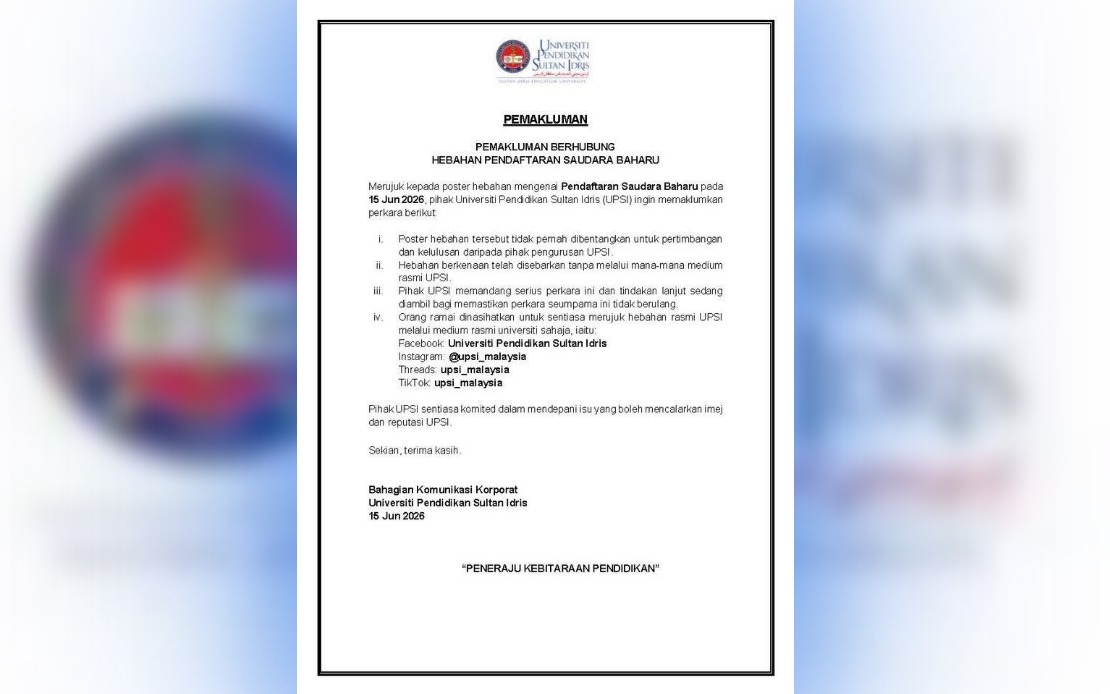
Universiti Pendidikan Sultan Idris (UPSI) has issued a statement rejecting any connection to a poster about registering 'saudara baharu' or newly converted Muslims that gained traction across social media platforms in mid-June. The institution stressed that the document, dated June 15, never received administrative review or formal approval from the university's leadership, nor was it distributed through any sanctioned UPSI communication mechanism.
The emergence of unauthorised materials purporting to represent an educational institution reflects a growing concern across Malaysian universities about content falsely attributed to their names. Such incidents can rapidly damage institutional credibility, particularly when they touch on sensitive religious or social matters. UPSI's swift public response demonstrates an awareness of how quickly viral posts can shape public perception, regardless of their actual origin or veracity.
In its official statement disseminated through verified social media accounts, UPSI made clear that it takes the matter seriously and indicated that organisational measures would be implemented to prevent similar incidents going forward. The university appealed to the general public to rely exclusively on announcements distributed through its formally recognised channels rather than unverified content circulating on social networks. This guidance reflects broader institutional concerns about misinformation in the digital age.
The university further underscored its commitment to protecting its institutional image and reputation against any developments that could undermine public trust or institutional standing. For an education-focused organisation like UPSI, maintaining credibility is fundamental to its operations, student recruitment, and community relationships. The statement thus carries the tone of an institution determined to establish clear boundaries between official communications and grassroots or bad-faith attempts to speak in its name.
The incident raises important questions about digital identity verification and the ease with which institutional logos, names, and credibility can be appropriated online. In Malaysia's context, where social media remains a primary information distribution channel for many citizens, the responsibility falls on both institutions and individual users to verify sources before sharing content that claims official status. The viral nature of such posts means that damage can occur rapidly, even when the falsity is subsequently clarified.
UPSI's emphasis on directing the public to official channels highlights the digital literacy challenge facing Malaysian institutions. Universities increasingly must educate stakeholders about distinguishing legitimate communications from imposters. This becomes especially critical when content addresses topics like religious conversion, which carries social and community significance and can prompt emotional responses that bypass critical evaluation.
The broader context includes growing sophistication in how false or unauthorised materials gain credibility by association with established institutions. Some posts may originate from well-meaning students or staff members acting without approval, while others might be deliberately created to misrepresent an organisation's positions. Without additional details about how this particular poster was generated and distributed, the university's measured response focuses on establishing the fact of its unauthorisation and disassociating the institution from its content.
For Malaysian higher education institutions, the incident underscores the need for robust digital governance frameworks that can quickly detect, respond to, and mitigate unauthorised material appearing under institutional names. Many universities have since implemented protocols requiring official approval for materials released under institutional identities, with clearer guidelines about which departments and individuals possess authority to speak publicly on behalf of the organisation.
The timing and subject matter of the poster warrant consideration within Malaysia's contemporary social landscape. Religious conversion and integration of converts into Muslim communities remain topics of active community engagement and institutional interest. When materials on such subjects appear under university names without authorisation, they risk creating misunderstandings about institutional positions on sensitive issues, potentially affecting various stakeholder groups including students, parents, and religious communities.
UPSI's stance aligns with standard institutional practice across Malaysian universities when confronted with similar situations. The combination of a clear denial, an assurance of corrective action, and guidance to the public represents a textbook approach to managing unauthorised attribution. However, the incident also illustrates the asymmetry inherent in digital communication: creating and spreading false institutional materials requires minimal effort and resources, while adequately addressing the resulting reputational damage demands sustained institutional engagement and public messaging.
Looking forward, universities across Southeast Asia face mounting pressure to develop more sophisticated approaches to digital credibility and institutional communication security. This extends beyond simply issuing denials to encompassing proactive authentication systems, regular stakeholder education, and partnerships with social media platforms to expedite removal of false institutional materials. UPSI's response, while appropriate, represents just the opening move in what is becoming an ongoing institutional challenge across the region's higher education sector.