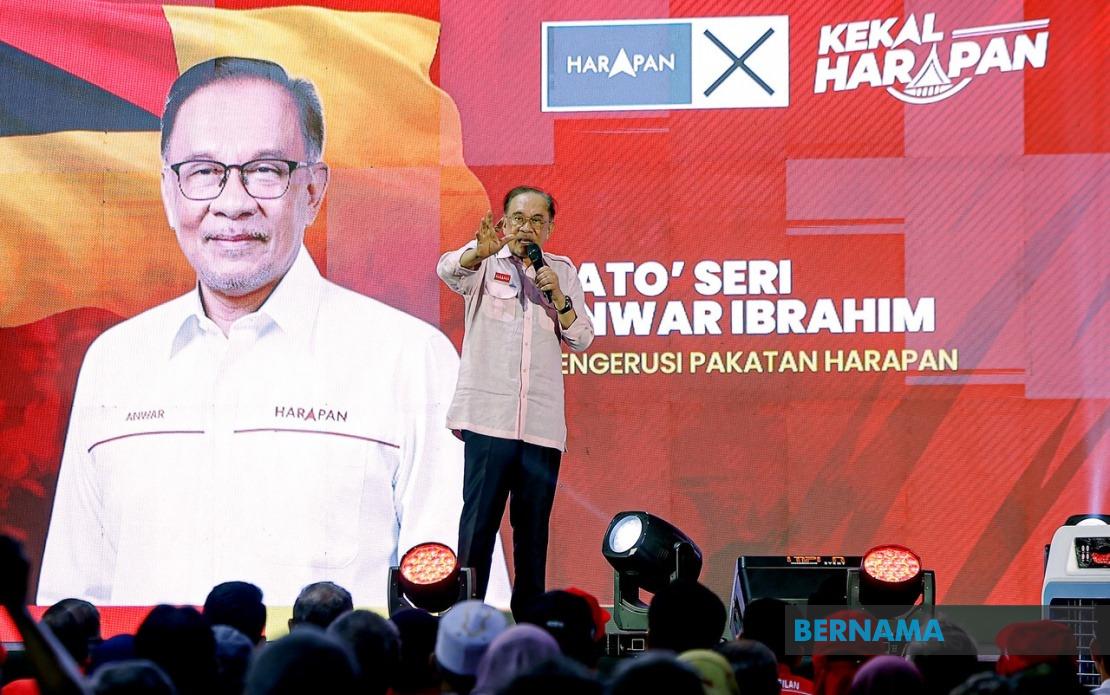
Prime Minister Datuk Seri Anwar Ibrahim has reaffirmed that the Unity Government maintains its cohesion and strength at the Federal level, dismissing concerns that internal strains could threaten the stability of Malaysia's administration and economic trajectory. Speaking in Seremban on July 22, the Premier emphasised that despite divergent interests among coalition partners at the state level, the Federal Government continues to function effectively with mutual cooperation and shared commitment to national interests.
The co-operation between parties in the Unity Government coalition demonstrates resilience through the consistent and orderly execution of Cabinet meetings, which Anwar highlighted as a barometer of governmental functionality. He noted that these regular high-level gatherings proceed without disruption, featuring productive engagement among ministers from different political parties working toward consensus on critical policy matters. This operational coherence contrasts with the inevitable competition that erupts when the same coalition partners contest elections in various states, where electoral dynamics occasionally create friction.
Anwar drew a deliberate distinction between challenges at the state and Federal levels, acknowledging that territorial politics occasionally generate tensions but insisting these do not cascade into Federal-level dysfunction. The Prime Minister suggested that while state elections and local political rivalries may produce contentious moments, the architects of the Unity Government have built sufficient institutional safeguards to prevent such disputes from destabilising the national administration. This compartmentalisation reflects a pragmatic understanding that electoral competition and governance require different operating principles within a coalition framework.
Recent Cabinet proceedings underscore this stability, with Anwar recounting that he conducted regular ministerial sessions alongside Agriculture and Food Security Minister Datuk Seri Mohamad Sabu, Transport Minister Anthony Loke, Deputy Prime Minister Datuk Seri Dr Ahmad Zahid Hamidi, and other senior officials. The normality with which these high-stakes meetings occur, bringing together leaders from potentially competing political factions, demonstrates the institutional maturity the coalition has developed since its formation following the 2022 general election.
The maintenance of Federal-level stability carries significant economic implications for Malaysia and the broader region. Investor confidence hinges substantially on political predictability and the absence of institutional paralysis. Anwar stressed that disruptions to government function would inevitably undermine economic growth prospects and deter foreign direct investment, which remains crucial for Malaysia's development ambitions. By explicitly linking governmental stability to economic performance, the Prime Minister articulated the coalition's understanding that internal cohesion is an asset with tangible value beyond politics.
The Prime Minister's comments emerge as Malaysia navigates the periodic tensions inherent in multi-party coalitions. The Unity Government, comprising Pakatan Harapan, Barisan Nasional, and several other parties, represents an unprecedented political alignment designed to provide stable governance and prevent any single faction from dominating. However, such arrangements require constant management and mutual restraint, particularly when election cycles create competing pressures.
Anwar's emphasis on safeguarding Federal stability reflects conscious effort to prevent escalation of any friction into systemic crisis. He employed religious language when expressing hope that the arrangement would persist after upcoming elections, signalling that maintaining unity transcends partisan calculation and touches upon a deeper commitment to national welfare. This rhetorical strategy reinforces the coalition's public positioning as stewards of stability rather than mere political conveniences.
The contrast between state and Federal dynamics offers insight into how Malaysian politics has evolved. Previously, single-party dominance meant that state and Federal interests typically aligned. The current fragmented landscape requires deliberate institutional design to prevent territorial tensions from undermining central government function. The Unity Government's apparent success in managing this separation suggests that coalition politics, though more complex, can deliver stable outcomes when all parties recognise mutual interest in maintaining the system.
For Malaysia's business community and foreign investors, Anwar's assurances directly address concerns about political uncertainty that could affect long-term planning and capital deployment. Multinational corporations and large-scale projects depend on predictable policy environments and functioning bureaucracies. The Prime Minister's effort to emphasise Federal robustness signals that despite occasional state-level turbulence, the foundations of Malaysia's governance remain sound.
The broader Southeast Asian context reinforces the significance of Malaysia's political stability. The region has experienced various episodes of governmental disruption in recent decades, making functional coalition governance increasingly valuable. Malaysia's experience in managing the Unity Government could offer lessons for other diverse democracies navigating similar challenges. The ability to separate electoral competition from executive function, while maintaining ministerial cooperation, represents a model worth studying for regional and global observers of democratic practice.
Looking forward, the Prime Minister's comments suggest that the coalition partners have collectively committed to preventing state-level conflicts from spilling into Federal administration. This compartmentalisation requires discipline and mature political culture, but appears to be taking root. However, challenges will inevitably test this arrangement, particularly if electoral outcomes produce dramatic shifts in state-level representation or if policy disputes emerge on issues of national importance. The stability Anwar described remains real but contingent upon continued commitment from all coalition members to preserving the institutional boundaries that currently prevent escalation.

