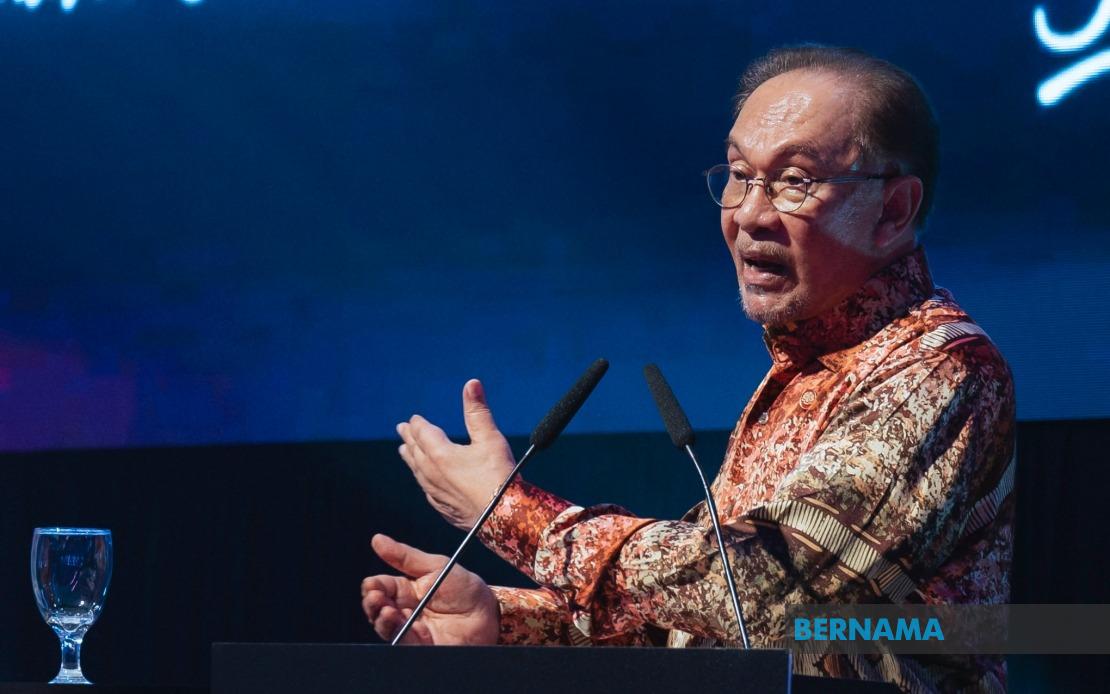
Prime Minister Datuk Seri Anwar Ibrahim's recent commentary on Taiwan generated significant controversy, particularly his acknowledgement of China's position regarding the use of force should peaceful reunification efforts ultimately fail. Yet interpreting these remarks as an endorsement of military conflict fundamentally misses the strategic logic he was articulating. Instead, his position reflects a sophisticated understanding of deterrence theory and the way sovereign states approach the question of territorial integrity in international relations.
Anwar's core argument rests on a principle applicable across the global system: no government willingly accepts the dismemberment of its territory or political federation without active resistance. He deployed Malaysia itself as an instructive analogy, positing that Malaysian authorities would never passively tolerate the breakup of the federation. This comparison was deliberate and revealing, designed to help audiences understand how Beijing views the Taiwan question not as an abstract geopolitical dispute but as a fundamental matter touching on national sovereignty and territorial wholeness.
The distinction between reserving the capacity for force and actually wielding it lies at the heart of this argument. A state that renounces military options entirely may inadvertently undermine its own security posture. By pre-committing to non-use of force, a government eliminates what strategists call the "credible possibility of action"—the notion that consequences exist for attempts to partition or coerce the state. Conversely, maintaining the option of military response, even while prioritising dialogue and diplomatic settlement, preserves deterrence. The paradox of effective deterrence is that the threat of force, if credible, often prevents its actual employment.
This logic does not mean military action becomes a first resort or preferred option. Quite the opposite. Anwar emphasised that negotiation, legal frameworks, and political settlements should always precede any resort to force. The sequence matters profoundly: peaceful means must be exhausted and shown to be genuinely ineffective before military options enter consideration. Yet renouncing those options preemptively creates a dangerous asymmetry. An aggressor knows that coercion will face no armed response, fundamentally altering the strategic calculus in their favour.
Within Malaysia's official diplomatic framework, which recognises the People's Republic of China and maintains the One China policy, Anwar's reasoning finds coherent expression. Malaysia does not treat Taiwan as a separate sovereign state in formal diplomatic relations, even while fostering substantial economic ties and people-to-people exchanges. Having adopted this political posture, Malaysia cannot simultaneously delegitimise Beijing's concern over territorial integrity without exposing a fundamental inconsistency. If Malaysia truly accepts One China as policy, it must acknowledge the legitimacy of China's desire to resolve the Taiwan question, however one might evaluate the appropriateness of various methods.
Taiwan's own perspective presents an entirely different framework. Taipei views itself as a sovereign democracy with its own political legitimacy independent of Beijing's historical narratives. From Taiwan's standpoint, any invocation of force against the island—even framed as a deterrent—risks normalising coercion against a democratic population. This viewpoint carries considerable moral and political weight in democratic societies and among nations valuing self-determination. The tension between these perspectives cannot be wished away or resolved through semantic nuance.
Yet understanding Anwar's remarks requires resisting the temptation to interpret deterrence arguments as warmongering. Classical deterrence theory, developed during the Cold War and refined across decades of strategic analysis, holds that visible capability and willingness to respond can actually prevent conflict by making aggression too costly. When successfully implemented, deterrence works through dissuasion—the potential adversary chooses not to attempt aggression precisely because the costs would be prohibitive. The nuclear standoff between superpowers, whatever one thinks of its wisdom, operated on this principle: mutually assured destruction was designed to prevent war rather than facilitate it.
China's own strategic positioning explicitly rests on deterrence logic. Chinese strategists have articulated the view that uncertainty about how Beijing would respond to successful Taiwanese independence actually discourages separatism on the island. If Taiwan's leadership believed independence was feasible without Beijing's military response, the incentive structure would shift dramatically. Maintaining ambiguity about military options thus serves a stabilising function from Beijing's perspective—it deters action that Beijing views as destabilising.
For Malaysia and the broader Southeast Asian region, however, the Taiwan Strait represents a profound vulnerability. Any serious conflict in those waters would devastate regional trade networks, disrupt semiconductor supply chains that feed global manufacturing, and shatter the carefully calibrated balancing act that ASEAN has maintained between major powers. The economic and strategic costs would be incalculable, affecting prosperity across the region including Malaysia's own economic interests. This reality underscores why Malaysian policy must consistently champion restraint, dialogue, and peaceful mechanisms for managing cross-strait tensions.
Anwar's careful framing actually reflects this concern. His remarks should not be misread as abandoning Malaysia's preference for peaceful resolution or as shifting toward support for military solutions. Rather, they represent an attempt to explain why Beijing takes the Taiwan question seriously—not as a mere rhetorical position but as touching fundamental aspects of national integrity. Understanding why an actor behaves as it does, even when one disagrees with that behaviour, is essential to effective diplomacy.
Malaysia's balanced position, therefore, involves several simultaneous commitments. First, maintaining the One China policy framework that structures Malaysia's diplomatic posture toward both Beijing and Taipei. Second, continuing to oppose military coercion and supporting peaceful, negotiated solutions to cross-strait disputes. Third, ensuring that Malaysian rhetoric does not inadvertently validate military solutions while still acknowledging the genuine anxieties both sides harbor. This requires intellectual clarity and rhetorical precision—distinguishing between explaining why Beijing maintains certain positions and endorsing those positions.
The underlying principle is fundamentally sound: states maintain capacity for military defence not because they eagerly anticipate its use but because facing potential dismemberment unprepared is strategically indefensible. A nation that cannot defend itself against coercion becomes vulnerable to it. This does not justify aggressive war or the initiation of conflict, but it does explain why even peaceful-minded governments retain military capabilities and maintain the option of force as a last resort. Malaysia, having accepted One China as policy, cannot reasonably expect Beijing to adopt a posture of complete military disarmament regarding what it considers a provincial matter. Anwar's remarks, properly understood, articulate this difficult reality rather than celebrating it.

