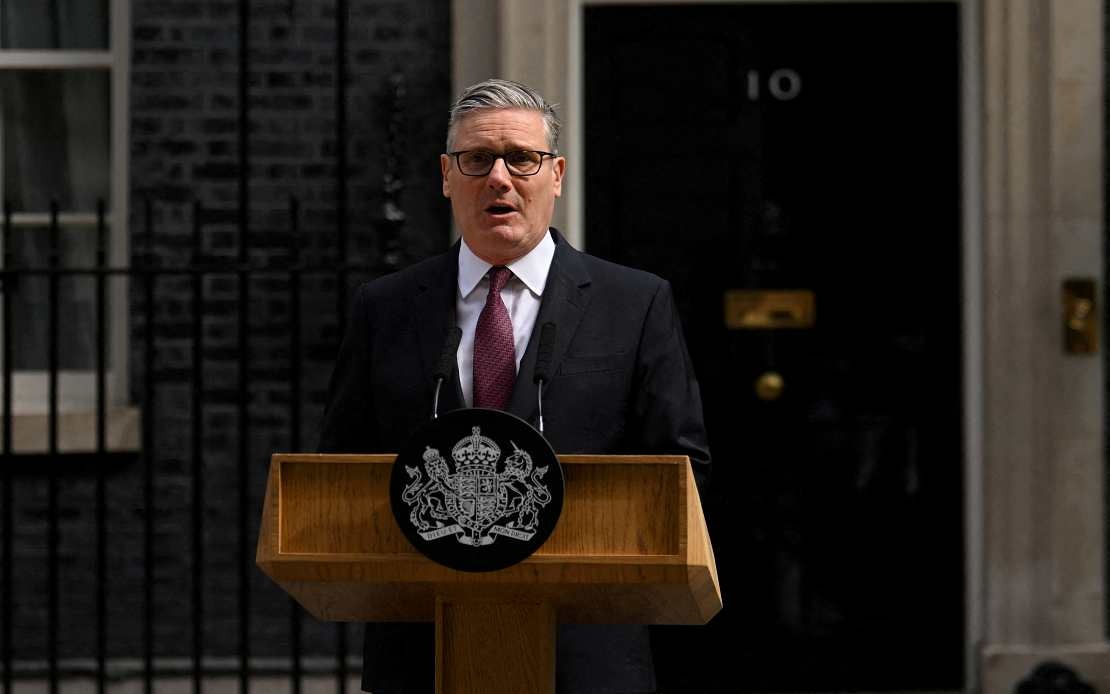
British Prime Minister Keir Starmer has made an urgent appeal for renewed peace negotiations between Iran and the United States, as tensions in the Persian Gulf threaten to destabilise one of the world's most critical shipping routes. Speaking at a joint press conference in Paris following a coalition meeting with French, German and Ukrainian leaders, Starmer expressed grave concern over the escalating military standoff that has effectively closed the Strait of Hormuz to international commerce.
The prime minister unequivocally condemned what he characterised as Iranian aggression, specifically targeting attacks launched by Tehran on commercial vessels and allied nations in the Gulf region. Starmer made clear that such military strikes must cease immediately if stability is to be restored. His remarks underscore deepening Western alarm at the deteriorating security situation, which threatens not only regional peace but also global energy security and trade flows through one of the world's most economically vital waterways.
Starmer signalled that Britain stands ready to take concrete steps to resolve the crisis, indicating London's willingness to deploy naval and logistical assets to facilitate the resumption of safe maritime passage through the Strait of Hormuz. This commitment reflects a broader Western determination to maintain freedom of navigation in international waters and prevent any single nation from controlling access to critical trade routes. The British position aligns with established international law principles governing maritime freedom and reflects concern that unilateral blockades could set dangerous precedents for global commerce.
The immediate trigger for the renewed tensions stems from a sharp escalation in US-Iran hostilities over the weekend. President Donald Trump announced that the United States was "reinstating" a blockade targeting Iran and declared that American forces would charge commercial vessels a fee for safe passage through the Strait of Hormuz. This assertion of control over the waterway represents a significant hardening of American policy and has provoked reciprocal Iranian military responses, creating a dangerous cycle of tit-for-tat escalation.
The current crisis originated from the broader Israeli-Palestinian conflict that intensified in late February, when Iran effectively closed access to the Strait of Hormuz in response to the escalating war. The waterway, which connects the Persian Gulf to the Gulf of Oman and ultimately the Arabian Sea, serves as the conduit for approximately one-third of global maritime oil trade. Control over this passage carries enormous geopolitical and economic significance, making any disruption to shipping patterns a matter of international concern.
Significantly, a breakthrough had appeared imminent just weeks earlier. In June, major parties signed a memorandum of understanding aimed at ending the underlying conflict, which had raised hopes that the Strait of Hormuz would reopen fully to international shipping and normalcy would be restored. That agreement suggested a pathway toward de-escalation and regional stability. However, the current renewed hostilities indicate that fundamental disputes remain unresolved and that goodwill agreements have proven insufficient to prevent military confrontation.
For Southeast Asian nations including Malaysia, the implications of prolonged Strait of Hormuz disruption are substantial. As major importers of Middle Eastern crude oil and significant participants in Asian maritime trade networks, countries throughout the region face potential energy price spikes and supply chain disruptions if the security situation deteriorates further. The strait serves as a crucial passage for vessels transiting between Europe, the Middle East, and Asian markets, making any sustained closure economically damaging to regional economies.
Starmer's call for resumed negotiations alongside guarantees of unrestricted freedom of navigation reflects a diplomatic strategy aimed at de-coupling the two issues—ending the underlying conflict while separately establishing absolute maritime security protections. This approach acknowledges that political settlements take time to negotiate, but insists that commercial shipping cannot become collateral damage in geopolitical disputes. The British position essentially argues that open waterways should be treated as non-negotiable foundations for international commerce, regardless of political differences between nations.
The involvement of French and German leaders in the Paris coalition meeting indicates broader European determination to resolve the crisis through coordinated diplomacy rather than military confrontation. European nations, heavily dependent on Gulf oil supplies and with significant maritime trade interests, have strong incentives to restore stability quickly. The inclusion of Ukrainian representation signals that Western allies view the Iran-US standoff through the lens of broader geopolitical competition and the importance of maintaining united Western positions on international law and maritime freedom.
Despite diplomatic efforts, the current trajectory suggests deepening entrenchment. Trump's announcement of a unilateral blockade and fee collection scheme appears designed to impose maximum economic pressure on Iran, suggesting the American administration views coercive measures as more likely to achieve policy objectives than negotiation. Iran's military responses indicate it will not accept such pressure passively. This dynamic creates genuine risks of miscalculation or accidental escalation that could trigger wider regional conflict.
The broader context reveals fundamental disagreement over the legitimacy of various parties' claims to control the Strait of Hormuz and the principle of whether economic leverage can be applied through controlling maritime passages. Iran argues it has defensive rights in regional waters, while the United States and its Western allies insist on absolute freedom of navigation. These competing visions of international maritime law lie at the heart of the dispute and suggest that technical ceasefire agreements, however urgent, may not address root causes of tension.

