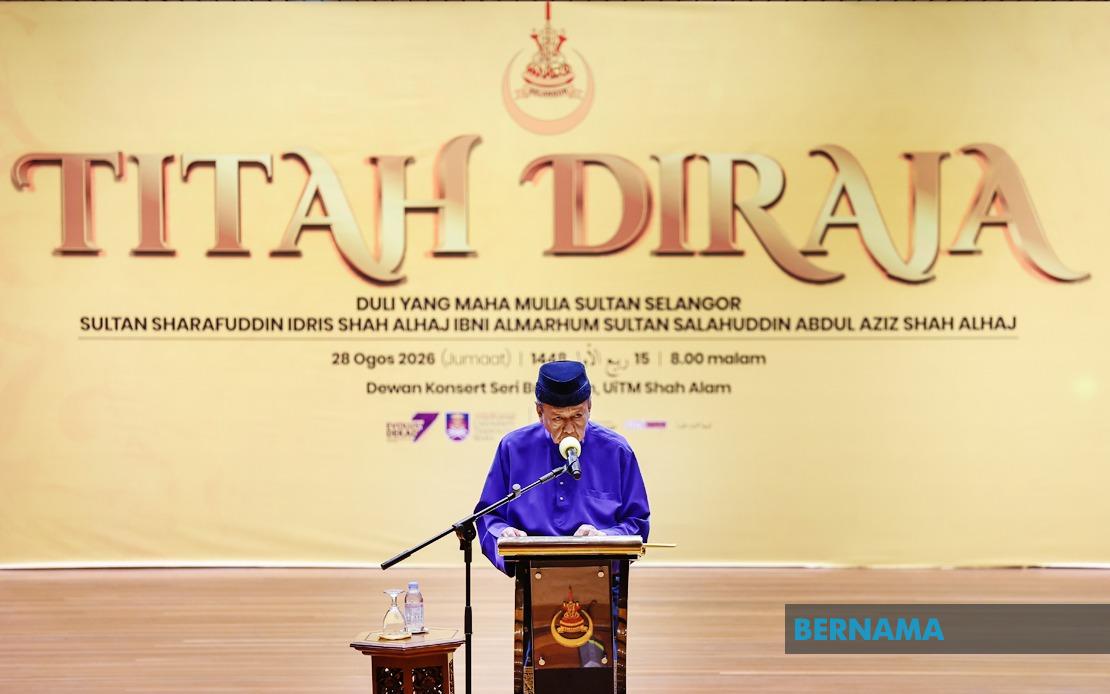
The Sultan of Selangor, Sultan Sharafuddin Idris Shah, has issued a pointed reminder that Universiti Teknologi MARA must not lose sight of its original mission to serve as an educational lifeline for economically disadvantaged Malay and Bumiputera youth, particularly those from rural and low-income backgrounds. Speaking at the university's 2026 Royal Address in Shah Alam, His Royal Highness emphasised that institutional growth and expansion should never come at the expense of accessibility for the communities the university was established to serve.
The Sultan's remarks underscore a persistent tension in Malaysian higher education: the challenge of balancing institutional prestige and expansion with equitable access. As UiTM has evolved into one of the nation's largest tertiary institutions, questions have periodically surfaced about whether the university adequately serves its foundational constituency. His Royal Highness articulated this concern with specificity, pointing out that children from farming families, fishing communities, transport workers, factory operatives, and impoverished rural households must continue to view UiTM as a genuine pathway to upward mobility.
To contextualise the scale of UiTM's transformation, the Sultan traced the institution's remarkable trajectory from its modest 1965 inception, when just 219 students and 11 lecturers formed the entire establishment. Within merely ten years, enrolment had mushroomed to nearly 7,000 students, while the teaching workforce expanded proportionally to approximately 1,000 academics offering roughly 60 academic programmes across multiple state campuses. This expansion reflected genuine success in democratising access to tertiary education during Malaysia's critical nation-building decades.
Today, UiTM has crystallised into an educational behemoth, annually graduating more than 40,000 students and boasting an alumni network exceeding one million individuals. The scale of this achievement cannot be understated—few institutions globally have managed to produce such large cohorts while maintaining reasonable quality standards. Yet this success introduces a sustainability challenge: how does UiTM continue supporting new generations of economically vulnerable students as its operational costs inevitably grow?
The Sultan's proposed solution represents an innovative approach to financial sustainability while leveraging institutional alumni networks. His Royal Highness advocated for establishing a system wherein every UiTM alumnus contributes minimally RM10 monthly or RM100 annually as an expression of gratitude for the educational opportunities they received. While individually modest, this scheme could theoretically generate up to RM100 million annually—a substantial figure that could meaningfully enhance scholarship provisions and student support infrastructure.
The financial mechanism the Sultan proposed reflects both pragmatism and psychological insight. Rather than framing contributions as onerous obligations, His Royal Highness positioned them as token gestures of appreciation, consciously noting that RM10 monthly should remain affordable for graduates now scattered across professional sectors. This framing appeals to graduates' gratitude and institutional loyalty rather than imposing guilt or resentment, a subtle but important distinction in fundraising psychology.
Underlying this proposal is a deeper assertion about measuring institutional success. The Sultan explicitly rejected the notion that UiTM's achievements should be calibrated primarily through enrolment figures, graduation statistics, or alumni quantity. Instead, he articulated a more profound metric: the extent to which the institution has genuinely transformed individual lives and contributed tangibly to national development. This distinction carries significant weight, particularly for an institution with an explicitly egalitarian founding mandate.
The evidence supporting this transformation narrative is substantial. UiTM graduates now populate virtually every professional sector and occupational hierarchy—from accounting and engineering through medicine, law, and architecture, to academia, entrepreneurship, and corporate leadership. Many have established businesses generating employment, founded major organisations, and shaped policy at national and sectoral levels. The university has demonstrably functioned as a genuine engine of social mobility for Bumiputera communities, a achievement particularly noteworthy given Malaysia's complex socioeconomic geography where rural-urban and ethnic disparities persist.
However, the Sultan's intervention also signals potential anxieties within royal and governmental circles about preserving equity as UiTM navigates contemporary pressures. Higher education systems globally face mounting pressure to internationalise, compete in global rankings, and generate research output—metrics that sometimes conflict with accessibility missions. The Sultan's speech implicitly cautions against allowing such pressures to dilute UiTM's commitment to its original constituency, particularly as competition for university places intensifies and aspirational middle-class families increasingly demand premium educational experiences.
The institutional framing of student contributions through the popular "UiTM Dihatiku" (UiTM in My Heart) slogan demonstrates awareness of emotional and cultural dimensions in fundraising. By connecting financial contributions to this existing sentiment, the Sultan endeavoured to transform an abstract obligation into a meaningful expression of institutional belonging and reciprocal obligation—a distinctly Malaysian approach that recognises non-monetary factors in community participation.
For Malaysian policymakers and higher education administrators, the Sultan's address offers several imperatives. First, it reaffirms that equity in tertiary education remains a royal priority and national concern, not merely an administrative detail. Second, it proposes concrete mechanisms—albeit requiring further institutional development—to sustain student support as operational costs escalate. Third, it challenges universities to articulate success through outcomes that extend beyond conventional metrics to encompass genuine social transformation.
The remarks also carry implications for Malaysia's broader higher education ecosystem. If successfully implemented, a large-scale alumni contribution system at UiTM could serve as a model for other institutions facing similar sustainability-equity tensions. It also suggests that public universities might increasingly rely on graduate communities to sustain equity missions, shifting some financial burden from government budgets—a development with significant implications for public finance and educational access in coming decades.
Ultimately, the Sultan's intervention represents both a validation of UiTM's historical achievements and a clarion call for renewed commitment to foundational principles. As Malaysia's higher education sector navigates internationalisation, technological change, and competing priorities, the Sultan's emphasis on remembering and serving disadvantaged Bumiputera youth provides essential counterweight to purely commercial or prestige-driven institutional logic. Whether the proposed alumni contribution system materialises will partly determine whether UiTM can sustain its dual mission of academic excellence and equitable access for generations to come.

