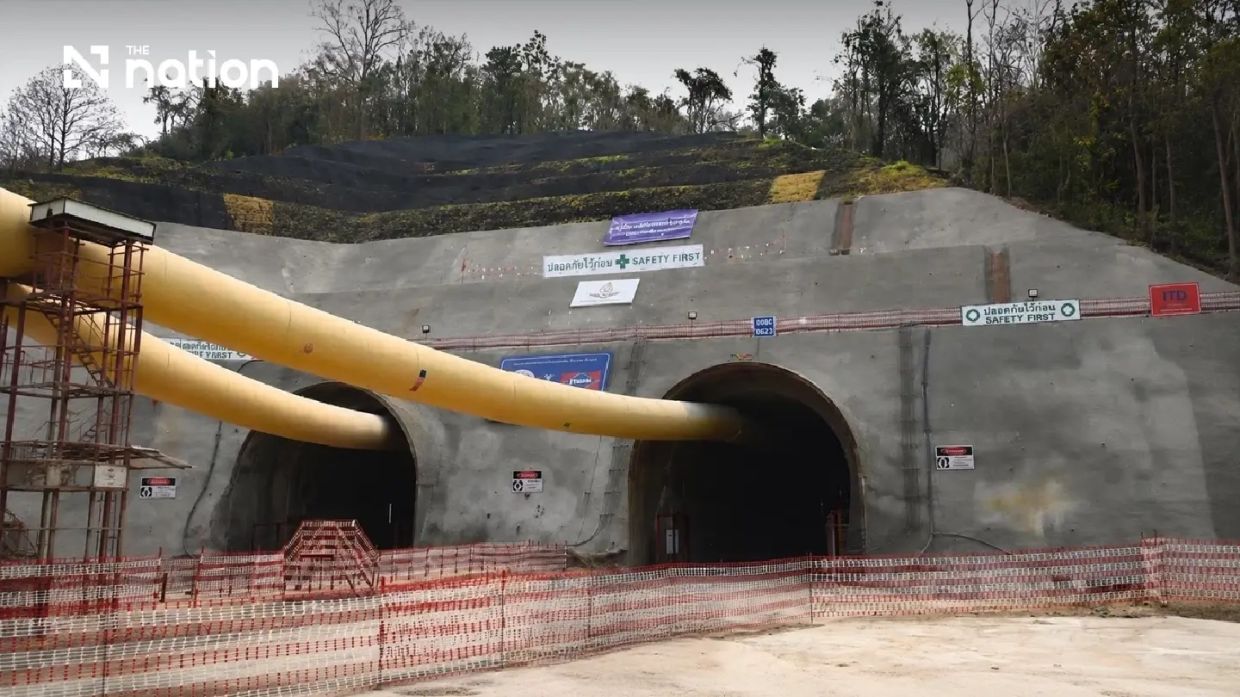
Two construction workers lost their lives and seven others sustained injuries when scaffolding gave way inside the Doi Luang railway tunnel in Chiang Rai's Chiang Saen district on Saturday evening. The accident occurred at approximately 8.35pm as workers were engaged in installing a waterproofing system within the tunnel, which forms part of the State Railway of Thailand's ambitious Den Chai-Chiang Rai-Chiang Khong railway corridor. The incident has once again highlighted safety challenges in large-scale infrastructure projects across Southeast Asia, where construction pace and working conditions frequently come under scrutiny from labour and safety advocates.
According to Deputy Transport Minister Siripong Angkasakulkiat, preliminary investigations suggest that falling rocks dislodged from the tunnel wall triggered the collapse. An earlier assessment had pointed toward instability in the shotcrete work area, though officials emphasised that the precise cause remained under examination at the time of the initial statement. The distinction between these accounts underscores the complexity of working within tunnel environments, where multiple structural systems interact and geological variables can introduce unpredictable hazards. The ministry indicated that a comprehensive forensic investigation would determine the exact sequence of events that led to the accident.
The three seriously injured workers and four with minor injuries were transported to hospital immediately following the incident. All casualties received prompt medical attention, though the severity of injuries sustained by the three seriously hurt individuals remained undisclosed. The rapid evacuation and hospitalisation reflected emergency protocols established on the site, though the accident itself suggests that hazard prevention measures may not have adequately addressed the specific risks associated with waterproofing installation work within this particular tunnel environment.
Siripong stated that authorities had secured the accident site and restricted access to prevent further casualties. The project's dedicated safety unit assumed control of operations and commenced continuous monitoring of conditions. This measured response aimed to stabilise the situation while investigators gathered evidence and technical teams assessed whether additional structural weaknesses existed elsewhere along the tunnel. The containment of the incident area represented standard practice, yet raised broader questions about the adequacy of safety planning across the entire contract.
The Doi Luang tunnel, already bored through at the time of the accident, extends 3.4 kilometres in length and represents a critical component of the larger railway development. The tunnel itself forms part of Contract 3 of the ambitious Chiang Rai-Chiang Khong section, valued at THB19.385 billion. This specific contract encompasses approximately 87 kilometres of both at-grade and elevated railway tracks, three full stations, three railway halts, the single major tunnel, and comprehensive signalling and telecommunications infrastructure. The contract's scope illustrates the scale and technical complexity involved, with multiple work streams progressing simultaneously across different geographical zones.
The project consortium undertaking Contract 3 comprises CH. Karnchang Public Company Limited, Sino-Thai Engineering & Construction Public Company Limited, and Chiangmai Construction Co., Ltd., operating together as the CKST-DC3 Joint Venture. This tri-partite arrangement brings together major Thai construction firms with significant experience in large-scale railway and infrastructure development. The accident raises questions about how effectively safety coordination functions within such large, multi-company joint ventures, where responsibility for worker protection must be clearly delineated yet remains collectively enforceable.
The Den Chai-Chiang Rai-Chiang Khong railway initiative holds strategic importance for both Thailand and the broader region, as it forms a crucial link in improving connectivity between northern Thailand and Laos. The project aligns with regional integration goals and ASEAN infrastructure development priorities, connecting important commercial and logistical hubs. However, the fatal accident demonstrates that ambitions for connectivity must remain balanced against the imperative to protect worker safety. For Malaysian observers, the incident carries lessons relevant to domestic construction projects of comparable scale, particularly those involving complex geological work such as tunnel boring and stabilisation.
The railway line itself, once completed, will significantly enhance trade and passenger movement across the Mekong subregion. Such infrastructure investments typically operate under substantial time and budget pressures, creating an environment where safety concerns may receive insufficient priority relative to scheduling demands. The accident investigation findings will likely influence how such projects approach worker protection going forward, potentially establishing precedents for safety standards across Thai and Southeast Asian construction industries more broadly.
Thailand's regulatory framework governing construction site safety has faced periodic criticism for inconsistent enforcement and inadequate penalties for violations. This accident will inevitably prompt reassessment of oversight mechanisms and contractor compliance records. The State Railway of Thailand and the transport ministry face pressure to demonstrate that they can manage large capital projects without sacrificing worker welfare. Whether the investigation identifies systematic failings or isolated lapses will substantially determine the extent of remedial measures implemented across the remaining contract phases.
For workers employed across Thailand's expanding infrastructure sector, the incident underscores persistent vulnerabilities despite nominal safety regulations. Migrant workers from neighbouring countries comprise a significant portion of Thailand's construction labour force, and they often occupy the most hazardous positions with least access to protective equipment or compensation mechanisms. The nationality and employment status of the two deceased workers remained unreported, yet historically such fatalities frequently affect vulnerable populations with limited recourse to justice or compensation.
The accident occurred during what remains an active rainy season in northern Thailand, a period when tunnel construction typically encounters elevated groundwater and associated instability challenges. Whether weather conditions contributed to the structural failure represented another investigative line that authorities would necessarily pursue. Seasonal factors significantly influence construction hazards in tropical environments, yet project schedules frequently proceed regardless of climatic conditions, potentially elevating risk profiles during vulnerable periods.

