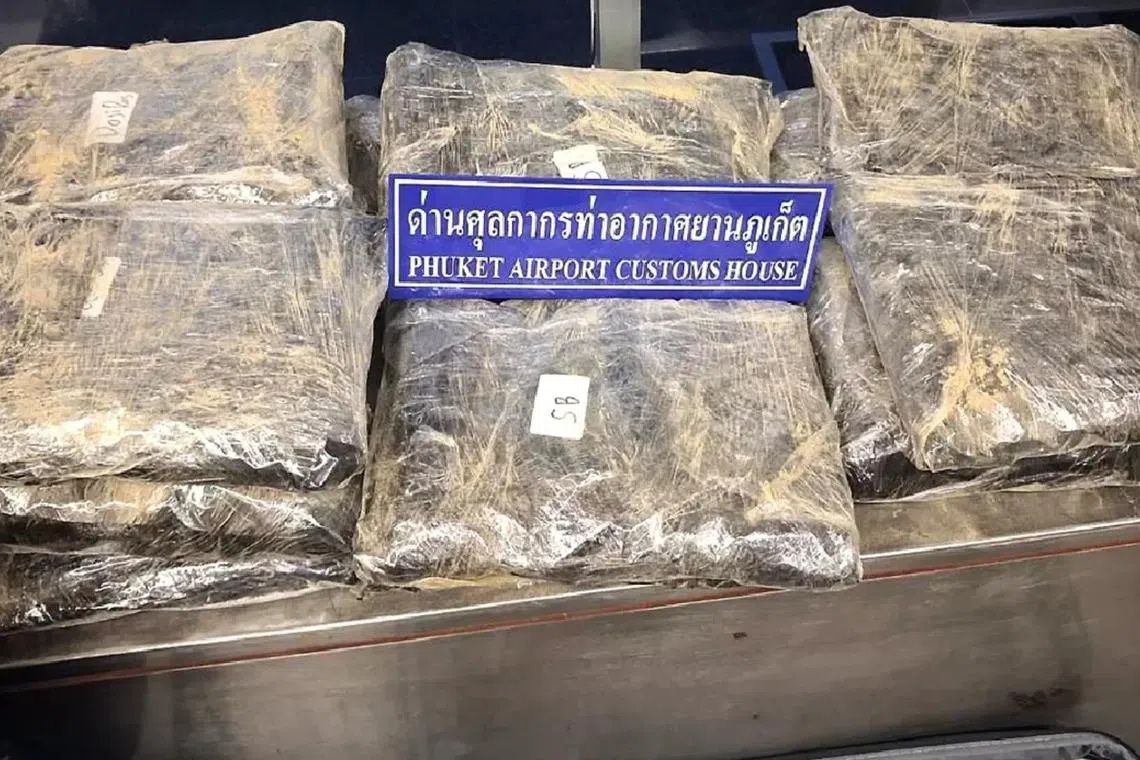
Authorities at Phuket International Airport made two significant drug seizures in a single day, apprehending a Thai national and a Filipino woman who were attempting to transport cannabis flowers out of Thailand without declaring them. The arrests, conducted jointly by officers from Phuket Airport Customs House and Sakhu Police Station, represent an intensifying crackdown on the illegal export of controlled substances through the kingdom's airports, a critical vulnerability in Thailand's drug enforcement architecture.
The first apprehension occurred at approximately 11 in the morning when customs officials conducted a routine inspection of a black Pierre Cardin wheeled suitcase belonging to 18-year-old Filipino national Levannah Chelsea Guzman in the international departures terminal. Within the luggage, inspectors discovered 14 vacuum-sealed packages containing cannabis flowers, collectively weighing 14.5 kilograms including their protective wrapping. When questioned by authorities, Guzman acknowledged ownership of both the suitcase and its contents, providing a straightforward admission that substantially streamlined the initial investigation phase.
The legal charges brought against Guzman encompass multiple statutes, reflecting the comprehensive nature of Thailand's drug control framework. Beyond the primary allegation of attempting to transport goods internationally without completing mandatory customs procedures—a violation of the Customs Act BE 2560—she faces prosecution under Thailand's Narcotics Code and the Protection and Promotion of Traditional Thai Medicine Wisdom Act BE 2542. Additionally, authorities invoked the Public Health Ministry's 2025 notification regarding controlled herbs and cannabis, demonstrating how Thai legislation has evolved to address the complexities of cannabis regulation in an era of changing global attitudes toward the plant.
Less than two hours after Guzman's detention, a second arrest unfolded when customs officers became suspicious of a green Swish Navy wheeled suitcase belonging to Penpitcha Phutsiang, a Thai citizen. The search revealed 16 vacuum-sealed packages of cannabis flowers with a combined weight of 17.6 kilograms, bringing the total cannabis quantity seized that day to over 32 kilograms. Like her counterpart, Phutsiang admitted that both the suitcase and its illicit contents were her property, facilitating the rapid progression of evidence collection and documentation procedures at the airport.
The charges levelled against Phutsiang mirror those applied to Guzman, encompassing violations of customs regulations and narcotics legislation. Both women were subsequently transported to Sakhu Police Station for continued investigation and further legal proceedings, where they would face the full apparatus of Thailand's criminal justice system. The parallel prosecutions underscore how Thai authorities treat such cases with consistency and severity, irrespective of the suspect's nationality or citizenship status.
These arrests occur within a broader context of Thailand's evolving approach to cannabis regulation. While some countries have moved toward decriminalization or medicinal use, Thailand maintains strict prohibitions on cannabis flower exports, though the kingdom has permitted certain cannabis derivatives for medical purposes. This distinction creates a complex legal landscape where cannabis in any form remains a controlled substance for international trafficking purposes, and the flowers specifically are subject to rigorous enforcement at border checkpoints and airports.
The seizures highlight critical vulnerabilities in Thailand's export control mechanisms. As one of Southeast Asia's primary international transit hubs, Phuket International Airport faces constant pressure from smugglers seeking to exploit procedural gaps or rely on detection failures. The scale of the interdiction—more than 32 kilograms—suggests this was not a minor possession case but rather an organized attempt to move substantial quantities of contraband across international borders.
For regional observers and Malaysian authorities particularly, these incidents underscore the interconnected nature of drug trafficking across Southeast Asia. Cannabis destined for export from Thailand may originate domestically or be sourced regionally, and interdiction at origin points like Phuket proves far more cost-effective than attempting interception at destination airports. The involvement of a Filipino national in this particular case also reflects how transnational criminal networks operate across the region's porous borders and shared transportation corridors.
Thailand's customs and police coordination demonstrated in these arrests reflects operational improvements achieved through specialized training and intelligence sharing. The rapid succession of two major interdictions on the same day suggests heightened vigilance and possibly intelligence-led targeting of suspect routes or trafficking patterns. This operational capability represents the kind of institutional capacity that regional partners, including Malaysia, seek to replicate through bilateral cooperation and ASEAN frameworks.
The investigation files on both suspects will now progress through Thai criminal courts, where they face substantial prison sentences if convicted. Cannabis trafficking charges in Thailand carry penalties significantly harsher than those in neighboring jurisdictions, serving as a powerful deterrent. The prosecutorial pathway—encompassing customs violations, narcotics offences, and controlled substance regulations—provides multiple legal vectors for conviction and sentencing.
Moving forward, these cases illustrate why airport security remains a priority in Thailand's drug enforcement strategy. The detection of 32 kilograms represents successful prevention, but law enforcement agencies acknowledge that unknown quantities continue to pass through international transportation nodes undetected. Enhanced scanning technology, behavioral analysis training for officers, and intelligence sharing between regional customs authorities remain critical investments for countering this persistent smuggling threat.

