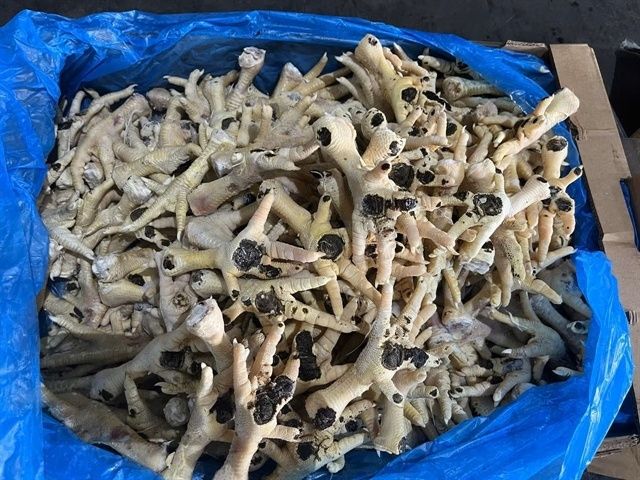
Hanoi authorities have brought smuggling charges against two prominent business executives following an investigation that uncovered a sophisticated operation to illegally channel hundreds of tonnes of frozen chicken feet into Vietnam's domestic food supply. Nguyen Thi To Loan, 47, who operated ABF Food Import-Export JSC based in Ninh Binh Province, and Trang Tuyet Ngoc, 45, serving as head of an assistant department at An Binh Group, have both admitted to their roles in the scheme. The case highlights vulnerabilities in Vietnam's customs enforcement and food safety oversight, raising concerns about what products may be reaching consumers through informal distribution networks across the country.
According to investigators, the operation spanned from 2023 through 2026, during which time ABF imported 339 containers of frozen chicken feet through legitimate-appearing customs declarations. The critical legal violation lay in the intended use: poultry products sourced from nations with active bird disease outbreaks may only enter Vietnam under strict conditions permitting processing and immediate re-export. Domestic sale of such products is explicitly prohibited under Vietnamese law, yet this requirement became merely a formality that the perpetrators deliberately circumvented. The paperwork presented to customs officials indicated all shipments would be processed and exported, conforming to regulatory expectations for potentially hazardous agricultural imports.
The scheme operated by diverting these shipments away from legitimate processing and export channels. Instead, Loan directed Ngoc to orchestrate distribution of the chicken feet throughout Vietnam's food service sector. Over 10,000 metric tonnes ultimately reached restaurants, hotels, and food preparation businesses across multiple provinces including Hanoi, Cao Bang, Ninh Binh, and Quang Ninh. The geographic spread of sales suggests a well-developed network of buyers and distributors, indicating this was no opportunistic small-scale operation but rather an organised effort to systematically breach import regulations.
The financial magnitude underscores the operation's scale. Investigators valued the total imported inventory at more than VNĐ347 billion, equivalent to approximately US$13 million at current exchange rates. Critically, no import duties were paid on any of these shipments, representing a substantial loss of government revenue in addition to the food safety violations and trade law breaches. The absence of duty payments suggests either deliberate customs evasion or systematic undervaluation of declared goods, compounding the criminal nature of the scheme beyond simple misappropriation of goods for domestic sale.
Police raids on facilities associated with the operation revealed the disturbing storage conditions and scale of the stockpiling. At the An Viet 2 freezer warehouse located in Hanoi's Quang Minh Industrial Zone, officers discovered over 1,000 metric tonnes of frozen chicken feet in storage. Among these shipments, approximately 260 metric tonnes had already exceeded their expiration dates and displayed visible signs of degradation including mold growth and foul odours. Yet despite this advanced state of spoilage, investigators noted that these expired products appeared to be staged for further distribution, suggesting the operators were preparing to move them into the market regardless of their condition.
Another significant cache was uncovered during a subsequent raid at THL cold-storage warehouse in Lang Son Province in northern Vietnam. This facility yielded more than 1,030 metric tonnes of additional frozen chicken feet. The distributed storage across multiple provinces indicates deliberate efforts to compartmentalise the operation and reduce the likelihood of complete discovery. By maintaining separate warehouses in different jurisdictions, the network could minimise exposure if one facility was investigated, while simultaneously maintaining sufficient inventory to supply markets across a broad geographic region.
The contamination and deterioration of products found at these facilities raises serious public health questions. The expired chicken feet displaying signs of mold and odour problems represented genuine food safety hazards had they reached consumers. Vietnam has experienced periodic food safety scandals involving contaminated or counterfeit products, and this case suggests that oversight mechanisms failed at multiple checkpoints. The original issue—importing poultry from disease-affected regions—carries inherent disease transmission risks, but the subsequent storage conditions and apparent intention to sell spoiled goods amplified the potential health danger.
Authorisation officials formally charged both defendants under Article 188 of Vietnam's 2015 Penal Code, which addresses smuggling offences. Both suspects have reportedly confessed to all charges against them, potentially facilitating faster case resolution. However, the investigation remains ongoing, with authorities actively working to identify other individuals and organisations implicated in the broader network. This investigative direction suggests the two charged executives may have been operating as part of a larger supply chain involving multiple parties, potentially including customs officials, warehouse operators, transportation companies, and retail food service establishments.
For Malaysian and Southeast Asian readers, this case reflects broader vulnerabilities in regional food import systems and the challenges that developing nations face in managing agricultural supply chains. Vietnam's experience demonstrates how legal frameworks prohibiting imports of poultry products from disease-endemic areas can be circumvented by determined operators willing to falsify documentation and cultivate relationships with willing downstream buyers. The sheer volume of chicken feet—over 10,000 metric tonnes—that managed to enter the market before detection suggests that informal food distribution networks across Vietnam remain substantial and difficult for authorities to monitor comprehensively.
The case also illustrates how sophisticated modern smuggling operations operate not through crude border crossings but rather through exploitation of legitimate import channels and documentation systems. By obtaining proper import permits and customs paperwork, then simply diverting products after clearance, these operators achieved economies of scale that smaller-scale smugglers could never achieve. This represents an evolution in food fraud that goes beyond traditional counterfeiting into systematic regulatory capture and deliberate breach of import conditions. The incident underscores why regional food safety cooperation and harmonised import standards remain important priorities for ASEAN nations seeking to protect their citizens from contaminated or falsified agricultural products entering the food chain.

