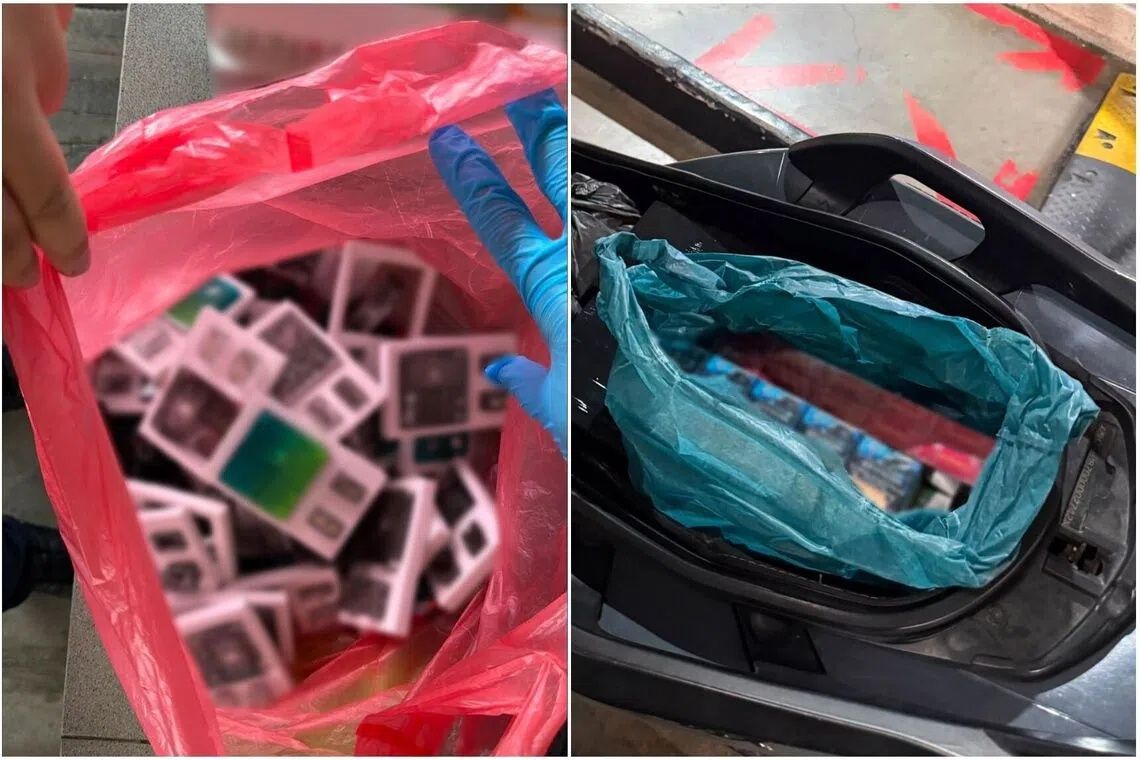
Singapore's Immigration and Checkpoints Authority has apprehended two motorcyclists suspected of smuggling contraband tobacco products and vaping devices across the Malaysia-Singapore border at Woodlands Checkpoint. The arrests, made on August 3 and 4, underscore the ongoing challenge faced by authorities in combating illicit trade in excisable goods through one of the world's busiest land crossings. A 46-year-old Malaysian national and a 51-year-old Singaporean resident now face serious criminal charges as investigations proceed jointly with Singapore Customs and the Health Sciences Authority.
The first enforcement action on August 3 occurred when ICA officers conducting routine checks on a Malaysia-registered motorcycle deemed suspicious ordered the vehicle for secondary screening. During this enhanced inspection, officers discovered a substantial cache of smuggled goods hidden within the motorcycle's storage compartment. They recovered more than 30 packets of cigarettes bearing no proof of Singapore duty payment, alongside over 60 individual vaping devices and associated components. The deliberate concealment in the storage box suggests a calculated attempt to evade detection, with the rider apparently betting that the compartment would escape cursory examination.
The following day's interception involved a Singapore-registered motorcycle, indicating that contraband movement is not solely a cross-border phenomenon but also involves domestic participation. Officers who searched this vehicle uncovered an even larger haul: 25 complete cartons and 30 loose packets of duty-unpaid cigarettes, plus more than 60 vaping products. This contraband was strategically hidden in two locations—beneath the motorcycle seat and within the storage box—suggesting the rider understood law enforcement tactics and attempted multiple hiding spots to increase the likelihood that at least some goods would evade discovery.
For Malaysian readers, these incidents highlight the persistent challenge of managing the porous Malaysia-Singapore border, particularly through informal channels like individual motorcyclists. The Woodlands Checkpoint processes thousands of vehicles daily, making interdiction efforts resource-intensive. Yet these two consecutive days of successful enforcement demonstrate that authorities do conduct targeted inspections, possibly based on intelligence or behavioural indicators that flag certain riders for additional scrutiny. The involvement of both a Malaysian and a Singaporean suspect suggests an organised operation rather than opportunistic smuggling by lone individuals.
The cigarette smuggling component reflects broader regional patterns. Duty rates in Singapore are among Asia's highest, making the price differential with neighbouring Malaysia a powerful economic incentive for illicit trade. A packet of cigarettes legitimately purchased in Malaysia might cost one-third of the Singapore retail price after duties are applied. This arbitrage opportunity has spawned a persistent underground economy, with smuggling occurring through multiple channels—not just motorcycles at checkpoints, but also via mail, commercial shipments, and organised criminal networks. The vaping component adds a newer dimension, as Singapore has maintained a complete prohibition on vaping products regardless of whether duties are paid.
Singapore's legal framework for such offences is notably severe, reflecting the city-state's zero-tolerance approach to tax evasion and public health violations. Individuals convicted of dealing in duty-unpaid cigarettes face penalties scaling to 40 times the evaded duty and tax amount, plus imprisonment up to six years. The motorcycle itself becomes subject to forfeiture, effectively destroying the economic asset used in the crime. For vaping specifically, the penalties escalate further: possession carries a maximum fine of $10,000, while trafficking can result in $300,000 in fines and nine years imprisonment. For foreign nationals, repeated violations trigger loss of work passes and permanent entry bans, essentially career-ending consequences for cross-border workers.
These draconian penalties underscore Singapore's determination to maintain both fiscal discipline and public health standards. Yet their severity raises questions about deterrence effectiveness. If such punishments were universally enforced and widely publicised, smuggling should theoretically decline sharply. That incidents continue suggests either that potential smugglers underestimate the risk of apprehension, or that profit margins remain sufficiently attractive to warrant the gamble. A single successful run might net substantial cash that justifies the legal exposure in the eyes of perpetrators who discount the probability of capture.
For Singapore's authorities, the operational challenge lies in targeting enforcement efficiently. With tens of thousands of motorcycles crossing daily, screening every vehicle is impractical. Intelligence-led operations, canine units, and random sampling represent compromise approaches. The back-to-back arrests on August 3 and 4 might indicate either heightened alert levels in response to intelligence about smuggling rings, or simply fortunate timing that routine checks happened to intercept contraband-laden riders. Regardless, such enforcement visibility serves important communicative purposes, reminding potential smugglers that detection remains a tangible risk.
From a Malaysian perspective, these arrests carry implications for cross-border commerce and worker mobility. Malaysian nationals employed in Singapore or engaged in legitimate cross-border trade must exercise extreme caution not to inadvertently become implicated in smuggling operations. The involvement of a Malaysian rider suggests that some nationals view smuggling as economically rational, given income differentials and employment opportunities. Yet conviction brings devastating consequences: not merely Singapore penalties, but permanent damage to future employment prospects across the region, as many employers conduct criminal background checks and view smuggling convictions as indicators of dishonesty and poor judgment.
The referral of suspects to Singapore Customs and the Health Sciences Authority indicates that investigations will likely expand beyond initial charges. Authorities may attempt to identify the source of contraband supplies, the distribution network on the Singapore side, and whether an organised smuggling enterprise exists. If the two arrests are part of a larger operation, police may target higher-level coordinators who source cigarettes in Malaysia, arrange transportation, and distribute through retail networks. Such investigations can unfold over months, potentially ensnaring numerous participants. Convicted individuals may face pressure to provide cooperation in exchange for sentence mitigation.
Looking forward, these incidents underscore the enduring friction between Singapore's regulatory regime and market incentives created by cross-border price differentials. Unless either Singapore substantially reduces tobacco duties—politically unlikely given public health objectives—or Malaysia significantly increases its duties to narrow the gap, smuggling will persist as a profitable enterprise. Enforcement can raise operational costs and risks for smugglers, thereby reducing supply at the margins, but cannot eliminate the fundamental economic driver. For regional policymakers and enforcement agencies, balancing revenue protection, public health goals, and border security remains an ongoing challenge with no perfect solutions.

