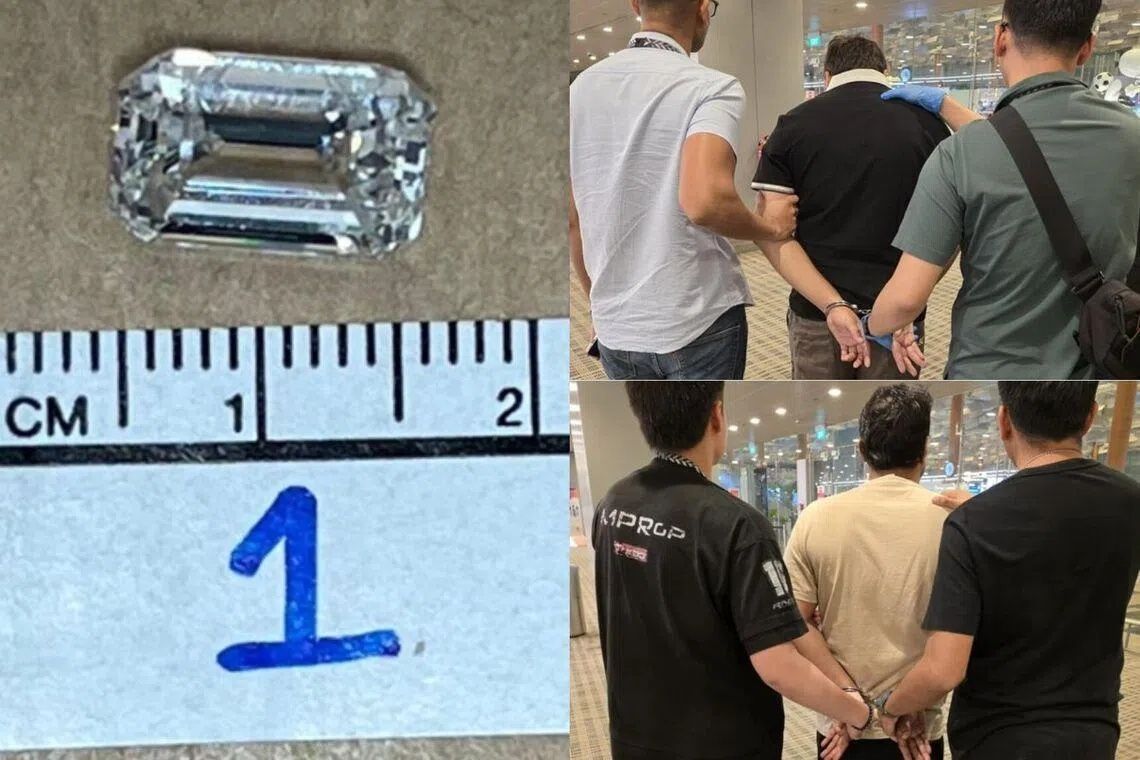
Two men aged 30 and 42 are facing theft charges following what police describe as a sophisticated sleight-of-hand operation at a jewellery store in Singapore's Chinatown district. The pair were arrested at Changi Airport Terminal 3 on June 19 after investigators identified them through CCTV footage and ground enquiries, with the stolen diamond subsequently recovered. The case highlights a growing concern among luxury retailers across the region about organised theft rings employing misdirection and substitution tactics.
The incident unfolded on Kreta Ayer Road when the jewellery store's assistant contacted police at 3.40pm on June 19, reporting the disappearance of a diamond valued at more than S$235,000. What made this theft particularly brazen was that it occurred during daylight hours in a busy commercial district, suggesting the perpetrators operated with considerable confidence and planning. The shop assistant's diligence in conducting an immediate inventory check proved crucial to detecting the crime before the suspects could exit the area.
Central Police Division officers and the Police Operations Command Centre launched a coordinated investigation that relied heavily on modern surveillance capabilities. Officers examined CCTV footage from the store itself as well as police camera networks positioned throughout Chinatown, a security measure that has become standard in Singapore's commercial districts. This technical approach, combined with traditional ground enquiries and follow-up interviews, allowed investigators to move swiftly from incident report to suspect identification and apprehension—all within several hours.
The modus operandi employed by the duo reveals the calculated nature of their operation. According to preliminary investigations, the two men initially presented themselves as genuine customers interested in purchasing the diamond. Their behaviour was apparently convincing enough to lower the shop assistant's guard, allowing them access to handle the merchandise closely. While examining the diamond under the pretence of considering a purchase, they executed a switch, substituting the authentic gem with a counterfeit piece designed to pass casual inspection.
The execution of such a switch requires considerable nerve and coordination. One man likely distracted the shop assistant or engaged their attention while the other completed the substitution. The sophistication of the counterfeit suggests they may have obtained it beforehand, possibly from an international criminal network. The fact that they proceeded to leave the store without making a purchase was a critical error—the absence of a transaction combined with their sudden departure immediately aroused suspicion and prompted the assistant to verify the diamond's authenticity.
The rapid arrest at Changi Airport indicates that these men were not Singapore residents attempting to hide within the local community. Instead, they appeared to be transit passengers or visitors attempting to flee the jurisdiction before the theft was discovered. Airport security protocols, combined with the police alert issued following the report, allowed officers to intercept them before they could board their departure flight. This outcome underscores the importance of coordination between airport authorities and law enforcement agencies across Southeast Asia in combating mobile crime networks.
The legal consequences facing these individuals are substantial. Both men are expected to face charges of theft in dwelling with common intention, an offence that carries a maximum penalty of seven years' imprisonment and a fine upon conviction. The fact that both will be jointly charged under the common intention provision of Singapore's Penal Code reflects the coordinated nature of their actions. Prosecutors will argue that this was not an opportunistic or spontaneous crime but rather a planned operation executed by two individuals working in concert.
For Malaysia and the broader Southeast Asian region, this case carries important implications. Organised theft rings targeting high-value jewellery often operate across multiple countries, using regional mobility to avoid detection. The incident demonstrates how counterfeiters have become increasingly sophisticated, producing fakes capable of deceiving even trained retail staff during initial examination. Malaysian jewellery retailers, particularly those operating in shopping districts and tourist areas, face similar vulnerabilities and would be wise to implement enhanced verification protocols.
Singapore's police have used the opportunity to issue a formal alert to all luxury retailers regarding this specific modus operandi. They have advised shop owners to remain vigilant against sleight-of-hand techniques and to implement multiple layers of verification when customers request to examine high-value items. Recommendations typically include having two staff members present during such transactions, using protective cases that limit access to merchandise, and employing ultraviolet or other authentication methods that cannot be easily replicated by counterfeiters.
The broader implications extend beyond jewellery retail. This case exemplifies how metropolitan areas with significant foot traffic and transient populations can become targets for coordinated theft operations. The perpetrators' willingness to attempt such a theft in broad daylight suggests confidence born from previous successes elsewhere. Intelligence agencies across the region are likely to monitor whether these individuals are connected to other jewellery thefts reported in Malaysia, Thailand, or Indonesia—indicators that would suggest a larger criminal network.
The swift resolution of this case also reflects Singapore's emphasis on technological integration in law enforcement. The deployment of police cameras in conjunction with commercial CCTV systems created a comprehensive surveillance environment that allowed investigators to track the suspects' movements from the crime scene to the airport. As other Southeast Asian nations grapple with similar challenges, this capability-building approach offers a model for how strategic investment in infrastructure can enhance public safety while maintaining operational efficiency.
For consumers across the region, the incident serves as a reminder of the value chain vulnerabilities that exist even in established retail environments. When purchasing high-value gemstones, buyers should insist on comprehensive authentication performed by independent certified assessors. The apparent ease with which these criminals executed their plan suggests that standard retail practices may be insufficient for items valued above certain thresholds, a lesson that applies equally to jewellery markets in Kuala Lumpur, Bangkok, and other major Southeast Asian commercial hubs.

