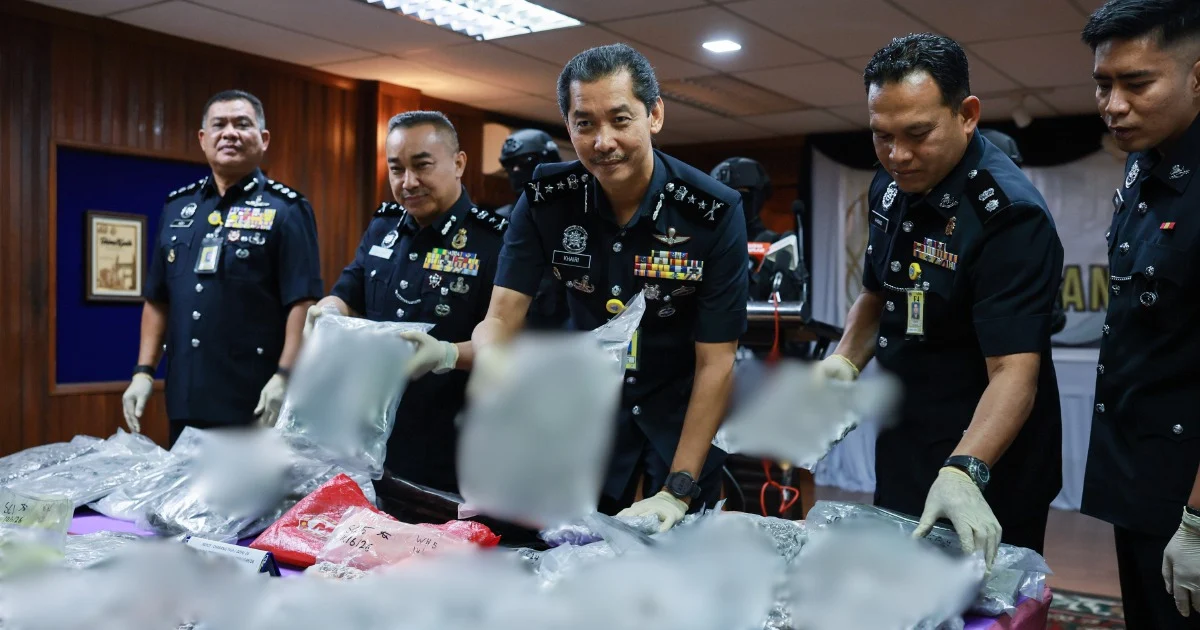
Law enforcement authorities in Kuala Terengganu have made significant progress against narcotics trafficking following the apprehension of two brothers linked to a substantial illicit drug operation. The suspects were detained after investigators uncovered a clandestine storage facility containing controlled substances valued at RM1.76 million concealed within their residential property in Kampung Duyong Besar, marking another successful intervention in the state's ongoing war against drug-related crime.
The discovery represents a notable seizure for the Terengganu police contingent and adds to a growing pattern of domestic residences being converted into distribution and storage points for trafficking networks across Malaysia. Rather than operating from commercial spaces or hidden rural compounds, increasingly sophisticated drug syndicates are exploiting the perceived anonymity of residential neighbourhoods, embedding themselves within normal suburban and semi-rural communities where heightened surveillance would attract less attention.
The brothers' arrest underscores a troubling trend whereby family structures become compromised through involvement in large-scale narcotics enterprises. When multiple family members participate in criminal operations, authorities face heightened investigative complexity while judicial systems must confront the collateral family destruction these crimes precipitate. The case illustrates how trafficking organisations strategically recruit individuals through familial bonds, banking on the reluctance of family members to testify against one another and the reduced likelihood of external informants within tight-knit household units.
Kampung Duyong Besar, situated within Kuala Terengganu's administrative area, has historically maintained a reputation as a maritime and fishing community with deep-rooted cultural traditions. The discovery of large-scale drug operations anchored in such neighbourhoods signals how trafficking networks have successfully penetrated traditionally low-crime areas, fundamentally altering the security landscape in smaller Malaysian towns beyond the major metropolitan centres of Kuala Lumpur and Selangor that typically dominate national crime reporting.
The valuation of the seized substances at RM1.76 million provides insight into the economic scales at which contemporary drug distribution operates. This figure typically reflects the street value of the contraband rather than acquisition costs, indicating that the actual quantity of narcotics involved would represent substantial quantities—likely encompassing multiple drug classifications from methamphetamine and heroin to synthetic substances increasingly prevalent throughout Southeast Asia. The magnitude of this particular seizure would have supplied illicit drug markets across Terengganu and potentially neighbouring states for an extended operational period.
Terengganu's position on Malaysia's eastern coast, coupled with its maritime infrastructure and relative proximity to international trafficking corridors, establishes it as strategically significant within broader regional drug supply chains. The state functions simultaneously as a transit point for narcotics moving between production regions in the Golden Triangle and consumer markets in southern Thailand, peninsular Malaysia, and beyond. Local storage facilities therefore serve critical logistical functions within these transnational trafficking networks, making residential drug busts particularly valuable from an enforcement perspective.
Police methodologies in identifying and dismantling such operations typically combine community intelligence with surveillance techniques and undercover operations. The successful location of this facility suggests that investigators had developed sufficient actionable leads—whether through informant networks, suspicious financial activities, or observed trafficking indicators—to justify the tactical intervention. Such intelligence-gathering operations remain essential given that traffickers continuously modify their operational security procedures in response to enforcement patterns.
The detention of the brothers will initiate standard investigative protocols designed to map the broader organisational structure supporting their storage operation. Law enforcement will pursue questions regarding the original sources of the narcotics, downstream distribution networks, financial mechanisms facilitating the enterprise, and any connections to other trafficking cells operating across the region. These investigations frequently extend well beyond the immediate arrestees, potentially unravelling wider criminal syndicates responsible for multiple trafficking operations.
For Malaysian readers and regional observers, this bust reinforces the persistent challenge narcotics authorities face in combating supply-side drug trafficking despite substantial enforcement resources. While seizures of this magnitude represent tactical victories against organised trafficking groups, they simultaneously reveal the resilience and adaptability of these criminal enterprises. The apparent ease with which traffickers establish residential storage operations suggests they maintain sufficient operational security knowledge and logistical capacity to sustain their activities despite ongoing law enforcement pressure.
The implications for community safety extend beyond the immediate criminal prosecution. Neighbourhoods harbouring drug storage facilities inadvertently become attractive targets for rival trafficking factions, potentially generating secondary violence and security deterioration. Additionally, residential-based drug operations inevitably involve local recruitment of lookouts, handlers, and dealers, spreading criminal involvement through community networks and destabilising social cohesion in affected areas. The Kampung Duyong Besar community will likely experience renewed attention from authorities and heightened public awareness regarding trafficking indicators in their neighbourhood.
Policies addressing drug trafficking must increasingly recognise that residential-based operations require different enforcement approaches than traditional commercial or rural cultivation sites. Intelligence systems need strengthening to identify suspicious household activity patterns without resorting to intrusive mass surveillance. Community education programmes should equip residents with knowledge to recognise trafficking indicators whilst respecting privacy boundaries. Regional cooperation mechanisms between Malaysian and Thai authorities become increasingly critical given Terengganu's geographic positioning within transnational trafficking networks.
The apprehension and pending prosecution of these two brothers will proceed through Malaysia's criminal justice system, where narcotics trafficking charges carry severe statutory penalties reflecting the government's zero-tolerance approach to drug-related crime. Beyond individual accountability, however, sustained efforts targeting trafficking infrastructure—financial flows, international supply lines, and organisational recruitment mechanisms—remain essential for addressing the underlying factors enabling such operations to flourish within Malaysian communities.

