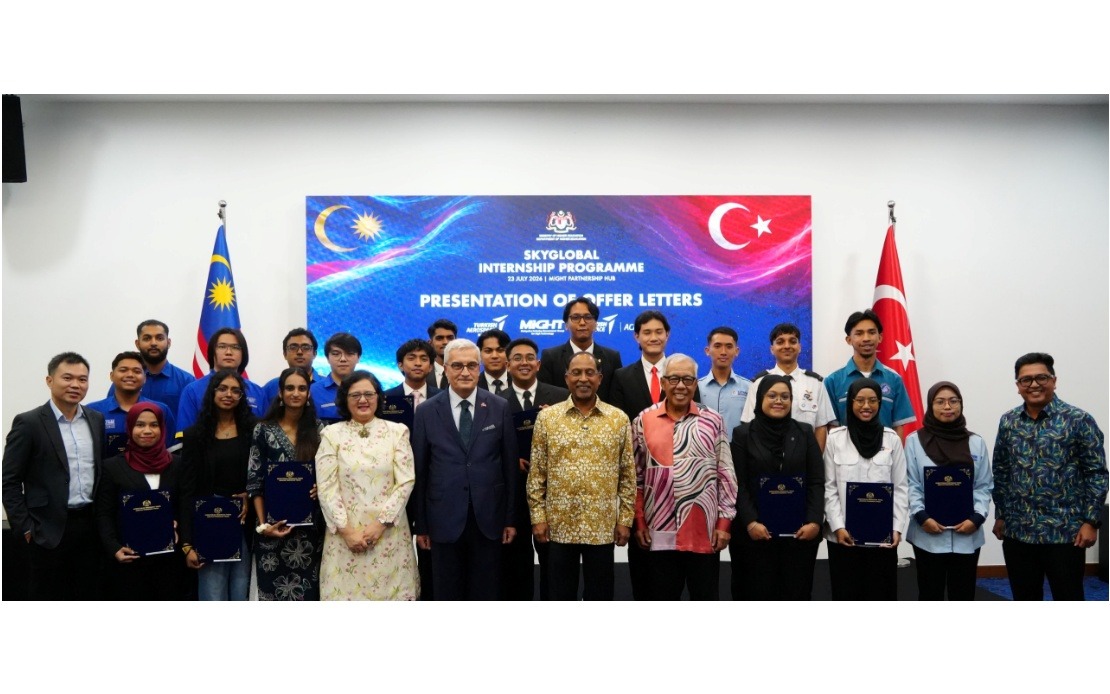
Twenty Malaysian students have secured places in an intensive aerospace internship programme that will see them train at Turkish Aerospace's headquarters in Ankara over the coming year. The SKY Global Internship Programme 2026 represents the fourth cohort of a structured talent development initiative designed to equip Malaysia's engineering graduates with hands-on experience in one of Europe's leading defence and aviation sectors. The selection underscores Malaysia's growing commitment to building a knowledge-intensive aerospace workforce capable of competing at global standards.
The programme operates as a tripartite collaboration between Turkish Aerospace (TUSAŞ), the Malaysian Industry-Government Group for High Technology (MIGHT), and the Consortium of Malaysian Universities (CMU). This institutional partnership reflects a deliberate effort to align academic training with industry requirements while fostering deeper connections between Malaysia and Türkiye beyond conventional diplomatic channels. The 2026 cohort comprises students drawn from nine Malaysian universities, chosen through a competitive selection process that evaluates both technical competence and professional potential.
Since its establishment, the SKY Global scheme has provided structured exposure to fifty-six Malaysian students across multiple intake cycles. Participants gain practical experience spanning critical aerospace disciplines including avionics systems, electronic design and prototyping, software programming, aircraft structural analysis, and systems installation procedures. This comprehensive exposure ensures that graduates return to Malaysia with not only theoretical knowledge but also familiarity with international best practices and industry-standard methodologies that are often unavailable in purely academic settings.
The programme's significance extends beyond individual skill development. Higher Education Minister Datuk Seri Dr Zambry Abd Kadir highlighted during the offer letter presentation ceremony at the MIGHT Partnership Hub in Cyberjaya that the initiative strengthens institutional bonds between Malaysia and Türkiye through direct engagement of students, academics, and industry practitioners. Such people-to-people exchanges create lasting networks that facilitate future collaboration in research, technology development, and knowledge transfer—dimensions increasingly important as both nations pursue higher-value manufacturing and innovation strategies.
For Malaysia's aerospace sector specifically, this pipeline development addresses a persistent challenge: sourcing engineers with genuine international exposure and practical competency in advanced systems integration. MIGHT's joint chairman for industry affairs, Tan Sri Dr Ir Ahmad Tajuddin Ali, framed the programme as a strategic investment in Malaysia's aspiration to establish itself as a competitive regional aerospace hub. As Southeast Asian countries compete to attract aerospace investment and supply chain activity, the availability of a globally-trained talent pool becomes a decisive advantage in attracting multinational manufacturers and support services.
TUSAŞ Malaysia's chief executive officer, Mohd Shahiman Sulaiman, underscored that the internship component serves mutual benefit. While Malaysian interns absorb cutting-edge technical knowledge at TUSAŞ headquarters, the Turkish company gains access to fresh engineering perspectives and innovative problem-solving approaches from international participants. This bidirectional knowledge flow has proven sufficiently valuable that three programme alumni have secured permanent employment with TUSAŞ in Türkiye under an extended two-year placement arrangement, demonstrating that Malaysian engineering talent successfully meets international aerospace standards.
The career outcomes achieved by prior cohorts carry particular significance for regional brain drain concerns. Rather than Malaysian graduates seeking opportunities exclusively in Western aerospace centres, the programme demonstrates viable pathways for advancement within strategic partner nations and their industries. This expanded opportunity landscape may encourage talented engineers to pursue international experience while maintaining connections to home institutions and eventually contributing to Malaysia's sector development.
Beyond student training metrics, the programme infrastructure itself generates institutional benefits. Collaboration between CMU's ten participating universities and TUSAŞ Akademi (the Turkish aerospace company's training division) creates channels for curriculum exchange, faculty engagement, and joint research initiatives. These academic partnerships often catalyse downstream opportunities in doctoral collaboration, technology licensing, and collaborative product development—avenues that Malaysian universities and companies currently exploit insufficiently relative to their Southeast Asian peers.
The timing of programme expansion reflects broader Malaysian policy directions emphasising high-technology sectors as drivers of economic transformation. As traditional manufacturing faces labour cost pressures and automation threats, aerospace represents a defensible sector offering premium wages, intellectual property development, and long-term employment security. Investing in talent pipelines through schemes like SKY Global acknowledges that such sectors depend on human capital quality rather than input cost advantages.
Türkiye's aerospace sector, ranked globally among the top defence and aviation equipment manufacturers, provides authentic exposure to industry challenges that Malaysian students would rarely encounter domestically. Participating in design reviews, testing protocols, and systems integration processes at a company producing aircraft for NATO operators and allied nations grants insights into quality standards, regulatory compliance frameworks, and multinational project management applicable across various advanced manufacturing domains.
The programme also positions Malaysia within emerging Turkish foreign policy priorities emphasising technology-driven partnership with Southeast Asian nations. As Türkiye deepens engagement with ASEAN countries, educational and vocational initiatives like SKY Global serve strategic purposes beyond immediate sector development. They build constituencies within Malaysian professional classes with positive exposure to Turkish institutions and capabilities, potentially facilitating future defence partnerships, technology transfers, and commercial relationships.
Looking forward, expansion of such structured internship pathways could address Malaysia's broader challenge of developing specialised technical workforces in emerging sectors. Digital transformation, advanced manufacturing, renewable energy systems, and autonomous vehicle development all require engineers with international exposure and practical problem-solving experience. Replicating the SKY Global model through partnerships with leading institutions in South Korea, Japan, Germany, and Singapore could systematically upgrade Malaysia's competitive positioning across multiple high-value sectors simultaneously.
For the twenty selected students embarking on their Ankara internships, the opportunity represents more than professional training. It constitutes entry into transnational professional networks, exposure to different working cultures and problem-solving methodologies, and building of relationships with peers and mentors across sectors and borders. These intangible dimensions frequently prove as valuable as technical knowledge in shaping career trajectories and enabling long-term innovation leadership within Malaysia's emerging technological landscape.

