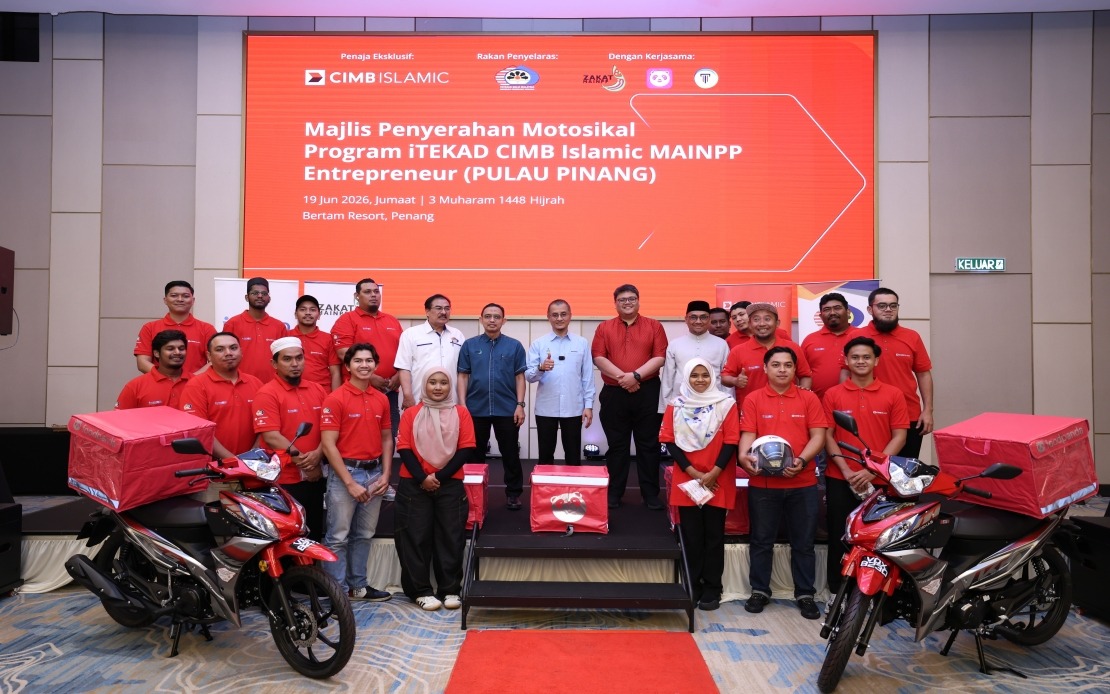
Twenty Penang residents selected for the iTEKAD CIMB Islamic-MAINPP Entrepreneur programme received motorcycles at a handover ceremony in Kepala Batas this week, marking the culmination of a competitive selection process aimed at lifting disadvantaged communities into self-employment and economic independence.
The initiative represents a collaborative effort between CIMB Islamic Bank Berhad and Penang's religious authority, the Majlis Agama Islam Pulau Pinang (MAINPP), supported by implementation partners including the Malaysian Youth Foundation, Taylor's Community and foodpanda Malaysia. Speaking at the ceremony, Penang Deputy Chief Minister I Datuk Dr Mohamad Abdul Hamid, who also chairs MAINPP, characterised the programme as evidence of how structured partnerships can transform zakat distribution from charitable giving into productive investment in human capital and entrepreneurship.
The programme operates on a matching grant framework totalling RM400,000, split equally between the CIMB Islamic Bank Berhad Wakalah Zakat fund and Bank Negara Malaysia. This funding model reflects growing recognition among Malaysian financial institutions and regulators that Islamic finance mechanisms and zakat systems can be leveraged for inclusive economic development beyond traditional welfare approaches. The participation of central banking authorities in funding suggests alignment with the country's broader financial inclusion objectives, particularly in rural and semi-urban areas where formal employment remains limited.
Competition for places proved intense. The programme received 151 initial applications from individuals seeking to escape poverty cycles through entrepreneurship. All candidates underwent a rigorous evaluation framework that extended beyond simple paperwork review. Between May 31 and June 3 this year, selected applicants participated in a residential Entrepreneurship BootCamp, an intensive programme designed to assess practical business acumen, commitment levels and suitability for self-employment. From this comprehensive screening, only twenty emerged as top performers meriting the motorcycle grants and equipment packages.
Mohamad emphasised that the asset transfer alone represented only one component of a holistic support ecosystem. Each recipient secured training modules covering fundamental financial management principles, workplace discipline standards and entrepreneurial methodologies essential for structured income generation. The provision of delivery equipment alongside motorcycles indicated a deliberate job pathway, with foodpanda Malaysia's involvement suggesting many participants would pursue last-mile logistics and food delivery services, occupations aligned with current gig economy growth trajectories across Southeast Asia.
The timing of this intervention reflects broader policy recognition that Malaysian asnaf populations—those eligible for zakat support—require pathways beyond subsistence assistance. Urban and semi-urban poverty in Malaysia has increasingly been characterised by underemployment and irregular income rather than complete joblessness. The iTEKAD model addresses this gap by converting zakat resources into equipment financing and skills development, enabling recipients to transition from irregular work to structured entrepreneurial activities with predictable income streams.
The programme also anchors within Penang's Penang Islamic Religious Development Agenda 2030 (APAI2030), a comprehensive framework extending beyond religious instruction into economic empowerment, family welfare and youth engagement. This integration suggests local religious authorities are reconceptualising their mandates from purely devotional functions toward broader socioeconomic stewardship. Such shifts occur throughout Malaysia as state Islamic councils recognise zakat systems can simultaneously fulfil religious obligations and contribute measurable developmental outcomes if properly structured and monitored.
For Malaysia's broader Islamic finance sector, the iTEKAD programme demonstrates domestic applications for Wakalah (agency) structures typically associated with international sukuk markets and large institutional transactions. By channelling zakat through Wakalah frameworks, institutions like CIMB Islamic position Islamic finance as economically productive rather than merely capital-preserving. This reorientation carries significance for Malaysia's aspirations as an Islamic finance hub, illustrating how instruments developed for global markets can address localised development challenges.
The motorcycle-based model carries practical relevance across Malaysian geography. Two-wheeled vehicles offer cost-effective transport solutions in congested urban environments and rural areas alike, lower fuel consumption compared to four-wheeled alternatives, and minimal maintenance requirements relative to other commercial assets. For emerging entrepreneurs with limited capital, motorcycles represent optimal entry points into self-employment, particularly within last-mile logistics services experiencing explosive growth as e-commerce penetration deepens across Southeast Asia.
Mohamad's statement that assistance should catalyse lasting transformation rather than merely addressing immediate needs reflects growing sophistication in poverty alleviation discourse. Rather than temporary relief, the programme envisions participants achieving stable income trajectories sufficient to fund family expenses, accumulate savings and gradually transition toward business expansion or asset acquisition. This progression pathway distinguishes the iTEKAD model from conventional welfare approaches, creating incentive structures aligned with long-term self-sufficiency.
The programme's success metrics will likely extend beyond participant satisfaction toward measurable income improvements, business retention rates and secondary employment generation if participants eventually hire additional workers. Similar initiatives across Malaysian states could establish replicable templates for converting zakat resources into scalable economic empowerment, particularly if implementation agencies document outcomes systematically and adjust methodologies based on longitudinal performance data.
For Malaysian readers navigating economic uncertainty and employment precarity, the iTEKAD initiative signals policy openness toward asset-based poverty reduction strategies complementing traditional welfare systems. The programme's emphasis on training and mentorship alongside equipment transfer recognises that sustainable entrepreneurship requires capability building and psychological preparation, not merely capital provision. As Malaysia pursues inclusive growth objectives and broader wealth distribution, similar collaborative initiatives between Islamic finance institutions, government bodies and private sector partners may proliferate, creating expanded pathways for economically marginalised populations toward genuine entrepreneurial participation.

