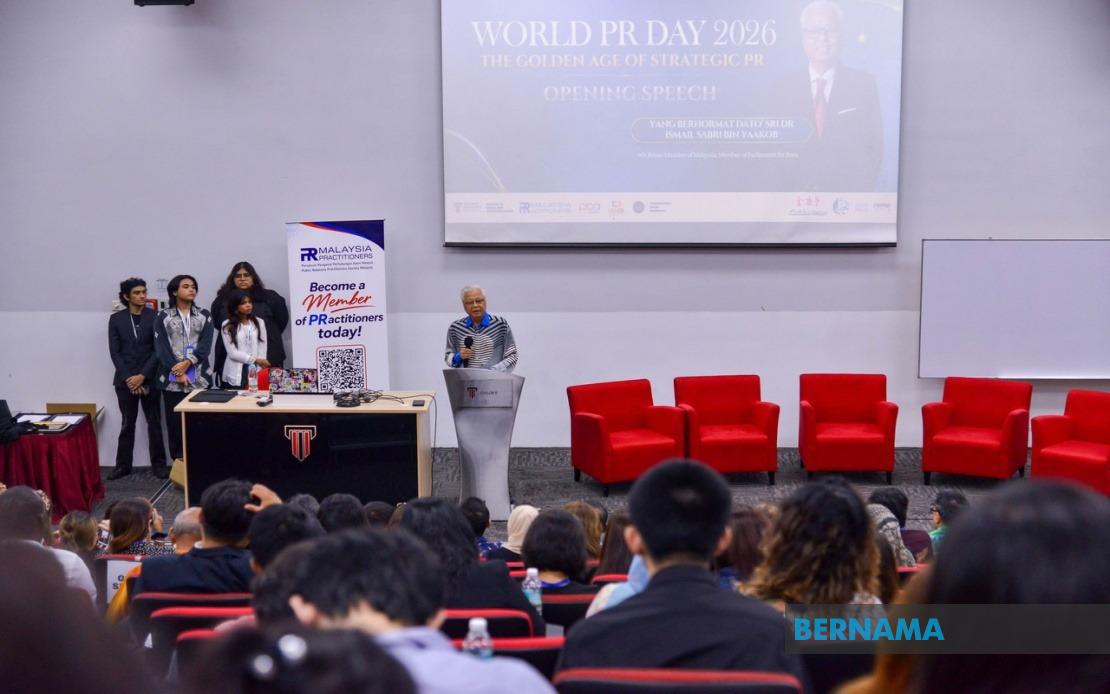
The contemporary operating environment for governments and organizations has fundamentally shifted in nature, according to former Prime Minister Datuk Seri Dr Ismail Sabri Yaakob, who argues that success is no longer determined solely by financial performance or policy outcomes. Speaking at the World PR Day 2026 launch ceremony at Taylor's University in Subang Jaya on July 16, Ismail Sabri posited that the modern era demands a parallel capacity to establish credibility through transparent, principled dialogue with stakeholders. This conceptual reorientation reflects a broader recognition that institutional legitimacy now depends as much on how leaders communicate as on what they accomplish.
The distinction Ismail Sabri drew between organizational reputation in successive eras carries significant implications for Malaysian policymakers and corporate leaders. Where the twentieth century was characterized by competition for market share and economic dominance, he contended that the current period has become defined by competition for public confidence and social license. Within this framework, trust functions as the primary strategic asset, irreplaceable by any other mechanism. The proliferation of digital connectivity has intensified this dynamic, as instantaneous information flows and horizontal communication networks allow publics to scrutinize institutional behaviour with unprecedented scrutiny and speed.
Drawing explicitly on his tenure as Prime Minister during the COVID-19 pandemic, Ismail Sabri illustrated how communication strategy becomes intertwined with policy efficacy during moments of systemic stress. His administration faced the complex challenge of repeatedly modifying standard operating procedures in response to evolving epidemiological circumstances, requiring frequent public explanation and justification. Rather than treating these communications as administrative necessity, Ismail Sabri characterized them as foundational to public acceptance of health protocols. The repeated engagement with journalists and the consistent provision of lucid, accurate information served not merely as announcement mechanisms but as instruments for sustaining confidence during an exceptionally turbulent period.
This perspective contests a conventional understanding of public relations as a subsidiary function subordinate to core operations. Instead, Ismail Sabri articulated a vision in which PR practitioners function as strategic architects of institutional narratives and custodians of organizational reputation. The evolution he described reflects a transition from PR as a tactical communication channel to PR as a core governance discipline that actively shapes how organizations are understood and evaluated within their communities. For Malaysian institutions—government agencies, corporations, and non-governmental organizations—this reframing suggests that communications expertise should be integrated into decision-making architecture rather than engaged after decisions have been finalized.
The imperative to ground all institutional communication in integrity represents Ismail Sabri's central thesis, though he acknowledged that maintaining this standard becomes increasingly complex within contemporary information ecosystems. Integrity in this context means more than rhetorical consistency; it denotes alignment between stated values and demonstrated practice, transparency about limitations and uncertainties, and honesty about costs and trade-offs associated with institutional decisions. In a context where digital scrutiny is pervasive and hypocritical gaps between rhetoric and reality are quickly exposed, the maintenance of integrity becomes a practical requirement rather than merely an ethical aspiration.
The proliferation of artificial intelligence technologies introduces both opportunity and hazard for communications practitioners, in Ismail Sabri's assessment. On the positive side, AI-driven analytical tools can enable far more sophisticated understanding of public sentiment, allowing organizations to detect emerging concerns and adjust communications strategies with greater agility. Simultaneously, these same technologies enable the creation of manipulated content, synthetic media, and deepfake material that can undermine the factual bases upon which informed public judgment depends. The asymmetrical challenge this creates—where defensive capacity struggles to match generative capacity—threatens to corrode the informational foundations necessary for functioning democracies and accountable institutions.
The proliferation of misinformation and synthetic content represents a structural threat to the trust-based operating model Ismail Sabri advocates. When substantial portions of the public struggle to distinguish accurate information from deliberately crafted falsehoods, the possibility of conducting honest institutional communication becomes severely constrained. Organizations that maintain scrupulous integrity may find their messages drowned out or obscured by higher-volume disinformation narratives. This dynamic creates a collective action problem in which the integrity-based approach only functions effectively when enough institutional actors maintain it simultaneously, yet individual incentives can pull in opposite directions.
The government's development of an AI Governance Bill, which Ismail Sabri explicitly endorsed, represents an attempt to establish regulatory frameworks that could mitigate some of these harms while preserving beneficial applications of the technology. Such governance mechanisms might establish standards for transparency regarding AI deployment, requirements for content authentication and provenance tracking, and prohibitions on particular categories of synthetic media generation. However, establishing effective governance of rapidly evolving technologies presents persistent challenges, particularly in contexts where regulatory capacity may lag behind technological development. Malaysia's positioning as both a developing economy and a regional technology hub creates particular complexity in balancing innovation encouragement against ethical safeguards.
For Malaysian public relations professionals and organizational leaders, Ismail Sabri's framework suggests several operational implications. First, integrity cannot be treated as peripheral to communications strategy but must be embedded within it from inception. Second, the capacity to explain institutional decisions transparently, particularly when those decisions involve complexity or trade-offs, becomes increasingly valuable as publics become more sophisticated and skeptical. Third, organizations must develop greater facility in engaging with emerging technologies, both to harness their analytical capabilities and to understand and counter their misuse by adversaries. Fourth, the competitive advantage increasingly accrues to institutions that maintain consistent, principled communication over time, establishing reputational capital that can sustain confidence even during periods of difficulty.
The shift from twentieth-century to twenty-first-century operating paradigms that Ismail Sabri described is not merely rhetorical but reflects genuine structural changes in how information circulates, how public judgment forms, and how institutional legitimacy is constructed and maintained. Malaysian organizations that internalize this framework and adapt their communication practices accordingly will likely prove more resilient and more capable of retaining public confidence through the various challenges ahead. Conversely, institutions that persist in treating communications as a secondary function or that fail to ground their messaging in demonstrated integrity risk finding themselves increasingly marginalized or mistrusted, regardless of their substantive accomplishments.

