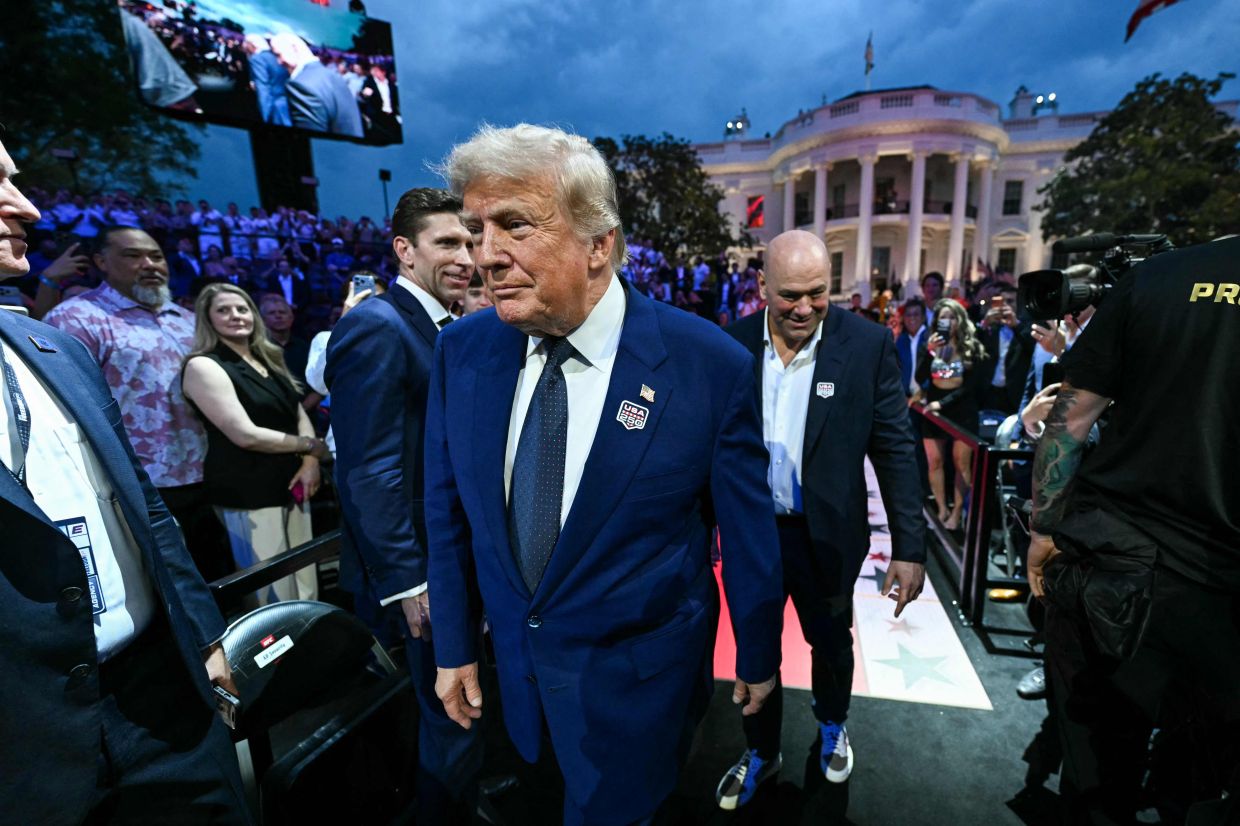
Donald Trump marked his 80th birthday Sunday evening by transforming the White House South Lawn into an unlikely battleground for the Ultimate Fighting Championship, blending American political tradition with the spectacle of combat sports in a way that exemplifies his distinctive approach to public pageantry. The unprecedented event, which kicked off just before 8:30pm with UFC President Dana White and Trump walking together through the executive residence to the arena, served as the centerpiece for broader celebrations of the United States' 250th anniversary—a milestone the administration is using as a launching pad for numerous nationwide festivities, from commemorative gold coins bearing Trump's likeness to an IndyCar race planned for August through Washington's streets.
The sporting spectacle itself was contained within a towering structure officially named the "Claw," a nearly 100-foot-tall arena structure that dwarfs most previous presidential lawn installations and will house seven cage matches. Inside this architectural novelty, 4,300 spectators had ringside access, while organisers anticipated an additional 120,000 people gathering at the nearby Ellipse, where free admission was distributed through a lottery system. UFC President Dana White, a longtime friend and ally of the president, described the event as Trump's own initiative, reflecting the commander-in-chief's long-standing fascination with the league's fights and their appeal to younger male audiences who proved instrumental in his 2024 election victory.
The gathering brought together an eclectic mix of American power players and cultural figures, underscoring both the event's symbolic importance to Trump's political brand and the administration's courtship of industries and figures previously on the periphery of White House influence. Meta Platforms CEO Mark Zuckerberg, Paramount Skydance CEO David Ellison, Treasury Secretary Scott Bessent, and various Trump family members occupied prime viewing positions. Commentary throughout the matches was provided by Joe Rogan, the podcast host whose audience of predominantly young men significantly overlaps with Trump's electoral coalition. Military servicemembers filled portions of the audience, with the broadcast notably cutting to watch parties at various military bases worldwide, including installations in Okinawa, suggesting the administration viewed the event as a morale-boosting exercise for the armed forces.
The logistical undertaking proved staggering by any presidential standard. The UFC reportedly spent over US$60 million to stage the Sunday fights, while court filings revealed that more than seven federal agencies allocated "significant resources and manpower" to executing what amounts to a private sporting event at taxpayer facilities. The scale of government involvement triggered legal action from the Public Integrity Project, which filed a lawsuit characterising the arrangement as a "volcano of corruption," though courts ultimately declined to halt the proceedings. The Trump family's World Liberty Financial venture contributed an additional US$250,000 in bonus payments to the top two fighters, further intertwining the president's business interests with the event's financial architecture.
Yet public sentiment appeared decidedly mixed about the enterprise. A YouGov poll released June 5 found that 51 percent of Americans disapproved of the White House fight, while only 27 percent expressed approval—a ratio suggesting the event resonated primarily within Trump's existing electoral base rather than commanding broader national enthusiasm. The administration's argument that UFC was covering all event costs and handling sponsorship discussions attempted to mitigate concerns about government resources being deployed for presidential birthday entertainment, though the sheer scale of federal agency involvement complicated such assurances. Commercial partnerships reflected the event's crossover appeal to Trump's supporters, with Crypto.com and Dodge's Ram truck brand among the listed sponsors, targeting demographics that have embraced both cryptocurrencies and the broader Trump brand ecosystem.
The pregame festivities showcased how thoroughly the administration had integrated the event into its broader ceremonial calendar. UFC President White and the competing fighters held their official news conference at the Lincoln Memorial, that most hallowed of American civil rights landmarks, where combatants engaged in the traditional pre-fight theatrics of insults and victory predictions. Fighter Michael Chandler, in particular, elevated the occasion to patriotic symbolism by referencing the privilege of fighting "on the White House lawn for America's 250th birthday," attempting to frame combat sport within nationalist narratives. The choice of the Lincoln Memorial as the venue for this announcement represented a striking juxtaposition—using the physical and symbolic location of Martin Luther King Jr.'s most famous speech as the setting for UFC promotional activities.
The White House itself required significant modifications to accommodate the undertaking. Locker rooms were established directly on the executive residence grounds, including within the Indian Treaty Room, a space ordinarily reserved for formal diplomatic and state functions. The South Lawn, historically the venue for more genteel affairs like the Easter Egg Roll and Congressional Picnic, underwent a remarkable transformation that prompted comparisons between the towering Claw structure and the Eiffel Tower in Paris. Trump himself suggested, in a TikTok video recorded June 2, that the structure might become a permanent White House fixture—"We're building something in front of the White House that's quite attractive to a lot of people," he remarked. "Maybe we'll never ever take it down." He later characterised this comment as humorous, though court filings indicated the structure would be disassembled beginning at 10am Monday.
The timing of the birthday celebration carried particular significance for Trump's immediate schedule. Having concluded the White House UFC event Sunday evening, the president was preparing to depart for France to participate in Group of Seven leadership discussions—meetings likely to involve contentious negotiations on trade, defence commitments, and geopolitical strategy. He was expected to travel to these consequential international forums equipped with a UFC championship belt, according to the company, suggesting the administration intended to carry forward the symbolic energy of the Sunday event into high-stakes diplomatic engagements. The contrast between the controlled spectacle of the UFC event and the more unpredictable dynamics of multilateral international negotiations illustrated the compartmentalisation increasingly characteristic of Trump's approach to governance.
Beyond the immediate event logistics, the White House UFC extravaganza signalled something more fundamental about how the Trump administration intends to leverage presidential platforms and institutional resources. The administration's embrace of the UFC—including State Department and Federal Bureau of Investigation partnership deals—reflected a broader willingness to integrate private entertainment enterprises into the machinery of government in ways that previous administrations had avoided. The generation of young male voters attracted to combat sports represented an electoral constituency that had previously been underrepresented in traditional White House ceremonial events, and Trump's deliberate cultivation of this demographic through venue choice, talent selection, and broadcast reach suggested a calculated strategy to maintain coalition cohesion. Whether such initiatives ultimately strengthen or strain public institutions remained a matter of significant debate among observers across the American political spectrum.