A contentious legal battle has erupted over a new commercial service offering wealthy subscribers privileged access to President Donald Trump's Truth Social announcements. The Intercept and the Freedom of the Press Foundation filed suit in Manhattan federal court on Wednesday, seeking to halt Truth API, a paid feed that charges users up to $100,000 monthly for early access to posts from ten high-profile accounts, with Trump's own account featuring prominently among them. The lawsuit strikes at the heart of ongoing tensions between presidential transparency, market fairness, and the commercialisation of government communications in the digital age.
Truth API launched on August 1, just four days after Democratic Senators Elizabeth Warren of Massachusetts and Adam Schiff of California formally requested that the U.S. Securities and Exchange Commission investigate whether the service compromised financial market integrity while enriching Wall Street insiders and enriching the president personally. The timing underscores deepening concern among lawmakers and transparency advocates that official government information is being monetised in ways that could advantage certain investors over the broader public. The plaintiffs argue in their complaint that providing paid subscribers with advance knowledge of presidential statements—particularly those addressing economic policy, tariffs, or geopolitical developments—creates an unjust information asymmetry that undermines fair market function.
The core grievance centres on Trump's documented pattern of using Truth Social to break news on consequential matters affecting financial markets. During his current term, the president has repeatedly announced policy positions on tariffs, Middle East conflicts, and economic measures through the platform before formal White House statements materialise. This practice has allowed subscribers to the Truth API service to potentially profit from advance intelligence on market-moving announcements. The lawsuit specifically targets White House officials, seeking to prohibit them from posting official government announcements exclusively on Truth Social while the paid access service remains operational, effectively arguing that government communications cannot be privatised through commercial subscription models.
In their legal filing, the Intercept and Freedom of the Press Foundation characterise Truth API as "profoundly corrupt," emphasising that the president stands to gain substantial financial benefit when subscribers sign up for the service. They contend the arrangement violates constitutional guarantees of equal access to public information. The complaint emphasises that the First Amendment protects not merely the right to publish, but the public's right to receive government communications on equal terms. There is no legitimate government interest, the plaintiffs argue, in selling presidential posts to private subscribers while allowing the president himself to profit from the arrangement.
The scale of Trump's financial stake in Truth Media underscores the apparent conflict of interest. The president holds a 41.3% stake in Trump Media & Technology Group worth approximately $950 million through his Donald J. Trump Revocable Trust, according to Reuters data. His oldest son, Donald Trump Jr., serves as a company director and oversees the trust arrangement. This ownership structure means that every subscription sold through Truth API directly enriches the president's personal wealth, raising acute questions about whether government communications are being sold to finance private interests.
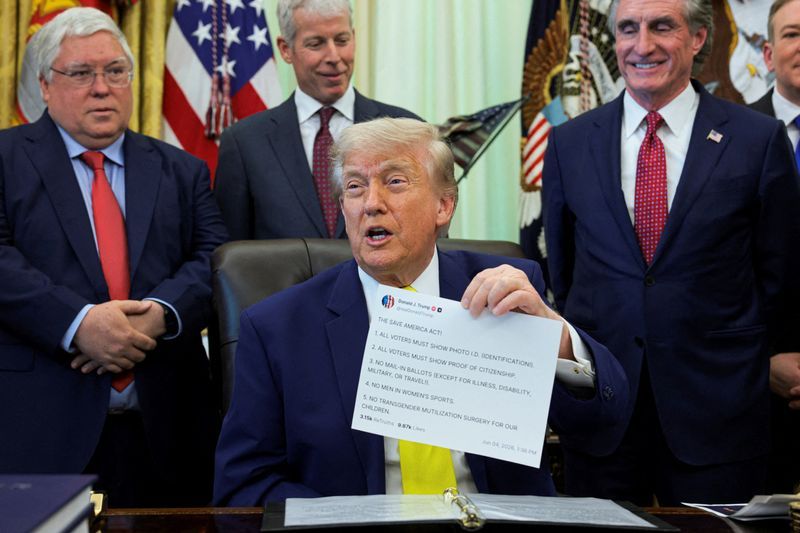
According to the complaint's analysis, many of Trump's 9,000 to 11,000 Truth Social posts and reposts during his second term were never followed by formal White House statements, suggesting that the platform has become a primary channel for presidential communication rather than a supplementary one. This reliance on Truth Social as the preferred announcement mechanism—combined with the pay-to-access model—creates a system where the public receives official government information only after paid subscribers have already acted on it. Other prominent accounts offered through Truth API include those of Vice President JD Vance, Health and Human Services Secretary Robert F. Kennedy Jr., FBI Director Kash Patel, and the White House itself, effectively extending the commercial access model across the highest levels of the executive branch.
Trump Media's response to the lawsuit has focused on comparative precedent and accusations of political weaponisation. A company spokesperson contended that "countless" media platforms and news outlets, including many operating subscription-based feeds, already disseminate information originating from Trump. The company argued that left-wing activists are attempting to "wrongfully weaponise the courts to censor him" and harm shareholders through the litigation. On a recent earnings call, interim Chief Executive Kevin McGurn characterised Truth API as merely enabling subscribers to receive news "fractionally faster" than others, attempting to minimise the service's significance as a marginal convenience rather than a material advantage.
For Malaysian and Southeast Asian observers, this dispute carries implications beyond the immediate U.S. context. The case raises fundamental questions about how digital platforms, government communications, and financial transparency intersect in democratic systems. As more governments worldwide develop official social media presences and consider monetisation strategies, this lawsuit establishes important precedent regarding the permissibility of commercialising government announcements. The outcome could influence how regional governments in Southeast Asia manage their own digital communications and whether they face similar challenges should they attempt to create subscription-based access to official policy announcements.
The lawsuit also reflects broader anxieties about information equity in digital-first societies. In an era where social media platforms serve as primary news sources for millions globally, questions about who receives information first and on what terms carry profound implications for market fairness and democratic accountability. The involvement of the Freedom of the Press Foundation—a nonprofit advocacy group focused on press freedom and government transparency—signals that transparency advocates view the case as establishing important principle rather than merely contesting a single commercial service.
The White House declined to comment on the litigation, and Trump Media is notably absent from the defendant list, with the lawsuit instead targeting White House officials personally. This procedural choice may prove significant as the case develops, potentially creating distinct liability questions for individual government figures versus the corporate entity operating the commercial platform. The composition of the Securities and Exchange Commission—currently controlled by three Republican commissioners—means that the congressional call for investigation may face institutional resistance, leaving the courts as the primary forum for resolving these disputes about government transparency and market integrity.

