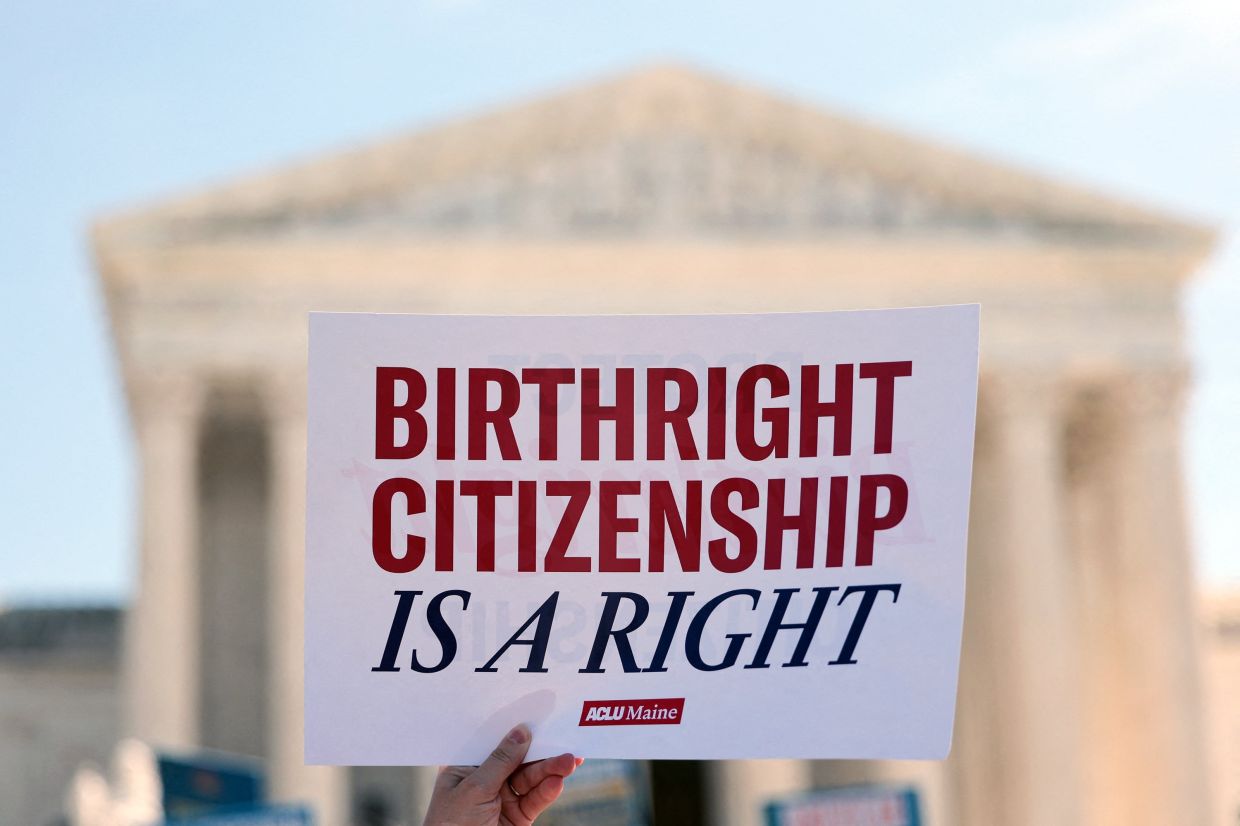
President Donald Trump's constitutional challenge to birthright citizenship suffered a significant setback when the US Supreme Court rejected his attempt to restrict citizenship for children born to undocumented immigrants or those on temporary visas. Rather than accept defeat, Trump immediately pivoted his strategy, directing public attention toward China through a sarcastic social media post congratulating Beijing on a perceived "massive Birthright Citizenship WIN". The message signalled a fundamental shift in how the administration would pursue its citizenship agenda, moving away from constitutional arguments toward enforcement actions and legislative approaches centred on alleged exploitation of US citizenship laws by foreign nationals.
In the immediate aftermath of the court ruling, the Department of Justice instructed federal prosecutors to prioritise investigations into birth tourism operations, and House Speaker Mike Johnson announced that lawmakers were developing legislation targeting women who travel to the United States specifically to give birth. These moves demonstrate a coordinated effort across the executive and legislative branches to circumvent the judicial rejection of Trump's initial approach. The administration appears to be banking on enforcement and legislative action where constitutional arguments failed, framing the issue through the lens of immigration system abuse rather than blanket restrictions on citizenship eligibility.
The rhetoric surrounding birth tourism has become increasingly centred on China despite the absence of comprehensive federal data measuring the actual scope of the phenomenon. Trump has repeatedly invoked Chinese citizens in his messaging, claiming in March 2025 that birthright citizenship attracts wealthy foreigners who pay to secure American citizenship for their children. He has also made the demonstrably false assertion that the United States stands alone in granting birthright citizenship, a claim contradicted by Pew Research Centre analysis showing that thirty-two other nations have substantially similar laws, including neighbouring Canada and Mexico. This selective emphasis on China appears driven more by geopolitical messaging than by empirical evidence.
The actual scale of birth tourism remains hotly contested. During a congressional hearing, Peter Schweizer of the Government Accountability Institute claimed roughly one million US citizens were being raised in China as a result of birth tourism, a figure that legal scholars have dismissed as wildly inflated. Peter Spiro, an American legal scholar, characterised the practice as having risen to become "a non-trivial phenomenon" in recent decades, but stopped well short of endorsing the extraordinary claims being circulated by administration figures. This gap between political rhetoric and academic assessment reveals the degree to which the administration is leveraging unsubstantiated figures to justify policy action.
Births to mothers born in China represent a minuscule fraction of overall United States births, according to National Centre for Health Statistics data. In 2023, Chinese-born mothers accounted for 27,476 of the 3.7 million total births recorded in the country, with only 113 births to non-US residents from China. These numbers have actually declined from 2018, when 267 births were recorded to non-US residents from China, suggesting the trend is moving in the opposite direction from what administration figures have suggested. Even accounting for potential misrepresentation of residence status, the data do not support claims of a widespread phenomenon requiring urgent legislative action.
The Northern Mariana Islands, a US territory frequently cited as a hotspot for birth tourism activity, presents a similar picture. In 2023, the territory recorded just 581 total births, with merely two attributed to foreign-resident mothers, compared to 2018 when 697 births were recorded to foreign residents out of 1,262 total births. The dramatic decline in absolute numbers and the minimal share of births to foreign residents contradicts the narrative of rampant exploitation that administration officials have constructed. However, these statistics do not specify the nationality of foreign residents giving birth, leaving open questions about the Chinese component of any birth tourism activity.
From a legal standpoint, giving birth while visiting the United States is not inherently criminal. Prosecutions in birth tourism cases have typically relied on charges of visa fraud, conspiracy, money laundering, or other offences involving allegations that travellers misrepresented the purpose of their visits. Joseph Kwon, a US-based immigration lawyer, has raised concerns about the burden such enforcement actions place on pregnant visitors, noting that "a pregnant traveller with a valid visa shouldn't have to prove she isn't a stereotype". The shift toward aggressive enforcement creates potential complications for legitimate travellers and raises questions about the practical implementation of birth tourism investigations.
The Justice Department has nevertheless framed organised birth tourism schemes as constituting systematic fraud and abuse of the immigration system. In recent enforcement memos, Justice Department officials have referenced cases including that of fugitive Chao "Edwin" Chen, who received a 37-month prison sentence for operating a birth tourism business that allegedly served over 500 cases. The department has cited such cases as evidence of organised criminal networks exploiting US citizenship law, arguing that thousands of foreigners enter the country under false pretences to secure citizenship for their children. These prosecutions form the evidentiary foundation for the administration's push for expanded enforcement and legislation.
Congressional Republicans have enthusiastically embraced the administration's framing of birth tourism as a sovereignty and security issue. Representative Chip Roy characterised birth tourism and related programmes as tools that "foreign adversaries like the Chinese Communist Party" leverage to gain influence within US borders, connecting immigration enforcement to broader geopolitical competition. This rhetorical link between immigration policy and strategic competition with China has proven politically potent, allowing Republicans to frame citizenship and visa issues through a national security lens. The language mirrors broader administration rhetoric positioning China as a fundamental threat to American institutions and sovereignty.
While China has become the focal point of administration messaging, other nations including Turkey, Russia, and Mexico have also faced allegations of operating birth tourism schemes. The selective emphasis on China appears driven by political calculation rather than proportional threat assessment based on available evidence. The administration's framing has successfully transformed what empirical data suggests is a marginal phenomenon into a central immigration and national security concern, with China serving as the symbolic embodiment of external threats to American citizenship integrity. This rhetorical strategy has proven effective in mobilising congressional action regardless of the limited evidentiary foundation.
For Malaysia and Southeast Asian observers, the Trump administration's pivot toward birth tourism enforcement carries several implications. First, it demonstrates how immigration policy can become weaponised in geopolitical competition, with China serving as a convenient focal point regardless of actual scope or severity. Second, it raises concerns about how enforcement actions targeting citizens of specific nations might proliferate, potentially affecting Southeast Asian travellers to the United States. Third, it reflects a broader pattern of the Trump administration using enforcement and legislative action to circumvent judicial setbacks, establishing precedents that could extend to other policy areas affecting regional interests.
The gap between the administration's claims and available data underscores how political narratives can diverge significantly from empirical reality in immigration policy debates. While birth tourism may warrant legitimate policy discussion and measured enforcement responses, the scale and urgency invoked by Trump administration figures appears substantially inflated. The strategic elevation of China as the primary villain in this narrative serves geopolitical messaging purposes beyond the immigration issue itself. For policymakers across the region, the case illustrates the importance of relying on empirical data rather than political rhetoric when evaluating claims about immigration system abuse and developing proportionate policy responses.

