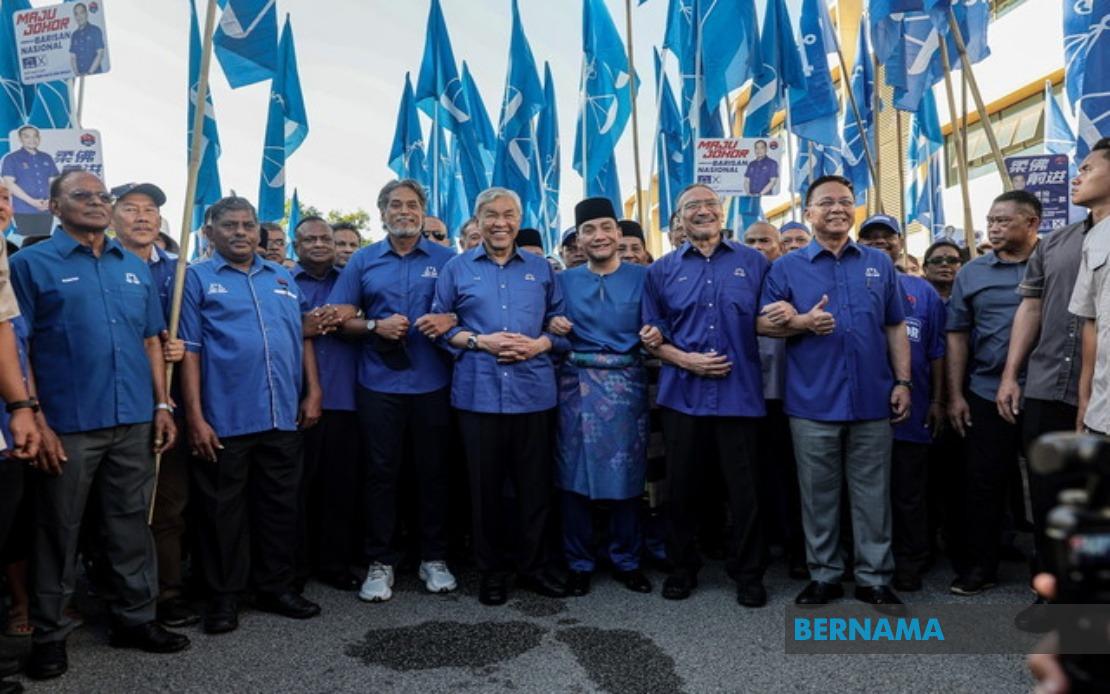
Johor's political establishment demonstrated its backing for continuity when Barisan Nasional chairman Datuk Onn Hafiz Ghazi lodged his nomination documents for the state election on June 27, supported by a notable ensemble of senior party figures at the nomination centre in Simpang Renggam. The incumbent Machap assemblyman arrived at the Muafakat Hall of the Simpang Renggam District Council at 9.10 am, accompanied by UMNO president Datuk Seri Dr Ahmad Zahid Hamidi, a move that underscores the party's strategic emphasis on presenting a united front during the campaign period.
The turnout of prominent figures alongside Onn Hafiz reflects the traditional approach of Malaysian political parties in leveraging leadership visibility during nomination exercises. Sembrong MP Datuk Seri Hishammuddin Tun Hussein and former minister Khairy Jamaluddin were among those joining the submission, their presence contributing to what observers might interpret as a consolidated display of organizational strength. Such gatherings have become standard practice in Malaysian electoral cycles, with parties recognising that early demonstrations of cohesion can shape media narratives and voter perception during the crucial initial phase of campaigning.
The participation of former Johor Menteri Besar Datuk Seri Hasni Mohammad added another symbolic layer to the proceedings, connecting the current leadership with the state's institutional memory and previous administrations. This intergenerational representation suggests deliberate effort to bridge past and present party directions, potentially messaging continuity in governance to the electorate. The inclusion of figures who have previously held high office carries particular weight in Malaysian politics, where respect for institutional hierarchy and political experience remains culturally significant.
Onn Hafiz's nomination filing marks a formal commencement of what promises to be a significant electoral contest for Johor. As the state where Barisan Nasional has traditionally maintained substantial influence, the outcome of this election will carry implications beyond Johor's borders. The electoral performance here could influence intra-coalition dynamics within BN and provide indicators of voter sentiment toward the ruling coalition's broader governance record at both state and national levels.
The scenes at Simpang Renggam reflected the mobilization of party machinery that characterises Malaysian elections. Supporters congregated in the surrounding areas, visibly displaying party colours through banners and flags, a manifestation of grassroots enthusiasm that parties view as crucial for momentum-building. These organic displays of support, when photographed and reported, contribute to the psychological dimension of electoral competition by creating impressions of candidate viability and party strength among the broader electorate.
Onn Hafiz's transition from his Machap state seat to the broader Johor leadership challenge under the BN banner indicates the party's confidence in his electoral appeal and administrative capabilities. His selection reflects internal party calculations regarding which figures possess sufficient credibility and organisational backing to lead the coalition's challenge in one of Malaysia's most politically significant states. The nomination represents both a validation of his standing within UMNO's internal structures and a test of his ability to translate party backing into electoral victory.
The presence of Dr Ahmad Zahid Hamidi holds particular significance given his role as UMNO president and his responsibilities in steering the party's broader strategic direction. His physical attendance at the nomination centre sends a clear signal about party prioritisation of the Johor election and confidence in the selected candidate. In Malaysian political communication, such visibility functions as an endorsement mechanism, effectively telling party members and supporters that leadership hierarchy approves and actively supports the campaign effort.
For Malaysian voters and political observers, the composition of figures supporting Onn Hafiz during nomination carries interpretive weight. The gathering represented not merely logistical support but a statement about the ideological and organisational coherence of Johor's BN machinery at a moment when opposition coalitions in other states have demonstrated capacity to challenge traditional ruling parties. The specific selection of accompanying leaders may also hint at which faction within UMNO Onn Hafiz aligns with or receives patronage from, an enduring subtext in Malaysian electoral politics where intra-party alignments frequently determine campaign resource allocation and messaging strategies.
The Johor state election represents a significant test for the Barisan Nasional coalition and UMNO specifically. The state's economic importance, diverse demographic composition, and historical significance in Malaysian politics mean that electoral performance here reverberates through national political calculations. Onn Hafiz's candidacy, backed by the senior leadership contingent present at Simpang Renggam, positions his campaign as a central battleground in the broader struggle between Malaysia's ruling and opposition coalitions.
Looking forward, the nomination filing initiates a campaign period during which the quality of Onn Hafiz's messaging, his ability to address constituent concerns, and the effectiveness of party machinery in mobilising voters will determine electoral outcomes. The strong institutional backing visible at Simpang Renggam provides organisational advantages, though Malaysian electoral history demonstrates that organisational support alone cannot guarantee results, particularly in an era where voter preferences have become increasingly unpredictable and issue-driven rather than traditionally aligned.

