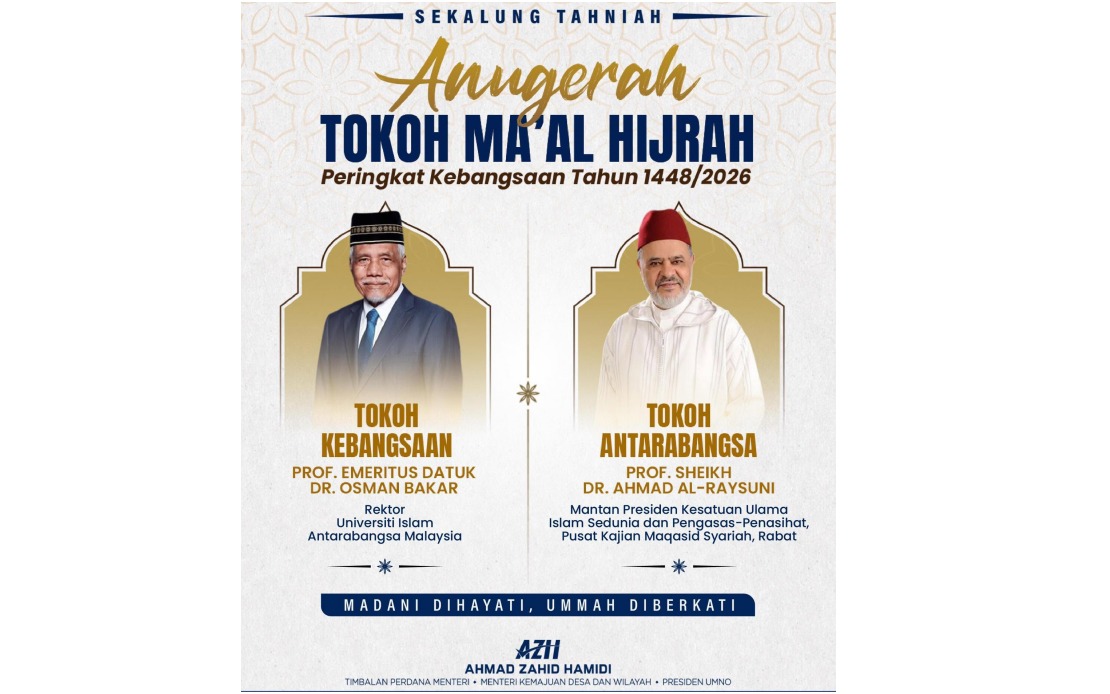
Malaysia's Deputy Prime Minister Datuk Seri Dr Ahmad Zahid Hamidi has urged the nation's Muslim population to find inspiration in the accomplishments of this year's Tokoh Maal Hijrah award recipients, viewing their recognition as a catalyst for broader spiritual and social engagement within the community. The ceremony, held at Masjid Putra in Putrajaya, witnessed the Sultan of Perak, Sultan Nazrin Shah, presenting the accolades alongside cash prizes, trophies and certificates of appreciation to the two honoured individuals.
Among those celebrated were Prof Emeritus Datuk Dr Osman Bakar, who received the prestigious National Tokoh Maal Hijrah Award, and Prof Sheikh Dr Ahmad Al-Raysuni from Morocco, recognised with the International Tokoh Maal Hijrah Award. Both scholars have distinguished themselves through substantial intellectual and social contributions to the Muslim world. Ahmad Zahid highlighted how their recognition underscores the significance of empowering Muslim communities and elevating knowledge within Islamic circles, while simultaneously promoting Islamic values characterised by compassion, discernment and societal benefit.
The Deputy Prime Minister articulated a vision of collective responsibility, calling upon Malaysian Muslims to maintain their commitment to expanding their learning, engaging meaningfully with their communities and actively participating in the development of the broader ummah, the nation itself, and the wider Islamic civilisation. This framing positions the awards not merely as recognition of past achievements but as benchmarks that should motivate ongoing contributions across religious, educational and civic spheres. The emphasis on knowledge-seeking reflects contemporary Islamic thought that views intellectual advancement as compatible with, and indeed essential to, spiritual development.
Deputy Prime Minister Datuk Seri Fadillah Yusof echoed similar sentiments while offering a slightly different perspective, extending the relevance of the awards beyond the Muslim community to encompass all Malaysians. Fadillah stressed that the recipients' accomplishments demonstrate the kinds of meaningful service and national contribution that should resonate across religious and cultural boundaries. His remarks suggest an understanding that the values embodied by the award recipients—dedication to excellence, community engagement and principled leadership—transcend sectarian lines and speak to universal aspirations for societal progress.
Crucially, Fadillah contextualised the awards within the broader theological and historical framework of the Islamic calendar's Maal Hijrah observance. Rather than treating the Migration of Prophet Muhammad as a distant historical occurrence, he positioned it as an enduring philosophical principle that continues to instruct Muslims in contemporary times. The hijrah, he explained, encapsulates fundamental values including sacrifice, mutual cohesion, steadfastness and a determined commitment to enacting constructive transformation. This interpretation emphasises continuity between the Prophet's actions and modern Muslim engagement with societal challenges.
The integration of historical Islamic examples into present-day policy discourse reflects a deliberate effort by Malaysian leadership to ground national development initiatives within Islamic principles. By invoking the hijrah's significance beyond its historical context, Fadillah suggested that Muslims should approach nation-building and community welfare with the same dedication and resilience that characterised the Prophet's migration. This rhetorical strategy serves to legitimise contemporary governance frameworks and societal objectives through reference to foundational Islamic narratives.
Fadillah's call for strengthened national unity, enhanced religious commitment and increased charitable actions targets multiple constituencies simultaneously. The formulation appeals to those prioritising religious observance, those focused on national development, and those concerned with social welfare and communal bonds. By linking these objectives together—suggesting they are mutually reinforcing rather than competing—the Deputy Prime Minister articulated a governing philosophy that positions religious devotion and patriotic engagement as complementary rather than contradictory impulses.
For Malaysian readers, the significance of these awards and their endorsement by senior government figures extends beyond ceremonial recognition. The explicit mention of an international recipient from Morocco signals Malaysia's positioning as a centre of Islamic intellectual life that engages with and honours scholarship beyond its borders. This enhances Malaysia's profile within the global Islamic community while simultaneously suggesting that excellence in Islamic learning transcends geographical boundaries. The national celebration of such international recognition potentially elevates Malaysia's soft power within Muslim-majority regions.
The Tokoh Maal Hijrah awards programme itself represents an institutional mechanism through which the Malaysian state curates and promotes particular visions of Islamic excellence and social contribution. By selecting specific individuals for honour, the programme implicitly establishes benchmarks for what constitutes meaningful engagement with Islamic knowledge and community service. Prof Osman Bakar's selection, in particular, highlights Malaysia's investment in recognising local scholars whose work bridges traditional Islamic learning and contemporary intellectual discourse. His emergence as a National Tokoh Maal Hijrah recipient affirms the government's prioritisation of intellectualism within Malaysian Islamic institutions.
The ceremony's location at Masjid Putra—a site laden with symbolic significance as Malaysia's national mosque—underscores the state's alignment with the religious dimension of national identity. The presence of the Sultan of Perak in conferring the awards further emphasises the constitutional role of traditional rulers in upholding Islamic institutions and values. This ceremonial apparatus demonstrates how contemporary Malaysia integrates monarchical traditions, religious institutions and state apparatus in articulating national identity and governance priorities.
Looking forward, Ahmad Zahid and Fadillah's remarks suggest that the government anticipates the award recipients' example will catalyse broader engagement with Islamic learning and community service among Malaysian Muslims. The emphasis on inspiration and emulation indicates an expectation that recognition alone carries motivational force. Whether this aspiration materialises depends on the extent to which the awards recipients' work becomes accessible and relevant to diverse Muslim constituencies, from urban professionals to rural communities.