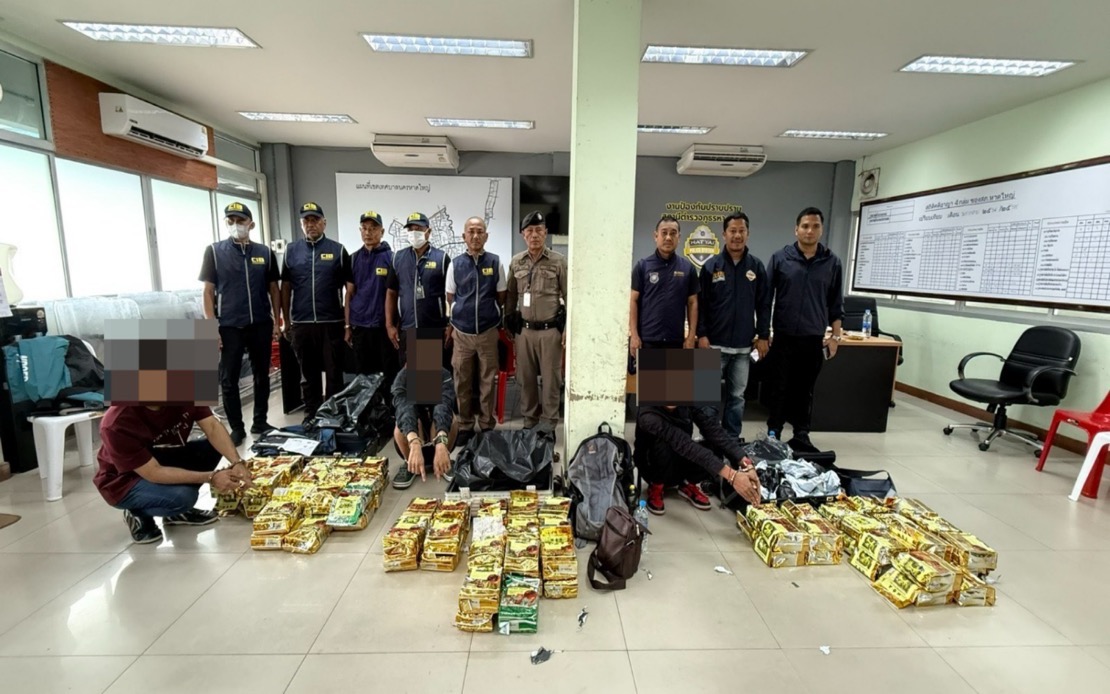
Three Malaysian men were taken into custody at Hat Yai Railway Station in Thailand's Songkhla province on July 31 after authorities discovered they were attempting to transport 87 kilograms of crystal methamphetamine, commonly known as syabu or 'ice', across the border. The contraband was concealed within three wheeled suitcases and three backpacks when officers intercepted the suspects upon their arrival from Bangkok, marking another significant seizure in the region's ongoing battle against transnational drug trafficking.
The operation represented a coordinated enforcement effort across Thai law enforcement agencies, with the Narcotics Control Board's Region 9 Office taking the lead. According to Ratchapon Palakul, director of the ONCB's Region 9 Office, the "Tawan Hat Yai" unit orchestrated the arrest in conjunction with railway police, the Crime Suppression Division, the Anti-Trafficking in Persons Division, tourist police, the Narcotics Suppression Bureau, and regional ONCB personnel. This multi-agency approach underscores how authorities have systematized their response to drug smuggling across international transport hubs.
The suspects' route proved instructive about trafficking patterns between the two countries. They had boarded a passenger train in Bangkok with the explicit intention of reaching Hat Yai, where border proximity would facilitate the final leg of their illicit journey into Malaysia. Their apprehension at the railway terminus demonstrates that screening operations at transportation checkpoints continue to yield results, particularly when agencies share intelligence and coordinate surveillance activities at vulnerable transit points.
During preliminary questioning, one of the detained individuals revealed that members of an organized syndicate had recruited them specifically for this operation, offering each suspect 8,000 ringgit as compensation for successfully delivering the narcotics into Malaysian territory. This financial incentive structure reflects how trafficking networks exploit economic desperation, particularly targeting individuals willing to assume substantial personal risk for relatively modest payments—a pattern familiar across Southeast Asia's drug trade.
The legal consequences facing the three men are severe under Thai law. They now face joint charges of possessing and trafficking Category 1 narcotics with intent to distribute, offenses that carry potential prison sentences reaching 15 years and financial penalties of up to 1.5 million baht, equivalent to approximately 183,000 ringgit. These sentencing guidelines reflect Thailand's zero-tolerance stance toward methamphetamine trafficking, an approach that has intensified across the region as governments confront record consumption rates, particularly among younger demographics.
The 87-kilogram seizure represents a substantial quantity by regional standards, suggesting this was a significant consignment rather than an opportunistic trafficking attempt. Such volumes typically indicate the involvement of established criminal networks with reliable supply sources, likely concentrated in the Golden Triangle region where clandestine production facilities continue operating despite sustained military and police operations. The scale of the operation implies that dismantling it will require investigation beyond the three apprehended individuals.
Thailand and Malaysia have escalated cooperation on narcotics enforcement in recent years, recognizing that bilateral trafficking undermines both nations' public health and security interests. Hat Yai, positioned as a major transport nexus between the two countries, has become a focal point for joint operations. The railway station represents a particularly critical chokepoint given the volume of regular passenger traffic crossing daily, making it an obvious target for systematic screening by narcotics authorities.
Investigators have now prioritized identifying upstream elements of the trafficking organization, particularly the principals who orchestrated recruitment, sourcing, and logistics. These "masterminds," as Thai officials termed them, typically operate with multiple redundancies, maintaining distance from street-level operatives and using compartmentalized networks that minimize exposure if individual cells are compromised. The apprehension of three transporters rarely yields sufficient intelligence to dismantle entire syndicates unless cooperation is secured and informant networks are properly cultivated.
From a Malaysian perspective, this seizure reflects the persistent threat posed by methamphetamine trafficking across the northern border. The drug has become increasingly accessible within the country over the past decade, driving addiction rates and associated social problems from Perlis to Kedah. The attempted importation of such quantities would have substantially expanded availability domestically, suggesting that prevention at source remains critical to managing supply-side pressures on the domestic market.
The incident also highlights how trafficking organizations continuously adapt their methods and routes in response to enforcement activities. The choice of rail transport, as opposed to road vehicles or maritime routes, suggests these smugglers believed railway checkpoints offered comparative advantages—or conversely, that criminal networks had identified intelligence gaps they hoped to exploit. Thai authorities' success in this instance indicates those calculations were flawed.
Broader regional implications extend to Myanmar, where production capacity for methamphetamine continues expanding despite international pressure on suppliers. As long as manufacturing remains economically viable and lucrative demand persists across Southeast Asia, traffickers will exploit land borders, maritime routes, and increasingly sophisticated concealment techniques. The three Malaysians captured at Hat Yai represent merely one link in supply chains that funnel drugs through multiple countries before reaching end consumers.
The case underscores why Malaysian authorities maintain heightened vigilance at land borders and transportation terminals, particularly during peak travel periods when criminal networks attempt to hide shipments among legitimate passenger movements. Coordination between Thai and Malaysian agencies continues proving essential for disrupting trafficking flows, suggesting that deepening institutional relationships and information-sharing mechanisms will remain priority areas for both governments as they confront this persistent transnational challenge.

