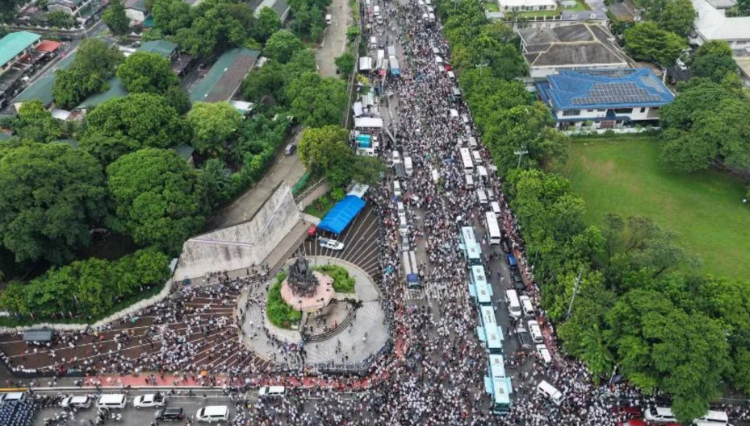
Thousands of members of the Iglesia Ni Cristo, one of the Philippines' most influential religious organisations, converged on Manila's EDSA highway on Tuesday to demonstrate against planned criminal charges targeting Senator Rodante Marcoleta, bringing the capital's rush-hour traffic to a near standstill. The massive show of force by the church came just 24 hours after the ombudsman announced that Marcoleta, a prominent senator and church adherent closely aligned with embattled Vice President Sara Duterte, would face graft prosecution related to alleged failures in his election campaign fund disclosures. Police estimated the crowd at 8,000 people during morning hours, with authorities predicting the numbers would swell as the day progressed, transforming the major arterial road into a sea of protesters and leaving only bus lanes functional for commuters.
The timing of the rally reflects the intense political stakes now gripping the Philippines as the country enters an unprecedented phase of governance turmoil. Vice President Duterte faces a Senate impeachment trial scheduled to commence on July 6, with conviction requiring 16 affirmative votes from the 24-member chamber—a threshold that would strip her of office and bar her permanently from elected positions. Marcoleta has emerged as a critical figure in this institutional drama, widely regarded as virtually certain to vote against conviction, potentially offering Duterte a crucial bulwark within the Senate proceedings. The graft charges against him—centred on his failure to declare approximately 75 million pesos in unspent campaign contributions—arrive at a politically sensitive moment, leading observers to question whether his prosecution represents legitimate governance or constitutes strategic manoeuvring ahead of the vice president's trial.
The Iglesia Ni Cristo's mobilisation demonstrates the continuing political muscle wielded by the fundamentalist Christian organisation, which has historically exercised disproportionate influence in Philippine electoral contests through its coordinated voting patterns. The church maintains deep institutional connections to the Duterte political family, dating back decades and encompassing both former president Rodrigo Duterte and his daughter. The group's decision to deploy its membership in defence of Marcoleta signals the religious sect's determination to protect interests aligned with the Duterte faction even as that family experiences what appears to be a dramatic reversal of political fortunes under the Marcos administration.
Church spokesman Edwil Zabala articulated the organisation's position through a Facebook video posted during the demonstration, framing the rally around grievances regarding selective justice and institutional transparency. Zabala rejected what the church characterized as discriminatory legal processes, warning authorities that even incarceration of Marcoleta would not dampen the INC's commitment to challenging what it termed unjust prosecutions. The language employed—emphasising selective application of law as fundamentally illegitimate—reflects broader sentiments within Duterte-aligned factions who contend that the administration of President Ferdinand Marcos is employing legal mechanisms to eliminate political rivals while shielding its own supporters from accountability.
The pattern of prosecutions involving Duterte loyalists has accelerated markedly in recent months, suggesting either a coordinated governmental offensive or the natural accumulation of longstanding corruption allegations that remained dormant under the previous administration. Senator Jose "Jinggoy" Estrada, another prominent Duterte ally, now faces criminal charges stemming from a massive corruption scandal involving fictitious flood-control infrastructure projects that sparked public outrage across the nation. Meanwhile, Senator Ronald "Bato" Dela Rosa, a former national police chief under Rodrigo Duterte and a key implementer of the former president's brutal anti-drug campaign, has effectively disappeared following his near-arrest on an International Criminal Court warrant connected to extrajudicial killings.
The trajectory of these prosecutions cannot be understood in isolation from the fractious relationship that has developed between Duterte and Marcos, whose alliance during the 2022 election has completely unravelled into open hostility. This rupture has fundamentally altered Philippine political geometry, with Duterte herself now facing impeachment initiated by the House of Representatives for conduct including alleged betrayal of state secrets and involvement in suspicious death investigations. The current administrative regime appears determined to pursue legal accountability against former Duterte associates while simultaneously using institutional powers to protect its own officials from similar scrutiny—a dynamic that the INC's language of "selective justice" directly addresses.
The Iglesia Ni Cristo's previous mobilisations offer instructive context for interpreting Tuesday's demonstration. In November of the previous year, the church orchestrated what organisers claimed was a multi-hundred-thousand strong rally condemning the flood-control scandal that ensnared multiple officials, though notably attempting to direct culpability toward President Marcos rather than toward Duterte-aligned figures implicated in the episode. Earlier in January, the INC organised an enormous Manila gathering explicitly opposing Duterte's first impeachment—an action that preceded the Supreme Court's unexpected reversal of that impeachment attempt, suggesting either remarkable prescience or potential coordination with institutional actors sympathetic to the vice president's position.
President Marcos responded to Tuesday's disruption by cancelling a scheduled luncheon with foreign media, signalling that the government perceives the religious sect's mobilisation as a matter warranting highest-level attention. This gesture underscores how the INC's capacity to commandeer major urban infrastructure and attract enormous crowds remains a political fact that even sitting executives cannot entirely dismiss or ignore, despite the administration's apparent determination to prosecute Marcoleta and other Duterte associates.
For Malaysian observers and regional analysts, the Philippine situation illustrates persistent challenges facing Southeast Asian democracies attempting to manage institutional rivalries and factional competition within frameworks nominally committed to rule of law. The apparent instrumentalisation of prosecutorial authority, the mobilisation of religious organisations for political objectives, and the blurring of boundaries between legitimate accountability and factional advantage represent patterns observable across the region. The Philippines' constitutional design requires Senate participation in impeachment proceedings, creating scenarios where individual senators wielding strong organisational support—whether religious, familial, or ideological—can effectively determine political outcomes. As Duterte's trial unfolds, the position maintained by Marcoleta and other church-aligned senators may determine whether the impeachment represents genuine institutional accountability or merely the temporary victory of one political faction over another.

