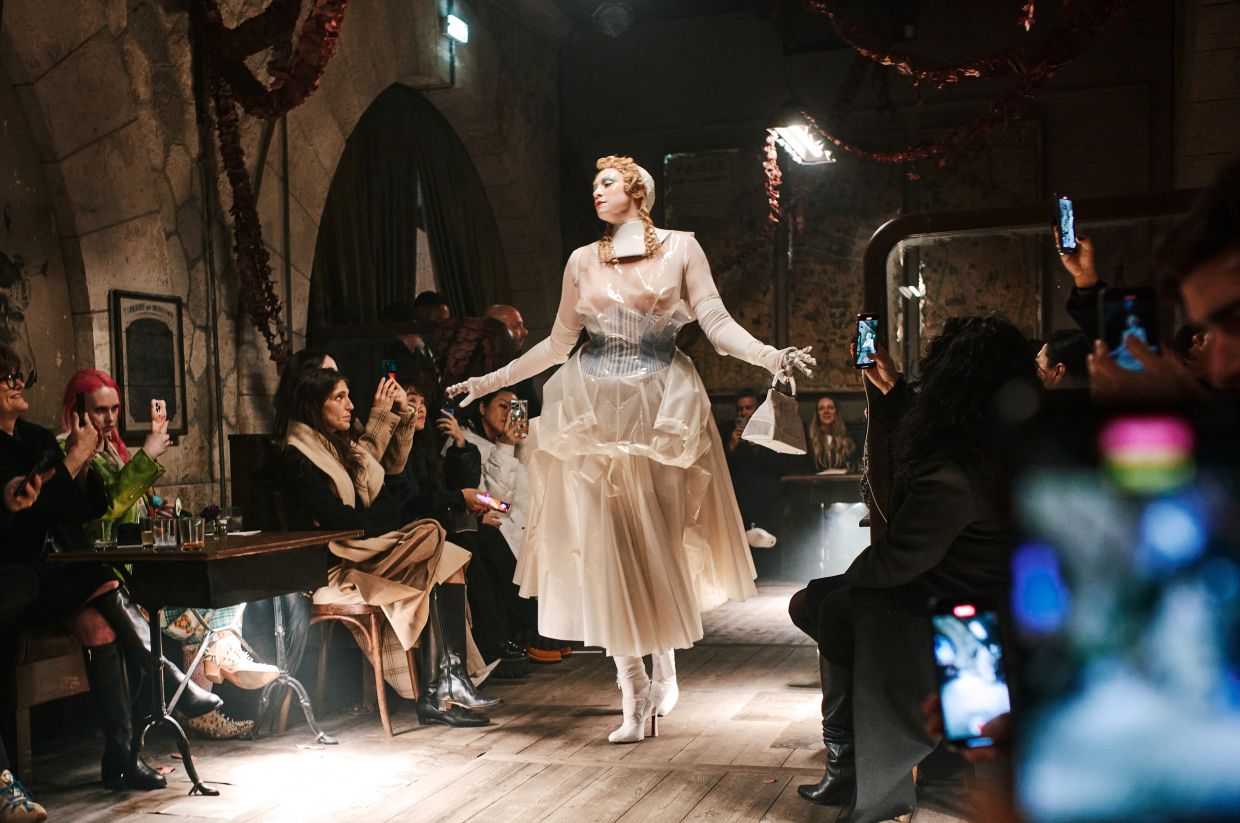
The Metropolitan Museum of Art convened an extraordinary closed-door session in May that brought together prominent figures from New York's cultural and Jewish leadership. The purpose was delicate: to gauge reactions to an audacious curatorial decision and, implicitly, to seek endorsement. At stake was next year's fashion exhibition celebrating the career of John Galliano, one of contemporary fashion's most transformative designers but also a figure whose antisemitic remarks in 2011 created one of the industry's deepest moral fractures. The meetings represented an unprecedented institutional acknowledgment that honouring certain artists requires more than aesthetic justification; it demands ethical reckoning.
Galliano's place in fashion history is undeniable. During his tenure as Dior's creative director from 1996 to 2011, he performed what amounted to an artistic resurrection of the venerable French house, infusing it with theatrical grandeur and commercial vitality that transformed it into a global luxury powerhouse. His mastery of the bias-cut, his architectural approach to draping, and his capacity to construct entire fantasy worlds on the runway established him as perhaps the most influential designer of his generation. Yet that accomplishment became almost irrelevant when a video emerged showing him in a Paris bar proclaiming "I love Hitler" alongside other deeply offensive antisemitic remarks. The fallout was swift and severe: dismissal from Dior, a conviction for hate speech in French court, and apparent professional exile.
What follows in Galliano's story, however, complicates any simple narrative of cancellation. Rather than disappearing, he undertook what appears to be genuine rehabilitation, working with rabbis in London and engaging with the Anti-Defamation League leadership. By 2014, he emerged as creative director of Maison Margiela, and has since rebuilt his professional standing to remarkable heights. Today, his vintage designs are worn regularly by celebrities including Zendaya, Tyla, and Amal Clooney, while his archive pieces command record prices at auction. The fashion industry has demonstrably moved past its discomfort with him. Yet the museum's decision to grant him a solo exhibition—an honour extended to only two other living designers, Yves Saint Laurent and Rei Kawakubo—represents something categorically different from industry forgiveness.
The timing amplifies the controversy. New York and much of the Western world are experiencing a measurable surge in antisemitic incidents and rhetoric. Just days before the May meetings, two men were stabbed in broad daylight in Manhattan, one while leaving a Jewish community centre, with authorities prosecuting the attack as a hate crime. This climate of rising antisemitism creates a fraught context for any institutional celebration of a designer whose past includes explicitly hateful speech. The question for Jewish community leaders became not whether Galliano has changed, but whether the Met Museum could responsibly stage this exhibition without appearing to sanitise or minimise the reality of antisemitism at a moment when such prejudice is ascendant.
Rabbi Rick Jacobs, president of the Union For Reform Judaism in North America, emerged from the May meeting with a somewhat cautious assessment. He described Galliano as genuinely open during their discussion, emphasizing what he characterised as sincerity rather than rehearsed messaging. Jacobs invoked the Jewish principle of teshuvah—repentance and restoration—suggesting that the possibility of meaningful redemption cannot be dismissed. Jonathan Greenblatt of the Anti-Defamation League issued a more explicit endorsement, stating that Galliano's efforts to repair harm and educate himself deserved acknowledgment. Yet even those more supportive of the exhibition raised a crucial concern: how could the museum present Galliano's aesthetic achievements while grappling substantively with the consequences of his past behaviour rather than burying it beneath celebration?
Rabbi Joshua Davidson of Temple Emanu-El, located just blocks from the Met, articulated perhaps the most constructive vision. Rather than viewing the exhibition as a problem to manage, he proposed that the museum might leverage it as an opportunity to educate the public about antisemitism's realities and the contemporary necessity of confronting such prejudice. This reframing shifts the exhibition from being primarily about Galliano's redemption to being about the broader social and historical context in which such redemption either becomes meaningful or remains hollow. The exhibition could, in this framework, become something more ambitious than a retrospective: a pedagogical intervention.
Curator Andrew Bolton acknowledged the unconventional approach his team would take. He revealed that he had considered a Galliano retrospective since 2010 but only moved forward seriously in 2024, after consulting with the museum's board. Rather than denying that hesitation stemmed from concerns about Galliano's past, Bolton reframed the delay as an opportunity to think more carefully about presentation. Crucially, he announced plans for an "orientation gallery" that would address what he termed "the rupture" defining Galliano's career—the disconnect between the beauty of his artistic output and the ugliness of his statements. Bolton committed to using Galliano's own words rather than curated euphemisms, a decision that reflects the Jewish community leaders' emphasis on clarity and directness.
Bolton further indicated that the museum is contemplating an accompanying online forum to facilitate broader public discussion beyond the exhibition's physical space. This suggests recognition that no single curatorial approach can adequately address the complexities involved. The conversation will necessarily extend beyond the museum walls, engaging viewers, fashion historians, Jewish communities, and the broader public in genuine debate rather than prescribing how visitors should interpret Galliano's trajectory. This democratisation of meaning-making contrasts sharply with the traditional curatorial model in which institutions present authorised narratives.
The larger implications extend well beyond fashion or even the Met Museum specifically. This moment reflects a broader societal struggle with how institutions should engage with complicated historical and contemporary figures whose contributions are significant but whose personal conduct or expressed beliefs are deeply troubling. The fashion industry has largely accepted Galliano's rehabilitation through market mechanisms: designers wear his clothes, auction houses celebrate his work, celebrities grace red carpets in his designs. But museum exhibitions carry different weight; they represent institutional validation and historical significance in ways commercial transactions do not. A Galliano retrospective at the Met essentially declares that his design legacy belongs to art history regardless of his past statements.
For Malaysian and Southeast Asian readers, the Galliano case resonates beyond fashion world drama. The questions it raises about redemption, institutional responsibility, and the possibility of meaningful change after expressions of prejudice apply across cultural contexts. Southeast Asia, like much of the world, grapples with persistent xenophobia, religious intolerance, and historical grievances. The Galliano example offers both cautionary notes and potentially constructive models: it demonstrates that institutions cannot simply ignore controversial pasts, yet it also suggests that possibilities for education and transformation exist if approached with sufficient seriousness and transparency. The exhibition will ultimately succeed or fail not based on whether Galliano deserves another chance—that is ultimately a question of individual conscience—but on whether the Met Museum uses this moment to generate genuine public conversation about antisemitism, accountability, and the conditions under which redemption becomes possible.
The Met's decision to proceed reflects confidence that careful curation can transform a potential institutional embarrassment into something educationally and ethically valuable. Whether that confidence proves justified will depend less on Galliano's talents as a designer than on the museum's willingness to make his past not a footnote to his aesthetic achievements but a central, unflinching element of how his work is understood and presented. The exhibition promises to be closely watched not merely as a fashion retrospective but as a test of whether major cultural institutions can navigate the murky territory between cancellation and amnesia, between punishment and genuine reconciliation.

