Scientists have long attributed the transformation of an ordinary honeybee larva into a queen to a single factor: royal jelly, the nutrient-rich secretion that worker bees produce. Yet a comprehensive new study challenges this singular explanation, revealing that the physical architecture of the chamber itself plays an equally vital role in determining a bee's royal destiny. Research led by Kai Wang at the Institute of Apicultural Research under the Chinese Academy of Agricultural Sciences, published in the journal Nature, demonstrates that honeybee colonies construct specialised wax structures with distinct physical and chemical properties specifically designed to foster queen development—structures Wang describes as sophisticated "smart incubators" rather than passive containers.
All honeybee colonies begin with a fundamental architectural blueprint. Worker bees, exclusively female, secrete wax and shape it into the hexagonal cells that form the colony's basic infrastructure, creating individual chambers for food storage and larval rearing. Yet when a colony faces the need for a new queen—whether through natural succession or preparation for swarming—the workers undertake an entirely different construction project. They build a third category of chamber, visually distinctive with a peanut-shell-like appearance that hangs downward from the honeycomb. Beekeepers have observed these structures for centuries as indicators of impending colony division or queen replacement, but conventional wisdom treated them simply as passive containers holding developing larvae. Wang's research fundamentally reframes this understanding, revealing instead an actively engineered environment optimised through millions of years of evolutionary refinement.
The distinction between ordinary worker cells and royal cells extends far beyond visual appearance. The wax comprising queen chambers possesses markedly different physical characteristics—it remains noticeably softer than standard cell wax and exhibits a higher melting point, around 39 degrees Celsius. Crucially, this royal wax also emits a chemically distinct "perfume," a combination of aromatic compounds that ordinary worker cells simply do not produce. These seemingly subtle differences carry profound biological significance. The softer walls may permit the developing larva greater spatial freedom as it grows, while the specific chemical signature potentially functions as a hormonal trigger, communicating developmental instructions directly to the larva's physiology. Testing this hypothesis, researchers exposed larvae to royal jelly but housed them in standard worker-cell wax; the results proved striking. Without the sensory environment of royal wax—neither its texture nor its chemical composition—larvae demonstrated severely compromised development and significantly elevated mortality rates, even when nutritionally supported with royal jelly.
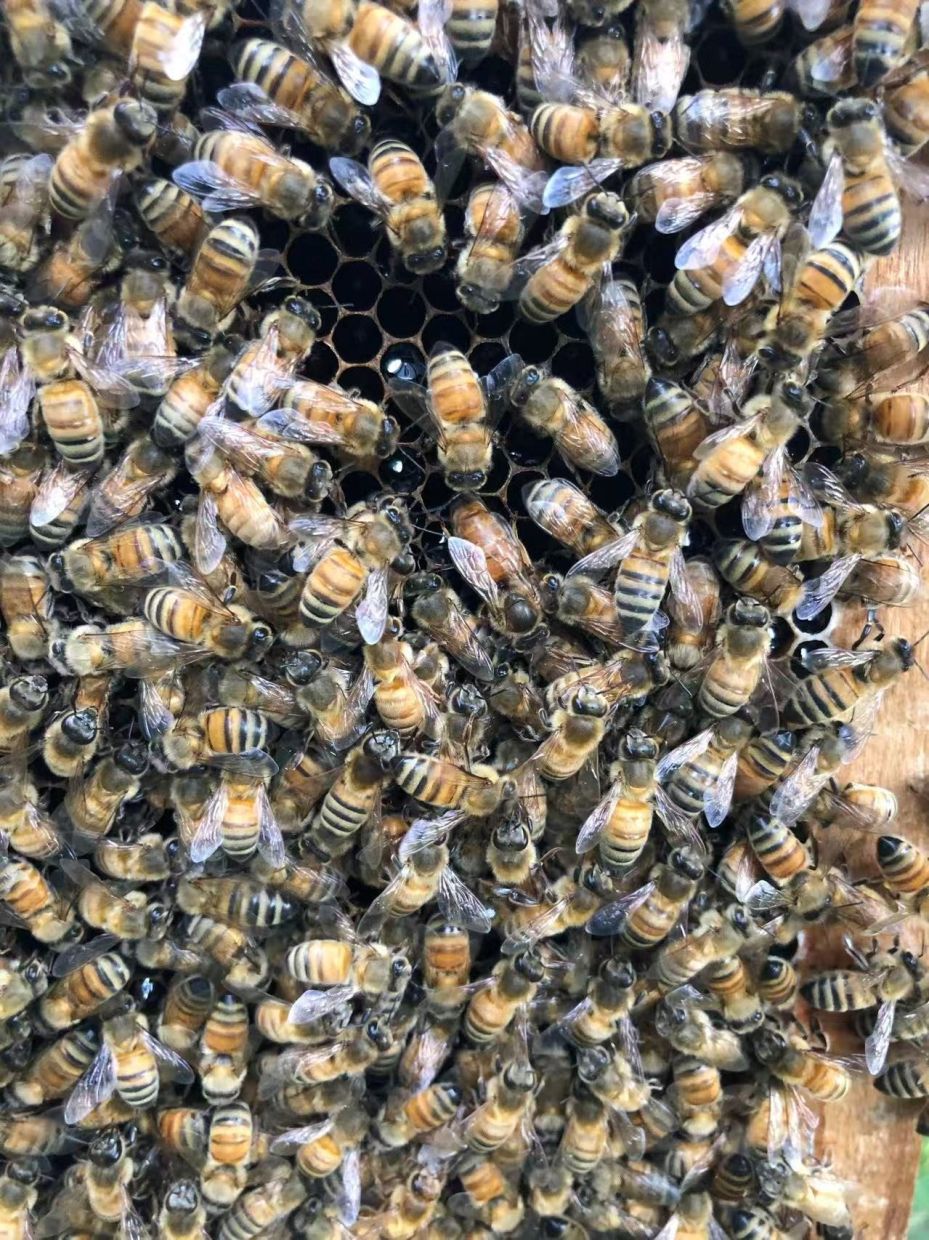
The worker bees tasked with constructing these royal chambers undergo their own remarkable physiological transformation. Researchers discovered that bees engaged in queen-cell construction maintain unusually elevated thoracic temperatures, requiring them to function as what Wang describes as "living furnaces." These young workers heat their bodies to temperatures exceeding 39 degrees Celsius—equivalent to running a sustained fever—to manipulate the wax into the required properties. This thermoregulation represents a substantial metabolic investment, yet the workers maintain it consistently throughout construction. Alongside this temperature elevation, the builders exhibit distinct gene expression patterns markedly different from their peers performing routine hive maintenance. These genetic shifts appear temporary and task-specific, enabling workers to process wax in ways their normal physiology would not permit. Yet despite this demanding specialization, these bees are not a permanently separate caste; Wang emphasises they represent "ordinary, flexible young workers" temporarily reprurposing their biology for an emergency collective need.
What renders the workforce particularly remarkable is their capacity for simultaneous multitasking. Even whilst undertaking the labour-intensive work of building royal chambers and maintaining elevated body temperatures, these same bees continue executing standard hive operations—sharing food with nestmates, inspecting other cells, and performing routine maintenance. This flexibility challenges conventional assumptions about social insect labour division, suggesting that rather than rigid specialisation, honeybee colonies employ dynamic task allocation guided by immediate colony needs. The ability to shift seamlessly between emergency projects and daily responsibilities speaks to the sophisticated social coordination underlying colony function and the adaptability that enables honeybee colonies to respond to environmental pressures and developmental crises.
Wang's findings directly challenge what he terms a "deeply rooted dogma" within apian science: the doctrine of nutritional determinism that positioned royal jelly as the solitary determining factor in queen development. This intellectual reorientation carries significant implications for how scientists understand developmental processes in social insects more broadly. The research suggests that larval fate depends not on a single variable but on an integrated multi-sensory environment combining nutrition, physical geometry, and chemical signalling. This holistic understanding opens substantial research questions. Most immediately, scientists have yet to identify which specific chemical compound or physical characteristic within royal wax serves as the primary developmental signal. Wang explicitly identifies this challenge as the next frontier: discovering the precise molecular mechanism that communicates to queen larvae's DNA, "You are the queen." This molecular detective work could yield insights into epigenetic regulation and how environmental factors interact with genetic expression to determine phenotypic outcomes.
The implications extend beyond honeybee biology. Wang suggests that similar environmental engineering may influence development in other social insects, fundamentally altering how researchers conceptualise colony architecture. Termite mounds and wasp paper nests may serve functions transcending mere physical shelter, actively shaping developmental trajectories of colony members. The intricate wax structures built by stingless bee species could similarly harbour secrets regarding how colonies control individual development and maintain social organisation. This comparative perspective elevates the study beyond a single species curiosity to a broader principle governing social insect evolution and function.
For practical beekeeping, these findings carry immediate relevance to a critical challenge confronting the industry. Queen production represents a central pillar of modern apiculture, yet beekeepers report increasing difficulty maintaining healthy, high-quality queens. Healthy queens are essential for maintaining robust colonies, yet the mechanisms governing natural queen development remained incompletely understood—a knowledge gap that potentially compromised artificial breeding efforts. Understanding the precise environmental conditions that foster optimal queen development could enable beekeepers to artificially replicate critical aspects of the colony's natural engineering process, potentially yielding healthier, more viable queens. This practical application becomes particularly pressing given that managed honeybees provide essential pollination services for more than 80 major agricultural crops globally.
The broader context of pollinator decline adds urgency to improved queen breeding. Beekeepers across the United States and numerous other regions report substantial colony losses, threatening both agricultural productivity and ecological stability. More resilient bee populations depend fundamentally on high-quality queens capable of maintaining colony health and reproductive success. By understanding how colonies naturally produce superior queens, scientists and beekeepers can develop strategies supporting colony resilience at a moment when populations face unprecedented pressure from habitat loss, disease, pesticides, and climate disruption. The knowledge that queens emerge from collective engineering—not merely through inheritance or feeding but through architectural design—underscores the sophistication of honeybee colonies and the interconnectedness of individual bee physiology and colony-level organisation.
Wang articulates this integrated understanding through a metaphor that captures the study's essential insight: "Eating well is important, but living in the perfect home is what truly changes your destiny." This formulation encapsulates how honeybee colonies represent genuine superorganisms, with individual worker bees collectively collaborating to transform an ordinary larva into a queen through coordinated architectural design and chemical engineering. The colony collectively invests resources, manipulates its own physiology through thermoregulation, and constructs an optimised developmental environment—all to ensure that a single larva acquires the biological capacity to sustain the entire colony through reproduction. This collective action, refined through evolutionary time, reflects the sophisticated coordination that defines eusocial insect societies and suggests depths of biological complexity that conventional laboratory studies examining single variables in isolation may systematically overlook. The work demonstrates that understanding colonial life requires examining not isolated biological mechanisms but integrated systems where architecture, chemistry, physiology, and behaviour combine to generate emergent properties impossible to predict from component parts alone.

