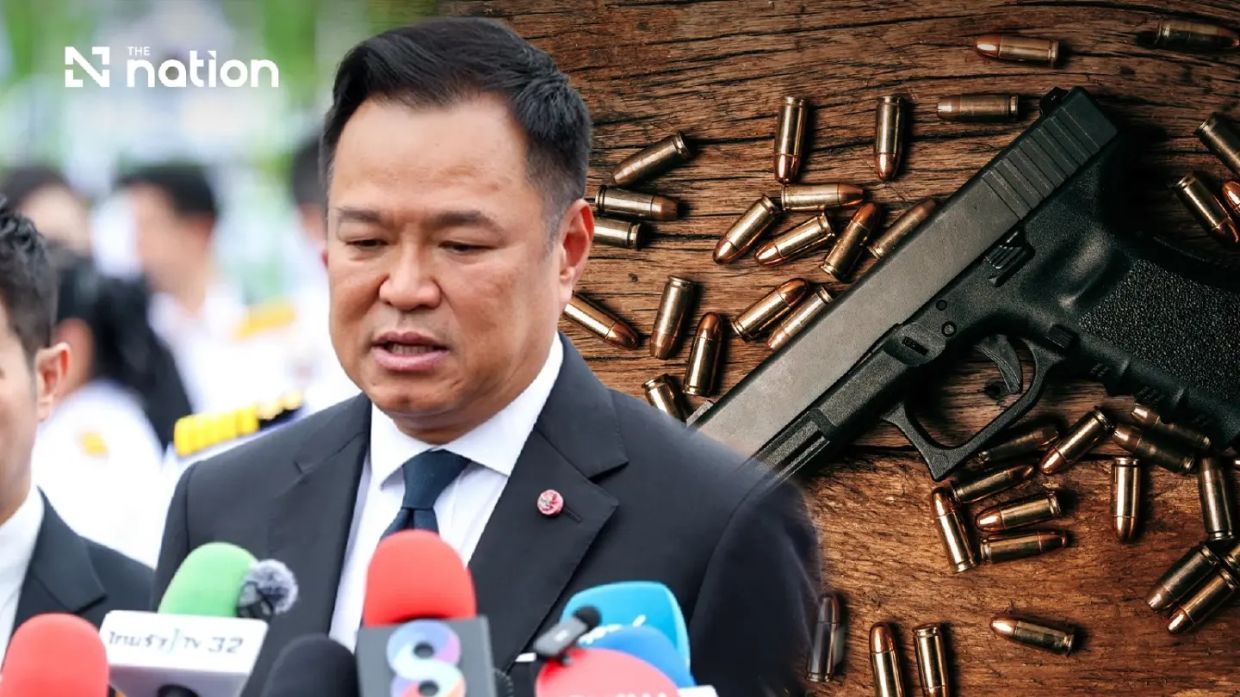
Thailand's Prime Minister Anutin Charnvirakul has moved swiftly to address public safety concerns in the aftermath of a mass shooting at Debsirin Nonthaburi School, announcing a comprehensive crackdown on illegal firearms and tighter weapons legislation. Following discussions with national police chief Pol Gen Kittharath Punpetch at Government House and a visit to the school, Anutin outlined an aggressive policy framework designed to remove guns from circulation and prevent future incidents through stricter enforcement mechanisms.
The immediate focus of the government's response centres on enhanced checkpoint operations and vehicle inspections to intercept individuals carrying unregistered or illegal firearms in public spaces. Under the proposed regime, anyone discovered transporting a gun outside their residence without legitimate official duties would face serious criminal charges, establishing a zero-tolerance framework that treats unauthorized possession as a grave violation. This approach signals a fundamental shift towards treating firearms as inherently dangerous items requiring stringent management rather than tools available for private use or self-defence purposes.
Anutin categorically rejected suggestions that teachers and school staff be armed for protection purposes, dismissing the concept as incompatible with educator roles and responsibilities. He maintained that granting civilians or untrained personnel firearm authority would compound safety risks rather than mitigate them, particularly in educational environments where children's welfare must remain paramount. This stance reflects broader regional concerns about armed teachers and the potential for accidental discharge, escalation of conflicts, or weapons falling into students' hands during school hours.
A significant component of the government's strategy involves reviving an amnesty programme that would permit citizens to voluntarily surrender illegal or unauthorised weapons to state authorities without facing prosecution. However, Anutin clarified that this initiative cannot retroactively legitimise previously illegal firearms or offer immunity for past possession. The programme is designed as a grace period encouraging compliance, with weapons surrendered to the Department of Provincial Administration, district offices, or police stations where proper documentation and secure disposal can occur.
The Prime Minister emphasized that all firearms discovered during searches or found in conjunction with criminal investigations automatically constitute additional charges against suspects. This compounding approach aims to increase deterrence by multiplying legal consequences for those attempting to conceal weapons or claim ignorance about their presence in vehicles or homes. The strategy effectively criminalizes passive possession alongside active offences, expanding the investigative and prosecutorial scope beyond the original incident.
For legally-owned firearms, Anutin outlined mandatory registration requirements combined with strict home storage protocols that place weapons beyond children's reach in secure, locked facilities. Both registered owners and individuals who use weapons in crimes face responsibility, creating dual liability that incentivizes proper storage and management. This framework acknowledges that legitimate gun owners exist within Thai society while imposing rigorous accountability standards designed to prevent unauthorized access or use by household members, particularly minors.
The broader investigation into the shooting incident remains ongoing, with Anutin cautioning against public speculation about potential bullying factors or psychological triggers that may have motivated the shooter. He urged restraint in discussing unconfirmed details, arguing that premature commentary could generate public anxiety or inspire copycat incidents. This measured approach attempts to balance transparent governance with responsible crisis communication, recognizing that detailed media coverage of such incidents carries psychological risks for vulnerable individuals.
Anutin's comprehensive gun control agenda reflects regional anxieties about firearms proliferation and mass casualty incidents, positioning Thailand within a wider Southeast Asian context where school safety and civilian security have become paramount concerns. The policy package addresses multiple enforcement levels, from street-level checkpoint operations to household storage requirements, creating interconnected mechanisms designed to reduce firearm accessibility across society. This multi-layered strategy acknowledges that no single intervention suffices without complementary measures targeting supply chains, enforcement capacity, and individual behaviour.
The government has directed police and provincial administration authorities to conduct thorough, systematic inspections across jurisdictions, signalling a nationwide campaign rather than localized response. This enforcement mobilization requires coordination across multiple agencies and substantial resource allocation, potentially straining police capacity while demonstrating political commitment to firearm suppression. Regional neighbours including Malaysia have observed similar mass casualty incidents prompting firearms policy reviews, making Thailand's legislative approach relevant throughout Southeast Asia where gun violence represents an emerging public health challenge.
Anutin's rejection of armed teacher proposals and emphasis on comprehensive gun control rather than expanded civilian armament positions Thailand differently from some international counterparts experiencing similar school incidents. The approach prioritizes removing weapons from circulation rather than distributing them more broadly, reflecting cultural and institutional contexts where armed civilian populations remain controversial. This philosophical stance influences all subsequent policy decisions, from amnesty programme design to enforcement prioritization, ensuring internal consistency across the government's firearm management strategy.

